Split-Horizon DNS Propagation Lag Causing Mixed Leader Routing
Database failover mechanism that updates an internal DNS record (db- primary.internal) to point to the new promoted replica.
Database failover mechanism that updates an internal DNS record (db- primary.internal) to point to the new promoted replica. Failure cascade dynamic: 100k QPS → TTL Expiration → Cache Miss Herd → Origin Slam → 💥 DB Meltdown.
Core Functional Requirements
- ✓Operational Invariant: "DNS is too slow and loosely bounded for transactional failover routing; use dynamic proxying or virtual IPs."
- ✓Production Hardening: Never rely on DNS for transactional database leader routing. Use virtual IP failover (Keepalived/GARP) or dynamic L4 proxies (HAProxy/ Envoy) that query the database cluster's cons
- ✓Prevent cascading failure by isolating downstream degradation at the ingress boundary.
Scale & Latency Constraints
- —Incident Scenario Baseline: Database failover mechanism that updates an internal DNS record (db- primary.internal) to point to the new promoted replica.
- —Failure Cascade Path: 100k QPS → TTL Expiration → Cache Miss Herd → Origin Slam → 💥 DB Meltdown
- —Sub-millisecond rejection / shed latency for overloaded requests
Never rely on DNS for transactional database leader routing. Use virtual IP failover (Keepalived/GARP) or dynamic L4 proxies (HAProxy/ Envoy) that query the database cluster's consensus API directly. Invariant: "DNS is too slow and loosely bounded for transactional failover routing; use dynamic proxying or virtual IPs."
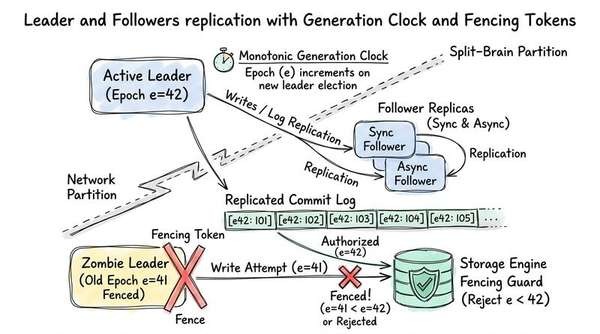
Hardened Implementation Steps
- 1Ingress Boundary Defense: Never rely on DNS for transactional database leader routing. Use virtual IP failover (Keepalived/GARP) or dynamic L4 proxies (HAProxy/ Envoy) that que
- 2Failure Containment: Eliminate unconstrained buffering and propagate physical backpressure.
- 3Invariant Enforcement: DNS is too slow and loosely bounded for transactional failover routing; use dynamic proxying or virtual IPs.
Production Code Contrast & Implementation
// HARDENED: Monotonic generation clock fencing token verification
public boolean writeData(String key, byte[] val, long fencingToken) {
    // Storage engine validates strictly monotonic fencing token before applying mutation
    if (storageEngine.validateAndAdvanceToken(fencingToken)) {
        return storageEngine.write(key, val);
    }
    throw new StaleFencingTokenException("Rejected mutation from superseded leader");
}Architectural comparison of naive unconstrained allocations versus production-hardened mechanical sympathy.
Architectural Decisions & Trade-Offs
- ⚖Ingress Admission: Naive unconstrained buffering causes queue bloat and GC exhaustion. Mitigation: Bounded ingress gate with fast non-blocking shedding.
- ⚖Resource Strategy: Static capacity allocations collapse under brownouts. Mitigation: Dynamic adaptive limits scaling to real-time physical bounds.
- ⚖Outage Impact: Cascading lock convoys and memory saturation. Mitigation: Isolated failure domains keep P99 latency flat and protected.
Alternatives Evaluated
- →Naive Approach: DNS TTL is configured to 60s, but upstream microservices and intermediate DNS resolvers cache the record for up to 15 minutes. Services continue writi
- →Production-Hardened Pattern: Never rely on DNS for transactional database leader routing. Use virtual IP failover (Keepalived/GARP) or dynamic L4 proxies (HAProxy/ Envoy) that que
Operational Hazards & Mitigations
- ⚠Cascading Failure: DNS TTL is configured to 60s, but upstream microservices and intermediate DNS resolvers cache the record for up to 15 minutes. Services continue writing to the demoted primary, creating extensive split-brain data corruption.
- ⚠Breakdown Chain: 100k QPS → TTL Expiration → Cache Miss Herd → Origin Slam → 💥 DB Meltdown
- ⚠Shedding Failure: Without fast rejection at the boundary, queued dead work triggers multi-second GC pauses, CPU thrashing, and cascading 504 Gateway Timeouts.
How does the system enforce physical resource boundaries under sudden downstream latency brownouts?
Interactive Assessment & Knowledge Check
Test your understanding of the architecture decisions, data patterns, and trade-offs used in Split-Horizon DNS Propagation Lag Causing Mixed Leader Routing.
Core Architectural Principles of Distributed Locking & Redlock Algorithm
What is the primary benefit of applying Distributed Locking & Redlock Algorithm in production systems?