Hot Key Cache Stampede / Dogpiling on Instantaneous TTL Expiration
E-commerce homepage trending feed cached in Redis with a 60-second TTL, serving 100,000 QPS.
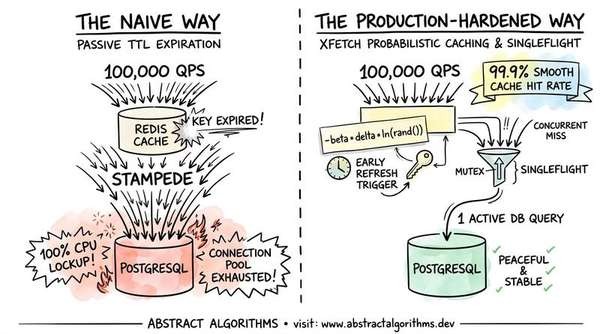
E-commerce homepage trending feed cached in Redis with a 60-second TTL, serving 100,000 QPS. Failure cascade dynamic: Burst → Pool Saturated → Queue Bloat (10k) → STW GC → 💥 504 Timeouts.
Core Functional Requirements
- ✓Operational Invariant: "Never allow hot keys to expire passively; use probabilistic early refreshing (XFetch) and singleflight mutex coalescing."
- ✓Production Hardening: Implement the XFetch Probabilistic Early Expiration algorithm (-beta · delta · ln(rand()) > time_to_expiry) where a background worker refreshes the key before expiration, paired wi
- ✓Prevent cascading failure by isolating downstream degradation at the ingress boundary.
Scale & Latency Constraints
- —Incident Scenario Baseline: E-commerce homepage trending feed cached in Redis with a 60-second TTL, serving 100,000 QPS.
- —Failure Cascade Path: Burst → Pool Saturated → Queue Bloat (10k) → STW GC → 💥 504 Timeouts
- —Sub-millisecond rejection / shed latency for overloaded requests
Implement the XFetch Probabilistic Early Expiration algorithm (-beta · delta · ln(rand()) > time_to_expiry) where a background worker refreshes the key before expiration, paired with Singleflight in-memory request coalescing. Invariant: "Never allow hot keys to expire passively; use probabilistic early refreshing (XFetch) and singleflight mutex coalescing."
Hardened Implementation Steps
- 1Ingress Boundary Defense: Implement the XFetch Probabilistic Early Expiration algorithm (-beta · delta · ln(rand()) > time_to_expiry) where a background worker refreshes the ke
- 2Failure Containment: Eliminate unconstrained buffering and propagate physical backpressure.
- 3Invariant Enforcement: Never allow hot keys to expire passively; use probabilistic early refreshing (XFetch) and singleflight mutex coalescing.
Production Code Contrast & Implementation
// HARDENED: Singleflight mutex coalescing with probabilistic early refresh
public byte[] getProduct(String key) {
    // XFetch algorithm evaluates early background refresh before TTL expiration
    if (shouldProbabilisticEarlyRefresh(key, beta, delta)) {
        backgroundPool.submit(() -> refreshCacheKey(key));
    }
    // Singleflight ensures exactly ONE upstream DB fetch executes per in-flight key
    return singleflightGroup.execute(key, () -> database.queryProduct(key));
}Architectural comparison of naive unconstrained allocations versus production-hardened mechanical sympathy.
Architectural Decisions & Trade-Offs
- ⚖Ingress Admission: Naive unconstrained buffering causes queue bloat and GC exhaustion. Mitigation: Bounded ingress gate with fast non-blocking shedding.
- ⚖Resource Strategy: Static capacity allocations collapse under brownouts. Mitigation: Dynamic adaptive limits scaling to real-time physical bounds.
- ⚖Outage Impact: Cascading lock convoys and memory saturation. Mitigation: Isolated failure domains keep P99 latency flat and protected.
Alternatives Evaluated
- →Naive Approach: At t=60s, the key expires. In that exact microsecond, all 100,000 concurrent requests miss the cache simultaneously and rush to execute the expensive
- →Production-Hardened Pattern: Implement the XFetch Probabilistic Early Expiration algorithm (-beta · delta · ln(rand()) > time_to_expiry) where a background worker refreshes the ke
Operational Hazards & Mitigations
- ⚠Cascading Failure: At t=60s, the key expires. In that exact microsecond, all 100,000 concurrent requests miss the cache simultaneously and rush to execute the expensive SQL query against PostgreSQL. Database connection pools exhaust in 15ms, crashing the platform.
- ⚠Breakdown Chain: Burst → Pool Saturated → Queue Bloat (10k) → STW GC → 💥 504 Timeouts
- ⚠Shedding Failure: Without fast rejection at the boundary, queued dead work triggers multi-second GC pauses, CPU thrashing, and cascading 504 Gateway Timeouts.
How does the system enforce physical resource boundaries under sudden downstream latency brownouts?
Extension Implementation Steps
- 1Track real-time latency gradients and inflight concurrency.
- 2Reject excess traffic at the ingress boundary within <0.1ms.
- 3Monitor P99 latency and verify autonomous recovery when downstream pressure subsides.
Follow-Up Trade-Offs
- ⚖Architectural Invariant: "Never allow hot keys to expire passively; use probabilistic early refreshing (XFetch) and singleflight mutex coalescing."
- ⚖Physical Resource Boundary: Dynamic admission control ensures worker threads never buffer dead requests during downstream brownouts.
Interactive Assessment & Knowledge Check
Test your understanding of the architecture decisions, data patterns, and trade-offs used in Hot Key Cache Stampede / Dogpiling on Instantaneous TTL Expiration.
Single-Thread Execution Bottleneck
Why does Redis execute single-threaded command processing faster than traditional multi-threaded locked data structures?