Two-Phase Commit (2PC) Blocking Indefinitely on Coordinator Death
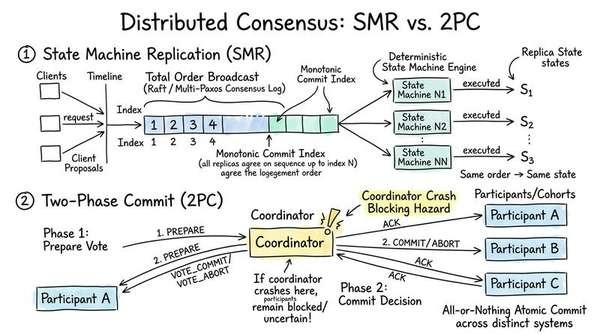
Distributed cross-database transaction manager executing 2PC across PostgreSQL and Oracle instances.
Distributed cross-database transaction manager executing 2PC across PostgreSQL and Oracle instances. Failure cascade dynamic: 50k Mut. → Row X-Lock → Spinlock Thrash → Deadlock Graph → 💥 DB Freeze.
Core Functional Requirements
- ✓Operational Invariant: "Synchronous 2PC is a blocking anti-pattern across microservices; prefer asynchronous Sagas with compensating actions."
- ✓Production Hardening: Avoid classic 2PC across microservices; replace with the Saga Pattern using asynchronous orchestrators and compensating transactions, or employ Paxos-backed consensus commit protoc
- ✓Prevent cascading failure by isolating downstream degradation at the ingress boundary.
Scale & Latency Constraints
- —Incident Scenario Baseline: Distributed cross-database transaction manager executing 2PC across PostgreSQL and Oracle instances.
- —Failure Cascade Path: 50k Mut. → Row X-Lock → Spinlock Thrash → Deadlock Graph → 💥 DB Freeze
- —Sub-millisecond rejection / shed latency for overloaded requests
Avoid classic 2PC across microservices; replace with the Saga Pattern using asynchronous orchestrators and compensating transactions, or employ Paxos-backed consensus commit protocols. Invariant: "Synchronous 2PC is a blocking anti-pattern across microservices; prefer asynchronous Sagas with compensating actions."
Hardened Implementation Steps
- 1Ingress Boundary Defense: Avoid classic 2PC across microservices; replace with the Saga Pattern using asynchronous orchestrators and compensating transactions, or employ Paxos-
- 2Failure Containment: Eliminate unconstrained buffering and propagate physical backpressure.
- 3Invariant Enforcement: Synchronous 2PC is a blocking anti-pattern across microservices; prefer asynchronous Sagas with compensating actions.
Production Code Contrast & Implementation
// HARDENED: Monotonic generation clock fencing token verification
public boolean writeData(String key, byte[] val, long fencingToken) {
    // Storage engine validates strictly monotonic fencing token before applying mutation
    if (storageEngine.validateAndAdvanceToken(fencingToken)) {
        return storageEngine.write(key, val);
    }
    throw new StaleFencingTokenException("Rejected mutation from superseded leader");
}Architectural comparison of naive unconstrained allocations versus production-hardened mechanical sympathy.
Architectural Decisions & Trade-Offs
- ⚖Ingress Admission: Naive unconstrained buffering causes queue bloat and GC exhaustion. Mitigation: Bounded ingress gate with fast non-blocking shedding.
- ⚖Resource Strategy: Static capacity allocations collapse under brownouts. Mitigation: Dynamic adaptive limits scaling to real-time physical bounds.
- ⚖Outage Impact: Cascading lock convoys and memory saturation. Mitigation: Isolated failure domains keep P99 latency flat and protected.
Alternatives Evaluated
- →Naive Approach: In phase 1, all participants vote PREPARED and acquire row locks. Before phase 2 (COMMIT) can be issued, the coordinator node crashes. Participants ho
- →Production-Hardened Pattern: Avoid classic 2PC across microservices; replace with the Saga Pattern using asynchronous orchestrators and compensating transactions, or employ Paxos-
Operational Hazards & Mitigations
- ⚠Cascading Failure: In phase 1, all participants vote PREPARED and acquire row locks. Before phase 2 (COMMIT) can be issued, the coordinator node crashes. Participants hold exclusive row locks indefinitely, halting production transaction traffic.
- ⚠Breakdown Chain: 50k Mut. → Row X-Lock → Spinlock Thrash → Deadlock Graph → 💥 DB Freeze
- ⚠Shedding Failure: Without fast rejection at the boundary, queued dead work triggers multi-second GC pauses, CPU thrashing, and cascading 504 Gateway Timeouts.
How does the system enforce physical resource boundaries under sudden downstream latency brownouts?
Interactive Assessment & Knowledge Check
Test your understanding of the architecture decisions, data patterns, and trade-offs used in Two-Phase Commit (2PC) Blocking Indefinitely on Coordinator Death.
Core Architectural Principles of Distributed Locking & Redlock Algorithm
What is the primary benefit of applying Distributed Locking & Redlock Algorithm in production systems?