Thread Pool Queue Sizing Masking SRE Alert Metrics Until Collapse
Microservice with a thread pool queue size of 50,000 tasks.
Microservice with a thread pool queue size of 50,000 tasks. Failure cascade dynamic: Burst → Pool Saturated → Queue Bloat (10k) → STW GC → 💥 504 Timeouts.
Core Functional Requirements
- ✓Operational Invariant: "Deep in-memory queues hide latency degradation; keep queues shallow and alert aggressively on Queue Wait Time."
- ✓Production Hardening: Keep in-memory queues small (<=100 items), monitor Queue Wait Time and Queue Depth in real-time, and trigger high-priority alerts when Queue Wait Time exceeds 50ms.
- ✓Prevent cascading failure by isolating downstream degradation at the ingress boundary.
Keep in-memory queues small (<=100 items), monitor Queue Wait Time and Queue Depth in real-time, and trigger high-priority alerts when Queue Wait Time exceeds 50ms. Invariant: "Deep in-memory queues hide latency degradation; keep queues shallow and alert aggressively on Queue Wait Time."
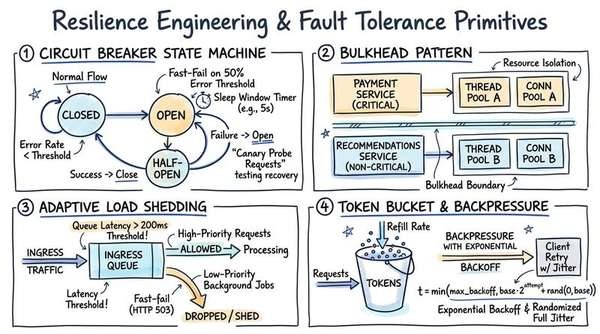
Hardened Implementation Steps
- 1Ingress Boundary Defense: Keep in-memory queues small (<=100 items), monitor Queue Wait Time and Queue Depth in real-time, and trigger high-priority alerts when Queue Wait Time
- 2Failure Containment: Eliminate unconstrained buffering and propagate physical backpressure.
- 3Invariant Enforcement: Deep in-memory queues hide latency degradation; keep queues shallow and alert aggressively on Queue Wait Time.
Production Code Contrast & Implementation
// HARDENED: Multi-layer memory budgeting reserving 30% OS headroom
// resources:
//   limits: { memory: "4Gi" }
// java -XX:MaxRAMPercentage=70.0 -XX:+UseG1GC -XX:+ExitOnOutOfMemoryError -jar app.jar
// Reserves 1.2GB headroom for Metaspace, Netty direct buffers, thread stacks & OS kernelArchitectural comparison of naive unconstrained allocations versus production-hardened mechanical sympathy.
Architectural Decisions & Trade-Offs
- ⚖Ingress Admission: Naive unconstrained buffering causes queue bloat and GC exhaustion. Mitigation: Bounded ingress gate with fast non-blocking shedding.
- ⚖Resource Strategy: Static capacity allocations collapse under brownouts. Mitigation: Dynamic adaptive limits scaling to real-time physical bounds.
- ⚖Outage Impact: Cascading lock convoys and memory saturation. Mitigation: Isolated failure domains keep P99 latency flat and protected.
Alternatives Evaluated
- →Naive Approach: When downstream services slow down, incoming requests queue silently in the 50,000-slot queue. SRE alerts monitor error rates (0%) and thread count (1
- →Production-Hardened Pattern: Keep in-memory queues small (<=100 items), monitor Queue Wait Time and Queue Depth in real-time, and trigger high-priority alerts when Queue Wait Time
Operational Hazards & Mitigations
- ⚠Cascading Failure: When downstream services slow down, incoming requests queue silently in the 50,000-slot queue. SRE alerts monitor error rates (0%) and thread count (100%), but not queue wait time. By the time requests timeout, 50,000 requests are stuck, and the system collapses with no early warning.
- ⚠Breakdown Chain: Burst → Pool Saturated → Queue Bloat (10k) → STW GC → 💥 504 Timeouts
- ⚠Shedding Failure: Without fast rejection at the boundary, queued dead work triggers multi-second GC pauses, CPU thrashing, and cascading 504 Gateway Timeouts.
How does the system enforce physical resource boundaries under sudden downstream latency brownouts?
Interactive Assessment & Knowledge Check
Test your understanding of the architecture decisions, data patterns, and trade-offs used in Thread Pool Queue Sizing Masking SRE Alert Metrics Until Collapse.
Core Architectural Principles of JVM Architecture, Memory Model & Garbage Collection
What is the primary benefit of applying JVM Architecture, Memory Model & Garbage Collection in production systems?