SQS FIFO Message Group ID Clustering Starving
Parallel Worker Capacity AWS SQS FIFO queue processing events across 50 concurrent worker threads.
Parallel Worker Capacity AWS SQS FIFO queue processing events across 50 concurrent worker threads. Failure cascade dynamic: Scale Surge → Unbounded Contention → Physical Bottleneck → 💥 Outage Cascade.
Core Functional Requirements
- ✓Operational Invariant: "In SQS FIFO, use high-cardinality MessageGroupIds to maximize concurrency while preserving per-entity message ordering."
- ✓Production Hardening: Set MessageGroupId to fine-grained entity IDs (e.g. order_id or user_id), allowing SQS to dispatch distinct message groups concurrently across all 50 worker threads while maintaini
- ✓Prevent cascading failure by isolating downstream degradation at the ingress boundary.
Scale & Latency Constraints
- —Incident Scenario Baseline: Parallel Worker Capacity AWS SQS FIFO queue processing events across 50 concurrent worker threads.
- —Failure Cascade Path: Scale Surge → Unbounded Contention → Physical Bottleneck → 💥 Outage Cascade
- —Sub-millisecond rejection / shed latency for overloaded requests
Set MessageGroupId to fine-grained entity IDs (e.g. order_id or user_id), allowing SQS to dispatch distinct message groups concurrently across all 50 worker threads while maintaining strict per-user ordering. Invariant: "In SQS FIFO, use high-cardinality MessageGroupIds to maximize concurrency while preserving per-entity message ordering."
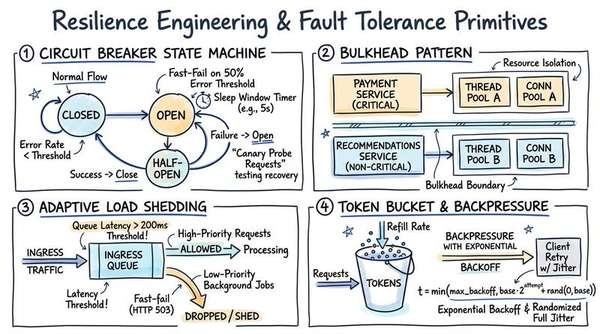
Hardened Implementation Steps
- 1Ingress Boundary Defense: Set MessageGroupId to fine-grained entity IDs (e.g. order_id or user_id), allowing SQS to dispatch distinct message groups concurrently across all 50
- 2Failure Containment: Eliminate unconstrained buffering and propagate physical backpressure.
- 3Invariant Enforcement: In SQS FIFO, use high-cardinality MessageGroupIds to maximize concurrency while preserving per-entity message ordering.
Production Code Contrast & Implementation
// HARDENED: Full Jitter exponential backoff with retry budget
public Response callService(Request req) {
    if (!retryBudget.acquireToken()) {
        throw new RetryBudgetExhaustedException("Shedding retries under cluster distress");
    }
    // Full Jitter: Uniform random backoff breaks synchronized wave patterns
    long sleepMs = (long) (Math.random() * Math.min(maxBackoffMs, baseMs * Math.pow(2, attempt)));
    scheduledExecutor.schedule(() -> executeCall(req), sleepMs, TimeUnit.MILLISECONDS);
}Architectural comparison of naive unconstrained allocations versus production-hardened mechanical sympathy.
Architectural Decisions & Trade-Offs
- ⚖Ingress Admission: Naive unconstrained buffering causes queue bloat and GC exhaustion. Mitigation: Bounded ingress gate with fast non-blocking shedding.
- ⚖Resource Strategy: Static capacity allocations collapse under brownouts. Mitigation: Dynamic adaptive limits scaling to real-time physical bounds.
- ⚖Outage Impact: Cascading lock convoys and memory saturation. Mitigation: Isolated failure domains keep P99 latency flat and protected.
Alternatives Evaluated
- →Naive Approach: All incoming messages are assigned the exact same MessageGroupId ('orders'). SQS FIFO strictly serializes messages sharing a MessageGroupId to a singl
- →Production-Hardened Pattern: Set MessageGroupId to fine-grained entity IDs (e.g. order_id or user_id), allowing SQS to dispatch distinct message groups concurrently across all 50
Operational Hazards & Mitigations
- ⚠Cascading Failure: All incoming messages are assigned the exact same MessageGroupId ('orders'). SQS FIFO strictly serializes messages sharing a MessageGroupId to a single worker , reducing throughput from 50 workers down to exactly 1.
- ⚠Breakdown Chain: Scale Surge → Unbounded Contention → Physical Bottleneck → 💥 Outage Cascade
- ⚠Shedding Failure: Without fast rejection at the boundary, queued dead work triggers multi-second GC pauses, CPU thrashing, and cascading 504 Gateway Timeouts.
How does the system enforce physical resource boundaries under sudden downstream latency brownouts?
Extension Implementation Steps
- 1Track real-time latency gradients and inflight concurrency.
- 2Reject excess traffic at the ingress boundary within <0.1ms.
- 3Monitor P99 latency and verify autonomous recovery when downstream pressure subsides.
Follow-Up Trade-Offs
- ⚖Architectural Invariant: "In SQS FIFO, use high-cardinality MessageGroupIds to maximize concurrency while preserving per-entity message ordering."
- ⚖Physical Resource Boundary: Dynamic admission control ensures worker threads never buffer dead requests during downstream brownouts.
Interactive Assessment & Knowledge Check
Test your understanding of the architecture decisions, data patterns, and trade-offs used in SQS FIFO Message Group ID Clustering Starving.
Message Ordering in Distributed Log Partitions
How does Apache Kafka guarantee strict sequential ordering for messages delivered to consumers?