A mobile app release adds a `seller { rating }` field to the Order History screen, issuing `orders(first: 50) { id items { qty product { id title seller { id name rating } } } }`. Your Apollo/Java GraphQL Gateway resolves each field independently: 1 query for 50 orders -> 50 queries for items -> 200 queries for products -> 200 gRPC calls for sellers = **451 backend calls per HTTP request**. At just 60 mobile RPS, backend traffic surges to **27,060 QPS**, saturating PostgreSQL and `Seller-Service` and causing 503s. Redesign the GraphQL execution layer to bound backend queries and protect against arbitrary nested queries.
From patterns to decisions.
A mobile app release adds a `seller { rating }` field to the Order History screen, issuing `orders(first: 50) { id items { qty product { id title seller { id name rating } } } }`. Your Apollo/Java GraphQL Gateway resolves each field independently: 1 query for 50 orders -> 50 queries for items -> 200 queries for products -> 200 gRPC calls for sellers = **451 backend calls per HTTP request**. At just 60 mobile RPS, backend traffic surges to **27,060 QPS**, saturating PostgreSQL and `Seller-Service` and causing 503s. Redesign the GraphQL execution layer to bound backend queries and protect against arbitrary nested queries.
Unbatched nested resolvers multiply calls.
Unbatched nested resolvers multiply calls at every list level: 1 + 50 + 200 + 200 = 451 calls/req * 60 RPS = 27,060 QPS.
| Choice | What it buys | What it costs |
|---|---|---|
| factor | Naive Resolvers vs. DataLoader; pro: Simple to write initially.; con: Exponential DB amplification on nested lists. |
Step 1
Enable GraphQL tracing / OpenTelemetry spans to count resolver invocations per request.
Step 2
Identify each list-to-entity fan-out (orders -> items -> product -> seller).
Alternative 1
name: Denormalized Read View; whenToUse: Read-heavy order history.; tradeOff: Duplicates seller rating updates.
name
Connection Pool Exhaustion; description: 27,060 QPS exhausts PostgreSQL connections in seconds.; mitigation: Batch via DataLoader.
calls_per_req = 1 + 50 + (50 * 4) + (50 * 4)  # 451
total_qps = calls_per_req * 60                 # 27,060 QPS
Implementation & Guardrails (2).
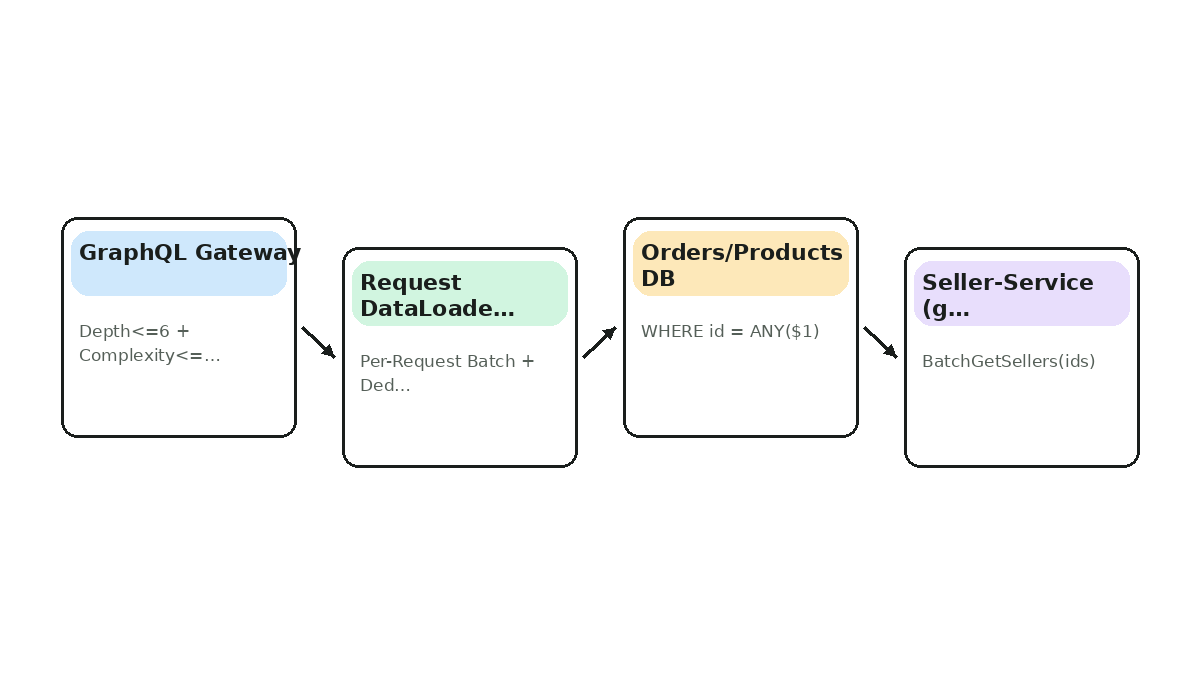
Use request-scoped MappedBatchLoader for items, products, and sellers, paired with depth <= 6 and complexity <= 500.
| Choice | What it buys | What it costs |
|---|---|---|
| factor | MappedBatchLoader vs. BatchLoader; pro: `MappedBatchLoader` handles missing IDs cleanly without positional alignment bugs.; con: Requires returning `Map<ID, Value>`. |
Step 1
Implement MappedBatchLoader<String, SellerDto>.
Step 2
Set DataLoaderOptions.newOptions().setMaxBatchSize(100).
Step 3
Add MaxQueryDepthInstrumentation(6) and MaxQueryComplexityInstrumentation(500).
Alternative 1
name: Lookahead SQL Join Builder; whenToUse: Single-DB GraphQL (e.g., Hasura/PostGraphile).; tradeOff: Cannot span PostgreSQL + gRPC microservices.
name
Singleton DataLoader Leak; description: Caching across requests leaks PII.; mitigation: Ensure framework creates a new DataLoaderRegistry per HTTP request.
@Bean
public Instrumentation maxDepth() { return new MaxQueryDepthInstrumentation(6); }

@Bean
public Instrumentation maxComplexity() { return new MaxQueryComplexityInstrumentation(500); }
BatchLoader requires the returned List<V>.
BatchLoader requires the returned List<V> to match the exact size and order of List<K>, whereas MappedBatchLoader keys by ID and safely returns null for missing sellers.
| Choice | What it buys | What it costs |
|---|---|---|
| factor | Map Alignment; pro: Zero index-shift corruption if a seller was deleted.; con: Negligible hash-map allocation. |
Step 1
Return Map<String, SellerDto> from batchGetSellers.
Step 2
Missing/deleted sellers resolve to null instead of shifting array indices.
Alternative 1
name: Positional List with Null Padding; whenToUse: Legacy DataLoader APIs.; tradeOff: Error-prone if SQL WHERE id IN (...) returns fewer rows.
name
Size Mismatch Exception; description: DataLoader throws IllegalStateException if result.size() != keys.size().; mitigation: Always use MappedBatchLoader or pad missing keys.
# Safe mapped lookup
sellers_by_id = {s.id: s for s in grpc_batch_get_sellers(list(set(keys)))}
return [sellers_by_id.get(k) for k in keys]
Enforce hard maxPageSize = 50.
Enforce hard maxPageSize = 50 in input validation and multiply complexity by first (5000 * 10 = 50,000 > 500).
| Choice | What it buys | What it costs |
|---|---|---|
| factor | Argument Clamping vs. Rejection; pro: Rejecting with `400` forces clients to paginate properly.; con: Breaking change if old clients requested `first: 200`. |
Step 1
Clamp or reject first > 50 at schema/argument validation.
Step 2
Use a field-cost calculator that multiplies child cost by first.
Alternative 1
name: Persisted Query Allowlist; whenToUse: First-party mobile/web apps.; tradeOff: Blocks arbitrary first values completely.
name
Unweighted Complexity; description: Scoring orders(first: 5000) as cost 1 lets giant queries pass.; mitigation: Multiply subtree cost by first/limit.
if (first > 50) {
    throw new IllegalArgumentException("Page size 'first' cannot exceed 50");
}
Deploy Automatic Persisted Queries (APQ).
Deploy Automatic Persisted Queries (APQ) first, collect all legacy query hashes for 30 days, seed them into the allowlist, then enforce strict allowlist.
| Choice | What it buys | What it costs |
|---|---|---|
| factor | Phased Allowlist Enforcement; pro: Zero breakage for older mobile app versions.; con: 30-day transition window before full lockdown. |
Step 1
Enable APQ (hash -> query cached in Redis).
Step 2
Log all unpersisted queries from older app versions and add their hashes to the allowlist before flipping allowArbitraryQueries = false.
Alternative 1
name: Client Version Header Enforcement; whenToUse: When forced-upgrade is supported.; tradeOff: Poor UX if users are forced to update.
name
CI Fails to Upload New App Hashes; description: New mobile release fails in production with PersistedQueryNotFound.; mitigation: Publish query manifest to S3/Redis as a blocking step in mobile CI before store release.
graphql:
  persistedQueries:
    mode: ALLOWLIST_ONLY
    redisCacheTtlSeconds: 86400
    legacyGracePeriodDays: 30
Theory & Tips and Tricks
Practical heuristics & interview traps
- 01Interview anchor: Always pair request-scoped
DataLoaderbatching (collapsing N+1 intoWHERE id IN (...)) with GraphQL query depth/complexity limits and persisted query allowlists. - 02Trade-off tip: factor: Map Alignment; pro: Zero index-shift corruption if a seller was deleted.; con: Negligible hash-map allocation.
- 03Watch out for: name: Unweighted Complexity; description: Scoring
orders(first: 5000)as cost 1 lets giant queries pass.; mitigation: Multiply subtree cost byfirst/limit.
Solving Graphql N Plus One Dataloader — Normal → Load / Fault → Recovery
Always pair request-scoped DataLoader batching (collapsing N+1 into WHERE id IN (...)) with GraphQL query depth/complexity limits and persisted query allowlists.
Putting Solving GraphQL N+1 Queries with DataLoader Together
Always pair request-scoped `DataLoader` batching (collapsing N+1 into `WHERE id IN (...)`) with GraphQL query depth/complexity limits and persisted query allowlists.
Putting Solving GraphQL N+1 Queries with DataLoader Together
- Implement
MappedBatchLoader<String, SellerDto>. - Set
DataLoaderOptions.newOptions().setMaxBatchSize(100). - Add
MaxQueryDepthInstrumentation(6)andMaxQueryComplexityInstrumentation(500).
Interview Readiness Check
Enforce hard maxPageSize = 50 in input validation and multiply complexity by first (5000 * 10 = 50,000 > 500).
Walk through bottlenecks, back-of-the-envelope math, and failure recovery.
Make the trade-off yourself.
Practice Check
Test your understanding
When is ACID Transaction Fundamentals the right default for a production team?
Solving GraphQL N+1 Queries with DataLoader
Always pair request-scoped DataLoader batching (collapsing N+1 into WHERE id IN (...)) with GraphQL query depth/complexity limits and persisted query allowlists.