Redis Maxmemory Eviction Thrashing on Volatile-LRU Under Write Surges
Redis instance configured with maxmemory 16 GB and volatile-lru eviction policy.
Redis instance configured with maxmemory 16 GB and volatile-lru eviction policy. Failure cascade dynamic: 100k QPS → TTL Expiration → Cache Miss Herd → Origin Slam → 💥 DB Meltdown.
Core Functional Requirements
- ✓Operational Invariant: "Unless dedicated strictly as a durable data store, configure caching Redis instances with allkeys-lru/lfu eviction."
- ✓Production Hardening: Configure eviction policy to allkeys-lru (or allkeys-lfu), ensuring that least recently used keys are eligible for eviction regardless of TTL flags, and set strict memory usage ale
- ✓Prevent cascading failure by isolating downstream degradation at the ingress boundary.
Configure eviction policy to allkeys-lru (or allkeys-lfu), ensuring that least recently used keys are eligible for eviction regardless of TTL flags, and set strict memory usage alert thresholds at 75%. Invariant: "Unless dedicated strictly as a durable data store, configure caching Redis instances with allkeys-lru/lfu eviction."
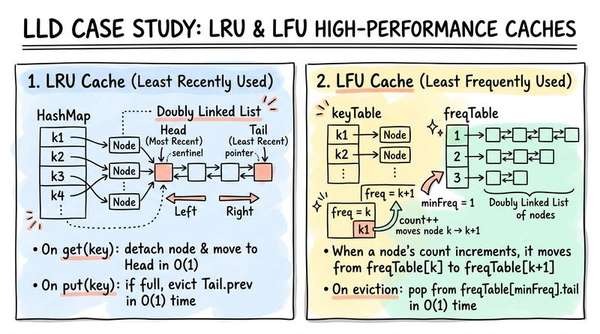
Hardened Implementation Steps
- 1Ingress Boundary Defense: Configure eviction policy to allkeys-lru (or allkeys-lfu), ensuring that least recently used keys are eligible for eviction regardless of TTL flags, a
- 2Failure Containment: Eliminate unconstrained buffering and propagate physical backpressure.
- 3Invariant Enforcement: Unless dedicated strictly as a durable data store, configure caching Redis instances with allkeys-lru/lfu eviction.
Production Code Contrast & Implementation
// HARDENED: Singleflight mutex coalescing with probabilistic early refresh
public byte[] getProduct(String key) {
    // XFetch algorithm evaluates early background refresh before TTL expiration
    if (shouldProbabilisticEarlyRefresh(key, beta, delta)) {
        backgroundPool.submit(() -> refreshCacheKey(key));
    }
    // Singleflight ensures exactly ONE upstream DB fetch executes per in-flight key
    return singleflightGroup.execute(key, () -> database.queryProduct(key));
}Architectural comparison of naive unconstrained allocations versus production-hardened mechanical sympathy.
Architectural Decisions & Trade-Offs
- ⚖Ingress Admission: Naive unconstrained buffering causes queue bloat and GC exhaustion. Mitigation: Bounded ingress gate with fast non-blocking shedding.
- ⚖Resource Strategy: Static capacity allocations collapse under brownouts. Mitigation: Dynamic adaptive limits scaling to real-time physical bounds.
- ⚖Outage Impact: Cascading lock convoys and memory saturation. Mitigation: Isolated failure domains keep P99 latency flat and protected.
Alternatives Evaluated
- →Naive Approach: A developer writes 5 GB of ephemeral session data without setting a TTL (no expiry). Since keys have no TTL, volatile-lru cannot evict them. When memo
- →Production-Hardened Pattern: Configure eviction policy to allkeys-lru (or allkeys-lfu), ensuring that least recently used keys are eligible for eviction regardless of TTL flags, a
Operational Hazards & Mitigations
- ⚠Cascading Failure: A developer writes 5 GB of ephemeral session data without setting a TTL (no expiry). Since keys have no TTL, volatile-lru cannot evict them. When memory fills, Redis throws 'OOM command not allowed when used memory > maxmemory', crashing write flows.
- ⚠Breakdown Chain: 100k QPS → TTL Expiration → Cache Miss Herd → Origin Slam → 💥 DB Meltdown
- ⚠Shedding Failure: Without fast rejection at the boundary, queued dead work triggers multi-second GC pauses, CPU thrashing, and cascading 504 Gateway Timeouts.
How does the system enforce physical resource boundaries under sudden downstream latency brownouts?
Interactive Assessment & Knowledge Check
Test your understanding of the architecture decisions, data patterns, and trade-offs used in Redis Maxmemory Eviction Thrashing on Volatile-LRU Under Write Surges.
Single-Thread Execution Bottleneck
Why does Redis execute single-threaded command processing faster than traditional multi-threaded locked data structures?