Readiness Probe Failure Cascades Diverting 100% of Ingress to Surviving Pods
Cluster of 20 pods where database slowdown causes 10 pods to fail their readiness probes simultaneously.
Cluster of 20 pods where database slowdown causes 10 pods to fail their readiness probes simultaneously. Failure cascade dynamic: Scale Surge → Unbounded Contention → Physical Bottleneck → 💥 Outage Cascade.
Core Functional Requirements
- ✓Operational Invariant: "Prevent readiness cascade collapses by enforcing minimum endpoint availability thresholds in load balancer routing."
- ✓Production Hardening: Implement Readiness Probe Damping / Graceful Fallback: if more than 50% of pods in a service fail readiness, circuit breakers freeze endpoint removal (fail-open routing), ensuring
- ✓Prevent cascading failure by isolating downstream degradation at the ingress boundary.
Scale & Latency Constraints
- —Incident Scenario Baseline: Cluster of 20 pods where database slowdown causes 10 pods to fail their readiness probes simultaneously.
- —Failure Cascade Path: Scale Surge → Unbounded Contention → Physical Bottleneck → 💥 Outage Cascade
- —Sub-millisecond rejection / shed latency for overloaded requests
Implement Readiness Probe Damping / Graceful Fallback: if more than 50% of pods in a service fail readiness, circuit breakers freeze endpoint removal (fail-open routing), ensuring degraded traffic continues flowing rather than collapsing completely. Invariant: "Prevent readiness cascade collapses by enforcing minimum endpoint availability thresholds in load balancer routing."
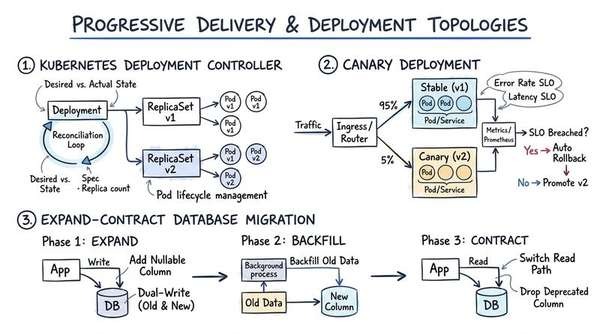
Hardened Implementation Steps
- 1Ingress Boundary Defense: Implement Readiness Probe Damping / Graceful Fallback: if more than 50% of pods in a service fail readiness, circuit breakers freeze endpoint removal
- 2Failure Containment: Eliminate unconstrained buffering and propagate physical backpressure.
- 3Invariant Enforcement: Prevent readiness cascade collapses by enforcing minimum endpoint availability thresholds in load balancer routing.
Production Code Contrast & Implementation
// HARDENED: Transactional Outbox Pattern with Debezium CDC
@Transactional
public void createOrder(Order order) {
    orderRepo.save(order);
    // Atomically persist event into outbox table within same ACID transaction
    outboxRepo.save(new OutboxEvent("orders", order.getId(), order.toJson()));
}
// Debezium captures transaction log (WAL) and guarantees at-least-once Kafka publicationArchitectural comparison of naive unconstrained allocations versus production-hardened mechanical sympathy.
Architectural Decisions & Trade-Offs
- ⚖Ingress Admission: Naive unconstrained buffering causes queue bloat and GC exhaustion. Mitigation: Bounded ingress gate with fast non-blocking shedding.
- ⚖Resource Strategy: Static capacity allocations collapse under brownouts. Mitigation: Dynamic adaptive limits scaling to real-time physical bounds.
- ⚖Outage Impact: Cascading lock convoys and memory saturation. Mitigation: Isolated failure domains keep P99 latency flat and protected.
Alternatives Evaluated
- →Naive Approach: Kubernetes immediately removes the 10 failing pods from the Service Endpoints list. The remaining 10 pods now receive 200% traffic, immediately overlo
- →Production-Hardened Pattern: Implement Readiness Probe Damping / Graceful Fallback: if more than 50% of pods in a service fail readiness, circuit breakers freeze endpoint removal
Operational Hazards & Mitigations
- ⚠Cascading Failure: Kubernetes immediately removes the 10 failing pods from the Service Endpoints list. The remaining 10 pods now receive 200% traffic, immediately overload, fail their readiness probes in turn, and drop the entire cluster out of service.
- ⚠Breakdown Chain: Scale Surge → Unbounded Contention → Physical Bottleneck → 💥 Outage Cascade
- ⚠Shedding Failure: Without fast rejection at the boundary, queued dead work triggers multi-second GC pauses, CPU thrashing, and cascading 504 Gateway Timeouts.
How does the system enforce physical resource boundaries under sudden downstream latency brownouts?
Interactive Assessment & Knowledge Check
Test your understanding of the architecture decisions, data patterns, and trade-offs used in Readiness Probe Failure Cascades Diverting 100% of Ingress to Surviving Pods.
Core Architectural Principles of Apache Spark: AQE, Catalyst Optimizer & Distributed DataFrames
What is the primary benefit of applying Apache Spark: AQE, Catalyst Optimizer & Distributed DataFrames in production systems?