Raft Leader Election Storms Triggered by Ephemeral GC Pauses
5-node Raft consensus cluster maintaining distributed metadata for a high- throughput search index.
5-node Raft consensus cluster maintaining distributed metadata for a high- throughput search index. Failure cascade dynamic: Scale Surge → Unbounded Contention → Physical Bottleneck → 💥 Outage Cascade.
Core Functional Requirements
- ✓Operational Invariant: "Raft election timeouts must safely exceed runtime GC ceilings, and the Pre-Vote protocol must guard against spurious term bumps."
- ✓Production Hardening: Configure Raft election timeouts with generous headroom (e.g. 1500– 3000ms randomized) exceeding maximum expected GC pauses, and implement Raft Pre-Vote protocol (phase 1 check bef
- ✓Prevent cascading failure by isolating downstream degradation at the ingress boundary.
Scale & Latency Constraints
- —Incident Scenario Baseline: 5-node Raft consensus cluster maintaining distributed metadata for a high- throughput search index.
- —Failure Cascade Path: Scale Surge → Unbounded Contention → Physical Bottleneck → 💥 Outage Cascade
- —Sub-millisecond rejection / shed latency for overloaded requests
Configure Raft election timeouts with generous headroom (e.g. 1500– 3000ms randomized) exceeding maximum expected GC pauses, and implement Raft Pre-Vote protocol (phase 1 check before bumping term number) to filter out disruptive partitioned nodes. Invariant: "Raft election timeouts must safely exceed runtime GC ceilings, and the Pre-Vote protocol must guard against spurious term bumps."
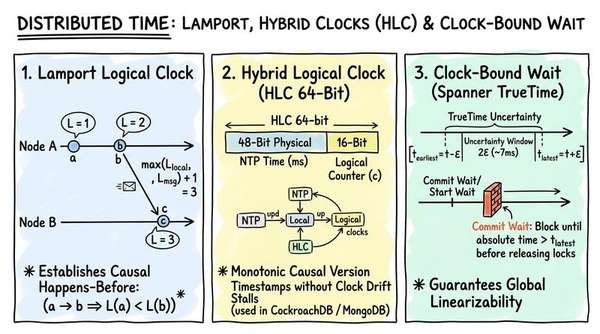
Hardened Implementation Steps
- 1Ingress Boundary Defense: Configure Raft election timeouts with generous headroom (e.g. 1500– 3000ms randomized) exceeding maximum expected GC pauses, and implement Raft Pre-Vo
- 2Failure Containment: Eliminate unconstrained buffering and propagate physical backpressure.
- 3Invariant Enforcement: Raft election timeouts must safely exceed runtime GC ceilings, and the Pre-Vote protocol must guard against spurious term bumps.
Production Code Contrast & Implementation
// HARDENED: Monotonic generation clock fencing token verification
public boolean writeData(String key, byte[] val, long fencingToken) {
    // Storage engine validates strictly monotonic fencing token before applying mutation
    if (storageEngine.validateAndAdvanceToken(fencingToken)) {
        return storageEngine.write(key, val);
    }
    throw new StaleFencingTokenException("Rejected mutation from superseded leader");
}Architectural comparison of naive unconstrained allocations versus production-hardened mechanical sympathy.
Architectural Decisions & Trade-Offs
- ⚖Ingress Admission: Naive unconstrained buffering causes queue bloat and GC exhaustion. Mitigation: Bounded ingress gate with fast non-blocking shedding.
- ⚖Resource Strategy: Static capacity allocations collapse under brownouts. Mitigation: Dynamic adaptive limits scaling to real-time physical bounds.
- ⚖Outage Impact: Cascading lock convoys and memory saturation. Mitigation: Isolated failure domains keep P99 latency flat and protected.
Alternatives Evaluated
- →Naive Approach: Leader node experiences an ephemeral 800ms JVM GC pause. Follower election timeout is set tightly to 500ms. Followers declare leader dead, transition
- →Production-Hardened Pattern: Configure Raft election timeouts with generous headroom (e.g. 1500– 3000ms randomized) exceeding maximum expected GC pauses, and implement Raft Pre-Vo
Operational Hazards & Mitigations
- ⚠Cascading Failure: Leader node experiences an ephemeral 800ms JVM GC pause. Follower election timeout is set tightly to 500ms. Followers declare leader dead, transition to Candidate, and trigger mass elections. Upon resuming, old leader contests, causing continuous election oscillations.
- ⚠Breakdown Chain: Scale Surge → Unbounded Contention → Physical Bottleneck → 💥 Outage Cascade
- ⚠Shedding Failure: Without fast rejection at the boundary, queued dead work triggers multi-second GC pauses, CPU thrashing, and cascading 504 Gateway Timeouts.
How does the system enforce physical resource boundaries under sudden downstream latency brownouts?
Extension Implementation Steps
- 1Track real-time latency gradients and inflight concurrency.
- 2Reject excess traffic at the ingress boundary within <0.1ms.
- 3Monitor P99 latency and verify autonomous recovery when downstream pressure subsides.
Follow-Up Trade-Offs
- ⚖Architectural Invariant: "Raft election timeouts must safely exceed runtime GC ceilings, and the Pre-Vote protocol must guard against spurious term bumps."
- ⚖Physical Resource Boundary: Dynamic admission control ensures worker threads never buffer dead requests during downstream brownouts.
Interactive Assessment & Knowledge Check
Test your understanding of the architecture decisions, data patterns, and trade-offs used in Raft Leader Election Storms Triggered by Ephemeral GC Pauses.
Core Architectural Principles of Distributed Locking & Redlock Algorithm
What is the primary benefit of applying Distributed Locking & Redlock Algorithm in production systems?