RabbitMQ Unbounded Queue Length Exhausting RAM and Thrashing to Disk
RabbitMQ queue without length limits accumulating messages during a consumer outage.
RabbitMQ queue without length limits accumulating messages during a consumer outage. Failure cascade dynamic: 50k Mut. → Row X-Lock → Spinlock Thrash → Deadlock Graph → 💥 DB Freeze.
Core Functional Requirements
- ✓Operational Invariant: "Every message queue must enforce bounded maximum length or byte quotas to prevent unconstrained memory and disk exhaustion."
- ✓Production Hardening: Set queue policies: 'x-max-length' or 'x-max-length-bytes' with 'x-overflow: reject-publish' or 'drop-head', or route overflow messages to a dead-letter exchange (DLX).
- ✓Prevent cascading failure by isolating downstream degradation at the ingress boundary.
Set queue policies: 'x-max-length' or 'x-max-length-bytes' with 'x-overflow: reject-publish' or 'drop-head', or route overflow messages to a dead-letter exchange (DLX). Invariant: "Every message queue must enforce bounded maximum length or byte quotas to prevent unconstrained memory and disk exhaustion."
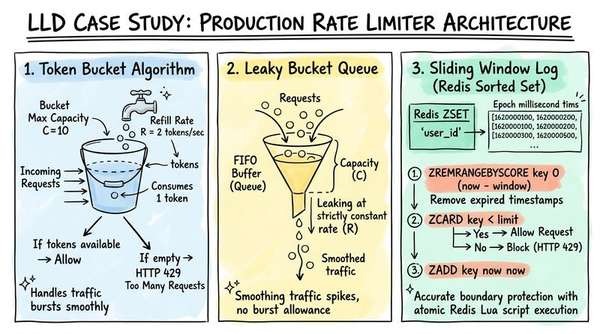
Hardened Implementation Steps
- 1Ingress Boundary Defense: Set queue policies: 'x-max-length' or 'x-max-length-bytes' with 'x-overflow: reject-publish' or 'drop-head', or route overflow messages to a dead-lett
- 2Failure Containment: Eliminate unconstrained buffering and propagate physical backpressure.
- 3Invariant Enforcement: Every message queue must enforce bounded maximum length or byte quotas to prevent unconstrained memory and disk exhaustion.
Production Code Contrast & Implementation
// HARDENED: Full Jitter exponential backoff with retry budget
public Response callService(Request req) {
    if (!retryBudget.acquireToken()) {
        throw new RetryBudgetExhaustedException("Shedding retries under cluster distress");
    }
    // Full Jitter: Uniform random backoff breaks synchronized wave patterns
    long sleepMs = (long) (Math.random() * Math.min(maxBackoffMs, baseMs * Math.pow(2, attempt)));
    scheduledExecutor.schedule(() -> executeCall(req), sleepMs, TimeUnit.MILLISECONDS);
}Architectural comparison of naive unconstrained allocations versus production-hardened mechanical sympathy.
Architectural Decisions & Trade-Offs
- ⚖Ingress Admission: Naive unconstrained buffering causes queue bloat and GC exhaustion. Mitigation: Bounded ingress gate with fast non-blocking shedding.
- ⚖Resource Strategy: Static capacity allocations collapse under brownouts. Mitigation: Dynamic adaptive limits scaling to real-time physical bounds.
- ⚖Outage Impact: Cascading lock convoys and memory saturation. Mitigation: Isolated failure domains keep P99 latency flat and protected.
Alternatives Evaluated
- →Naive Approach: Queue accumulates 10 million messages in RAM. RabbitMQ begins paging messages to disk, slowing throughput to a crawl and blocking incoming connections
- →Production-Hardened Pattern: Set queue policies: 'x-max-length' or 'x-max-length-bytes' with 'x-overflow: reject-publish' or 'drop-head', or route overflow messages to a dead-lett
Operational Hazards & Mitigations
- ⚠Cascading Failure: Queue accumulates 10 million messages in RAM. RabbitMQ begins paging messages to disk, slowing throughput to a crawl and blocking incoming connections, bringing the entire messaging infrastructure down.
- ⚠Breakdown Chain: 50k Mut. → Row X-Lock → Spinlock Thrash → Deadlock Graph → 💥 DB Freeze
- ⚠Shedding Failure: Without fast rejection at the boundary, queued dead work triggers multi-second GC pauses, CPU thrashing, and cascading 504 Gateway Timeouts.
How does the system enforce physical resource boundaries under sudden downstream latency brownouts?
Extension Implementation Steps
- 1Track real-time latency gradients and inflight concurrency.
- 2Reject excess traffic at the ingress boundary within <0.1ms.
- 3Monitor P99 latency and verify autonomous recovery when downstream pressure subsides.
Follow-Up Trade-Offs
- ⚖Architectural Invariant: "Every message queue must enforce bounded maximum length or byte quotas to prevent unconstrained memory and disk exhaustion."
- ⚖Physical Resource Boundary: Dynamic admission control ensures worker threads never buffer dead requests during downstream brownouts.
Interactive Assessment & Knowledge Check
Test your understanding of the architecture decisions, data patterns, and trade-offs used in RabbitMQ Unbounded Queue Length Exhausting RAM and Thrashing to Disk.
Message Ordering in Distributed Log Partitions
How does Apache Kafka guarantee strict sequential ordering for messages delivered to consumers?