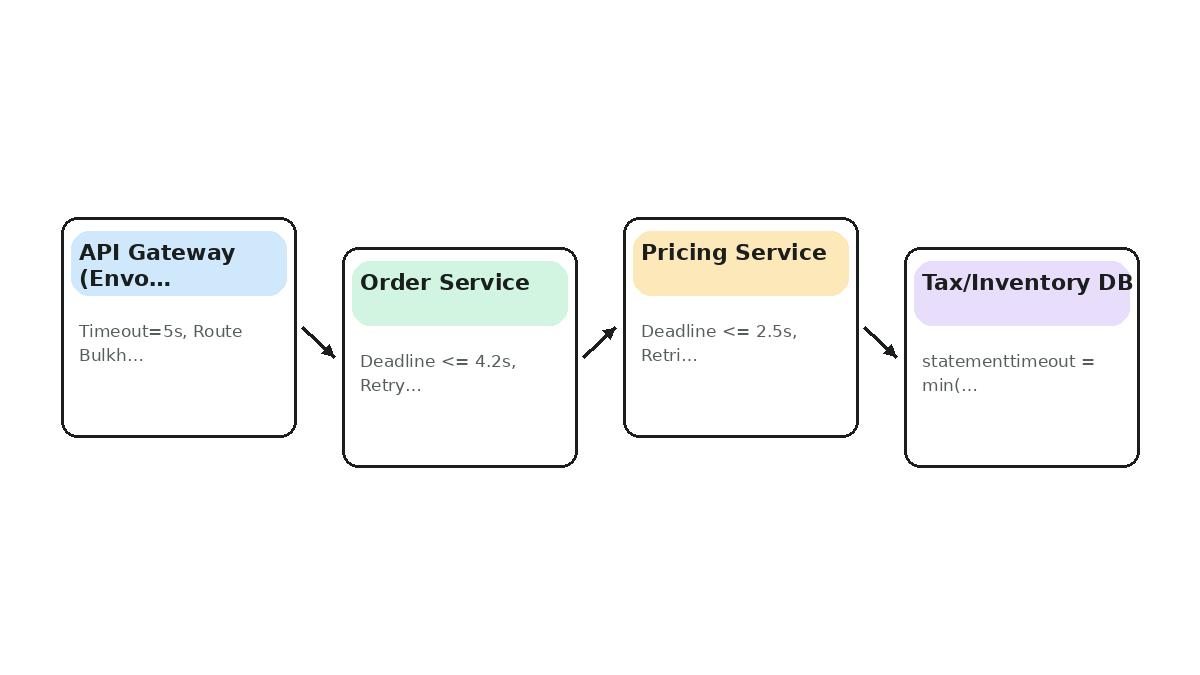
A 4-hop synchronous microservices chain (`API Gateway -> Order Service -> Pricing Service -> Tax/Inventory DB`) runs at 2,500 RPS. The API Gateway has a 60s timeout, while Order Service and Pricing Service both configure 90s HTTP client timeouts with 3 automatic retries on `5xx`/`Timeout`. When a missing index slows the Tax/Inventory DB from 20 ms to 4.5 seconds, Order Service threads pile up, Pricing Service retries 3x on timed-out calls, and the API Gateway returns cascading HTTP `504 Gateway Timeout` across unrelated endpoints (`GET /catalog`, `GET /profile`). Design a deadline-propagation, retry-budget, and load-shedding architecture that contains the blast radius and eliminates cascading 504s.
From patterns to decisions.
A 4-hop synchronous microservices chain (`API Gateway -> Order Service -> Pricing Service -> Tax/Inventory DB`) runs at 2,500 RPS. The API Gateway has a 60s timeout, while Order Service and Pricing Service both configure 90s HTTP client timeouts with 3 automatic retries on `5xx`/`Timeout`. When a missing index slows the Tax/Inventory DB from 20 ms to 4.5 seconds, Order Service threads pile up, Pricing Service retries 3x on timed-out calls, and the API Gateway returns cascading HTTP `504 Gateway Timeout` across unrelated endpoints (`GET /catalog`, `GET /profile`). Design a deadline-propagation, retry-budget, and load-shedding architecture that contains the blast radius and eliminates cascading 504s.
Inverted timeouts (90s downstream >.
Inverted timeouts (90s downstream > 60s gateway) created zombie work, while 3x retries at multiple hops multiplied load by 9x and starved shared pools.
| Choice | What it buys | What it costs |
|---|---|---|
| Trade-off 1 | Retries improve transient-blip success rates but are catastrophic during sustained latency degradation |
Explain zombie work
Gateway returned 504 at 60s while Order/Pricing kept holding threads for 90s.
Calculate retry amplification
3 retries in Order x 3 retries in Pricing = 9x DB load.
Step 3
Show how shared Gateway/thread pools caused collateral 504s on /catalog and /profile.
Alternative 1
Move non-critical order enrichment to async background workers
Failure Mode 1
Client SDK retries on 504 add another 3x layer on top of service retries
Load Multiplier = (1 + 3_order_retries) * (1 + 3_pricing_retries) = 16x worst-case DB queries per user request
Use Envoy retry_budget.
Use Envoy retry_budget: 10% with per-route circuit breakers, propagate relative remaining TTL, and clamp DB statement_timeout dynamically.
| Choice | What it buys | What it costs |
|---|---|---|
| Trade-off 1 | Dynamic `SET LOCAL statement_timeout` adds 1 extra lightweight SQL command per transaction (or use `BEGIN; SET LOCAL ...`) |
Set monotonic timeouts
Gateway 5s -> Order 4.2s -> Pricing 2.5s -> DB <=1.5s.
Step 2
Cap retries to 10% via Envoy retry_budget and disable retries in Pricing.
Step 3
Set SET LOCAL statement_timeout from remaining deadline budget.
Alternative 1
Use gRPC WithTimeout / Context.WithDeadline, which propagates grpc-timeout natively
Failure Mode 1
Passing absolute epoch timestamps across pods with NTP drift causes premature deadline rejections
circuit_breakers:
  thresholds:
    - max_requests: 1000
      max_pending_requests: 200
      retry_budget:
        budget_percent: { value: 10.0 }
        min_retry_concurrency: 5
Relative remaining TTLs are immune.
Relative remaining TTLs are immune to NTP clock skew between VMs/pods, whereas absolute timestamps can immediately expire if a downstream node's clock is 2 seconds ahead.
| Choice | What it buys | What it costs |
|---|---|---|
| Trade-off 1 | Relative TTLs don't account for variable network transit time unless a small wire margin (10–20ms) is subtracted |
Step 1
Explain NTP clock drift (100ms–2s on overloaded VMs).
Step 2
Each hop reads X-Timeout-Remaining-Ms, subtracts its own processing + estimated network RTT, and forwards the remainder.
Step 3
This matches gRPC's standard grpc-timeout wire design.
Alternative 1
Use gRPC natively, which handles grpc-timeout serialization and cancellation automatically
Failure Mode 1
Using time.time() instead of time.monotonic() for elapsed calculation breaks during NTP step adjustments
def forward_headers(remaining_ms: int, start_time: float) -> dict:
    elapsed_ms = int((time.monotonic() - start_time) * 1000)
    next_budget = remaining_ms - elapsed_ms - 10  # 10ms wire margin
    return {"X-Timeout-Remaining-Ms": str(max(0, next_budget))}
Implementation & Guardrails (4).
Combine adaptive concurrency limiting (CoDel / LIFO queue with 200ms max queue wait) and HTTP 503 shedding so the healthy subset of requests finishes within the 5s SLA.
| Choice | What it buys | What it costs |
|---|---|---|
| Trade-off 1 | Shedding returns fast 503s to excess callers, preserving 100% success for the capacity the DB can actually serve |
Step 1
Cap active in-flight calls to the DB at its sustainable concurrency (e.g., 150 connections).
Step 2
Use a LIFO queue with a 200ms sojourn timeout (CoDel) so stale queued requests shed immediately.
Step 3
Return 503 Service Unavailable with Retry-After: 5 instead of letting all 2,500 RPS time out at 5s.
Alternative 1
Prioritized load shedding (shed non-VIP or retry traffic first, preserve checkout)
Failure Mode 1
FIFO queuing under overload causes 0% goodput because every request waits 5s and times out
if queue_wait_ms > 200 or not db_semaphore.acquire(blocking=False):
    return Response(status=503, headers={"Retry-After": "5"})
Use Equal/Full Jitter on client.
Use Equal/Full Jitter on client Retry-After backoff and a Circuit Breaker HALF_OPEN ramp (or Envoy slow-start) to smooth recovery.
| Choice | What it buys | What it costs |
|---|---|---|
| Trade-off 1 | Full jitter spreads recovery traffic evenly over the backoff window, adding minor recovery delay (seconds) for total stability |
Ensure clients apply Full Jitter
sleep = random(0, min(cap, base * 2^attempt)).
Step 2
Configure Circuit Breaker permittedNumberOfCallsInHalfOpenState: 10 before closing.
Step 3
Gradually ramp pod weights or concurrency limits via AIMD.
Alternative 1
Decorrelated jitter (sleep = min(cap, random(base, prev_sleep * 3)))
Failure Mode 1
Fixed backoff (sleep(5)) synchronizes all 2,500 clients to slam the DB together every 5 seconds
def backoff_with_full_jitter(attempt: int, base: float = 0.5, cap: float = 30.0) -> float:
    exp = min(cap, base * (2 ** attempt))
    return random.uniform(0, exp)
Theory & Tips and Tricks
Practical heuristics & interview traps
- 01Interview anchor: Enforce monotonically decreasing deadline budgets from edge to leaf, cap retry amplification with token-bucket retry budgets, and shed load early.
- 02Trade-off tip: Relative TTLs don't account for variable network transit time unless a small wire margin (10–20ms) is subtracted
- 03Watch out for: FIFO queuing under overload causes 0% goodput because every request waits 5s and times out
Preventing Cascading Gateway Timeouts — Normal → Load / Fault → Recovery
Enforce monotonically decreasing deadline budgets from edge to leaf, cap retry amplification with token-bucket retry budgets, and shed load early.
Putting Preventing Cascading 504 Gateway Timeouts Together
Enforce monotonically decreasing deadline budgets from edge to leaf, cap retry amplification with token-bucket retry budgets, and shed load early.
Putting Preventing Cascading 504 Gateway Timeouts Together
- Set monotonic timeouts: Gateway 5s -> Order 4.2s -> Pricing 2.5s -> DB <=1.5s.
- Cap retries to 10% via Envoy
retry_budgetand disable retries in Pricing. - Set
SET LOCAL statement_timeoutfrom remaining deadline budget.
Interview Readiness Check
Combine adaptive concurrency limiting (CoDel / LIFO queue with 200ms max queue wait) and HTTP 503 shedding so the healthy subset of requests finishes within the 5s SLA.
Walk through bottlenecks, back-of-the-envelope math, and failure recovery.
Make the trade-off yourself.
Practice Check
Test your understanding
When is ACID Transaction Fundamentals the right default for a production team?
Preventing Cascading 504 Gateway Timeouts
Enforce monotonically decreasing deadline budgets from edge to leaf, cap retry amplification with token-bucket retry budgets, and shed load early.