Over-Aggressive Health Check Probes Causing
Cascading Cluster Ejections Kubernetes cluster with liveness probe configured to 'failureThreshold: 2, periodSeconds: 2' on an endpoint executing a database query.
Cascading Cluster Ejections Kubernetes cluster with liveness probe configured to 'failureThreshold: 2, periodSeconds: 2' on an endpoint executing a database query. Failure cascade dynamic: Scale Surge → Unbounded Contention → Physical Bottleneck → 💥 Outage Cascade.
Core Functional Requirements
- ✓Operational Invariant: "Liveness probes must check strictly local process liveness; never check external dependencies in liveness probes."
- ✓Production Hardening: Decouple liveness probes from external dependencies: liveness probes must check ONLY local process health (is the web server running and event loop ticking?). Configure readiness p
- ✓Prevent cascading failure by isolating downstream degradation at the ingress boundary.
Scale & Latency Constraints
- —Incident Scenario Baseline: Cascading Cluster Ejections Kubernetes cluster with liveness probe configured to 'failureThreshold: 2, periodSeconds: 2' on an endpoint executing a database query.
- —Failure Cascade Path: Scale Surge → Unbounded Contention → Physical Bottleneck → 💥 Outage Cascade
- —Sub-millisecond rejection / shed latency for overloaded requests
Decouple liveness probes from external dependencies: liveness probes must check ONLY local process health (is the web server running and event loop ticking?). Configure readiness probes for traffic routing, with generous failure thresholds (e.g. failureThreshold: 5). Invariant: "Liveness probes must check strictly local process liveness; never check external dependencies in liveness probes."
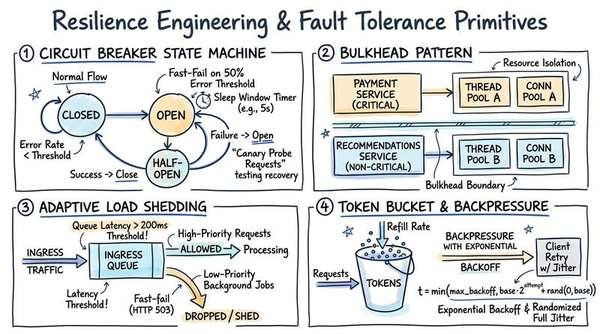
Hardened Implementation Steps
- 1Ingress Boundary Defense: Decouple liveness probes from external dependencies: liveness probes must check ONLY local process health (is the web server running and event loop ti
- 2Failure Containment: Eliminate unconstrained buffering and propagate physical backpressure.
- 3Invariant Enforcement: Liveness probes must check strictly local process liveness; never check external dependencies in liveness probes.
Production Code Contrast & Implementation
// HARDENED: Multi-layer memory budgeting reserving 30% OS headroom
// resources:
//   limits: { memory: "4Gi" }
// java -XX:MaxRAMPercentage=70.0 -XX:+UseG1GC -XX:+ExitOnOutOfMemoryError -jar app.jar
// Reserves 1.2GB headroom for Metaspace, Netty direct buffers, thread stacks & OS kernelArchitectural comparison of naive unconstrained allocations versus production-hardened mechanical sympathy.
Architectural Decisions & Trade-Offs
- ⚖Ingress Admission: Naive unconstrained buffering causes queue bloat and GC exhaustion. Mitigation: Bounded ingress gate with fast non-blocking shedding.
- ⚖Resource Strategy: Static capacity allocations collapse under brownouts. Mitigation: Dynamic adaptive limits scaling to real-time physical bounds.
- ⚖Outage Impact: Cascading lock convoys and memory saturation. Mitigation: Isolated failure domains keep P99 latency flat and protected.
Alternatives Evaluated
- →Naive Approach: A transient 4-second database blip causes 2 consecutive liveness probes to fail. Kubernetes kills the pod. Surviving pods absorb the redirected traffi
- →Production-Hardened Pattern: Decouple liveness probes from external dependencies: liveness probes must check ONLY local process health (is the web server running and event loop ti
Operational Hazards & Mitigations
- ⚠Cascading Failure: A transient 4-second database blip causes 2 consecutive liveness probes to fail. Kubernetes kills the pod. Surviving pods absorb the redirected traffic, experience higher load, fail their probes, and are killed in a cascading domino collapse.
- ⚠Breakdown Chain: Scale Surge → Unbounded Contention → Physical Bottleneck → 💥 Outage Cascade
- ⚠Shedding Failure: Without fast rejection at the boundary, queued dead work triggers multi-second GC pauses, CPU thrashing, and cascading 504 Gateway Timeouts.
How does the system enforce physical resource boundaries under sudden downstream latency brownouts?
Interactive Assessment & Knowledge Check
Test your understanding of the architecture decisions, data patterns, and trade-offs used in Over-Aggressive Health Check Probes Causing.
Core Architectural Principles of JVM Architecture, Memory Model & Garbage Collection
What is the primary benefit of applying JVM Architecture, Memory Model & Garbage Collection in production systems?