OOMKilled (Exit Code 137) Pod Outages from Underestimated Off-Heap Buffers
Java Spring Boot microservice deployed on Kubernetes with container memory limit = 4 GB and -Xmx3g.
Java Spring Boot microservice deployed on Kubernetes with container memory limit = 4 GB and -Xmx3g. Failure cascade dynamic: Burst → Pool Saturated → Queue Bloat (10k) → STW GC → 💥 504 Timeouts.
Core Functional Requirements
- ✓Operational Invariant: "Container memory limits must provide at least 30% headroom above JVM maximum heap (-Xmx) for off-heap buffers and native runtimes."
- ✓Production Hardening: Account for all JVM memory regions when sizing container limits: Container Limit >= Heap (-Xmx) + Direct Memory (-XX:MaxDirectMemorySize) + Metaspace (- XX:MaxMetaspaceSize) + (Thr
- ✓Prevent cascading failure by isolating downstream degradation at the ingress boundary.
Scale & Latency Constraints
- —Incident Scenario Baseline: Java Spring Boot microservice deployed on Kubernetes with container memory limit = 4 GB and -Xmx3g.
- —Failure Cascade Path: Burst → Pool Saturated → Queue Bloat (10k) → STW GC → 💥 504 Timeouts
- —Sub-millisecond rejection / shed latency for overloaded requests
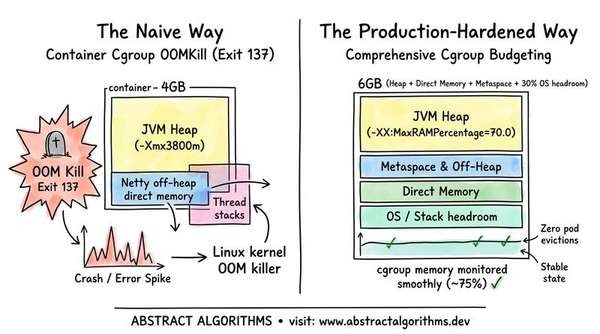
Account for all JVM memory regions when sizing container limits: Container Limit >= Heap (-Xmx) + Direct Memory (-XX:MaxDirectMemorySize) + Metaspace (- XX:MaxMetaspaceSize) + (Threads * -Xss) + 512MB OS buffer . Set -XX:+UseContainerSupport and - XX:MaxRAMPercentage=70.0. Invariant: "Container memory limits must provide at least 30% headroom above JVM maximum heap (-Xmx) for off-heap buffers and native runtimes."
Hardened Implementation Steps
- 1Ingress Boundary Defense: Account for all JVM memory regions when sizing container limits: Container Limit >= Heap (-Xmx) + Direct Memory (-XX:MaxDirectMemorySize) + Metaspace
- 2Failure Containment: Eliminate unconstrained buffering and propagate physical backpressure.
- 3Invariant Enforcement: Container memory limits must provide at least 30% headroom above JVM maximum heap (-Xmx) for off-heap buffers and native runtimes.
Production Code Contrast & Implementation
// HARDENED: Transactional Outbox Pattern with Debezium CDC
@Transactional
public void createOrder(Order order) {
    orderRepo.save(order);
    // Atomically persist event into outbox table within same ACID transaction
    outboxRepo.save(new OutboxEvent("orders", order.getId(), order.toJson()));
}
// Debezium captures transaction log (WAL) and guarantees at-least-once Kafka publicationArchitectural comparison of naive unconstrained allocations versus production-hardened mechanical sympathy.
Architectural Decisions & Trade-Offs
- ⚖Ingress Admission: Naive unconstrained buffering causes queue bloat and GC exhaustion. Mitigation: Bounded ingress gate with fast non-blocking shedding.
- ⚖Resource Strategy: Static capacity allocations collapse under brownouts. Mitigation: Dynamic adaptive limits scaling to real-time physical bounds.
- ⚖Outage Impact: Cascading lock convoys and memory saturation. Mitigation: Isolated failure domains keep P99 latency flat and protected.
Alternatives Evaluated
- →Naive Approach: Engineers assume 1 GB headroom is sufficient. However , Netty direct memory buffers, Metaspace, thread stacks (200 threads * 1MB), and JIT code cache
- →Production-Hardened Pattern: Account for all JVM memory regions when sizing container limits: Container Limit >= Heap (-Xmx) + Direct Memory (-XX:MaxDirectMemorySize) + Metaspace
Operational Hazards & Mitigations
- ⚠Cascading Failure: Engineers assume 1 GB headroom is sufficient. However , Netty direct memory buffers, Metaspace, thread stacks (200 threads * 1MB), and JIT code cache consume an additional 1.4 GB. Container cgroup memory exceeds 4 GB; the Linux kernel OOM killer terminates the pod instantly with Exit Code 137.
- ⚠Breakdown Chain: Burst → Pool Saturated → Queue Bloat (10k) → STW GC → 💥 504 Timeouts
- ⚠Shedding Failure: Without fast rejection at the boundary, queued dead work triggers multi-second GC pauses, CPU thrashing, and cascading 504 Gateway Timeouts.
How does the system enforce physical resource boundaries under sudden downstream latency brownouts?
Extension Implementation Steps
- 1Track real-time latency gradients and inflight concurrency.
- 2Reject excess traffic at the ingress boundary within <0.1ms.
- 3Monitor P99 latency and verify autonomous recovery when downstream pressure subsides.
Follow-Up Trade-Offs
- ⚖Architectural Invariant: "Container memory limits must provide at least 30% headroom above JVM maximum heap (-Xmx) for off-heap buffers and native runtimes."
- ⚖Physical Resource Boundary: Dynamic admission control ensures worker threads never buffer dead requests during downstream brownouts.
Interactive Assessment & Knowledge Check
Test your understanding of the architecture decisions, data patterns, and trade-offs used in OOMKilled (Exit Code 137) Pod Outages from Underestimated Off-Heap Buffers.
Core Architectural Principles of Apache Spark: AQE, Catalyst Optimizer & Distributed DataFrames
What is the primary benefit of applying Apache Spark: AQE, Catalyst Optimizer & Distributed DataFrames in production systems?