Metric Aggregation Skew (Average of Averages Fallacy) Hiding Catastrophic Spikes
SRE dashboard calculating average P99 latency across 50 microservice instances: 'avg(p99_latency)'.
SRE dashboard calculating average P99 latency across 50 microservice instances: 'avg(p99_latency)'. Failure cascade dynamic: Scale Surge → Unbounded Contention → Physical Bottleneck → 💥 Outage Cascade.
Core Functional Requirements
- ✓Operational Invariant: "Never compute averages of percentiles; calculate true percentiles directly from unified histogram bucket counters."
- ✓Production Hardening: Aggregate percentiles correctly from underlying histogram bucket counters using Prometheus 'histogram_quantile(0.99, sum(rate(http_request_duration_seconds_bucket[5m])) by (le))',
- ✓Prevent cascading failure by isolating downstream degradation at the ingress boundary.
Scale & Latency Constraints
- —Incident Scenario Baseline: SRE dashboard calculating average P99 latency across 50 microservice instances: 'avg(p99_latency)'.
- —Failure Cascade Path: Scale Surge → Unbounded Contention → Physical Bottleneck → 💥 Outage Cascade
- —Sub-millisecond rejection / shed latency for overloaded requests
Aggregate percentiles correctly from underlying histogram bucket counters using Prometheus 'histogram_quantile(0.99, sum(rate(http_request_duration_seconds_bucket[5m])) by (le))', or use HdrHistogram data structures. Invariant: "Never compute averages of percentiles; calculate true percentiles directly from unified histogram bucket counters."
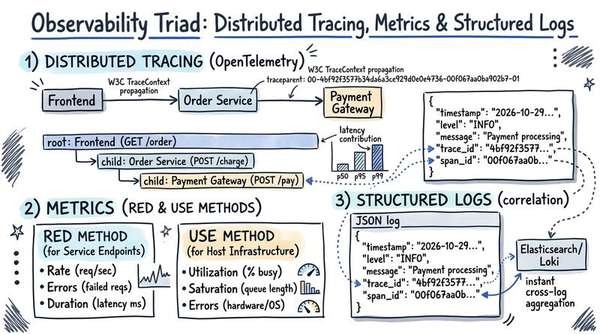
Hardened Implementation Steps
- 1Ingress Boundary Defense: Aggregate percentiles correctly from underlying histogram bucket counters using Prometheus 'histogram_quantile(0.99, sum(rate(http_request_duration_se
- 2Failure Containment: Eliminate unconstrained buffering and propagate physical backpressure.
- 3Invariant Enforcement: Never compute averages of percentiles; calculate true percentiles directly from unified histogram bucket counters.
Production Code Contrast & Implementation
// HARDENED: Adaptive tail-based sampling with non-blocking ring buffer drop
Span span = Tracer.startSpan("process");
// Retain 100% of error spans (5xx) and latency outliers (>P95); sample 0.1% of nominal 200s
spanCollector.offerWithDropPolicy(span, DropPolicy.DROP_OLDEST_NOMINAL);Architectural comparison of naive unconstrained allocations versus production-hardened mechanical sympathy.
Architectural Decisions & Trade-Offs
- ⚖Ingress Admission: Naive unconstrained buffering causes queue bloat and GC exhaustion. Mitigation: Bounded ingress gate with fast non-blocking shedding.
- ⚖Resource Strategy: Static capacity allocations collapse under brownouts. Mitigation: Dynamic adaptive limits scaling to real-time physical bounds.
- ⚖Outage Impact: Cascading lock convoys and memory saturation. Mitigation: Isolated failure domains keep P99 latency flat and protected.
Alternatives Evaluated
- →Naive Approach: Averages of percentiles are mathematically invalid. 49 instances have 10ms latency, while 1 instance is completely frozen at 30,000ms. The average P99
- →Production-Hardened Pattern: Aggregate percentiles correctly from underlying histogram bucket counters using Prometheus 'histogram_quantile(0.99, sum(rate(http_request_duration_se
Operational Hazards & Mitigations
- ⚠Cascading Failure: Averages of percentiles are mathematically invalid. 49 instances have 10ms latency, while 1 instance is completely frozen at 30,000ms. The average P99 shows 609ms, completely masking that 2% of all users are suffering a complete service failure.
- ⚠Breakdown Chain: Scale Surge → Unbounded Contention → Physical Bottleneck → 💥 Outage Cascade
- ⚠Shedding Failure: Without fast rejection at the boundary, queued dead work triggers multi-second GC pauses, CPU thrashing, and cascading 504 Gateway Timeouts.
How does the system enforce physical resource boundaries under sudden downstream latency brownouts?
Interactive Assessment & Knowledge Check
Test your understanding of the architecture decisions, data patterns, and trade-offs used in Metric Aggregation Skew (Average of Averages Fallacy) Hiding Catastrophic Spikes.
Distributed Tracing: fundamentals
When is Distributed Tracing the right default for a production team?