Massive Batch Deletes Bloating PostgreSQL WAL
Logs & Exhausting Disk Space Nightly cleanup cron job running 'DELETE FROM audit_logs WHERE created_at < NOW() - INTERVAL '90 days'' on 50 million rows.
Logs & Exhausting Disk Space Nightly cleanup cron job running 'DELETE FROM audit_logs WHERE created_at < NOW() - INTERVAL '90 days'' on 50 million rows. Failure cascade dynamic: Scale Surge → Unbounded Contention → Physical Bottleneck → 💥 Outage Cascade.
Core Functional Requirements
- ✓Operational Invariant: "Large-scale historical data pruning must utilize time-based table partitioning (DROP TABLE) or throttled chunked batch deletes."
- ✓Production Hardening: Execute bulk deletions in small, throttled chunk batches (e.g. 5,000 rows per batch) with sleep pauses between batches, or partition tables by time range (pg_partman) and simply ex
- ✓Prevent cascading failure by isolating downstream degradation at the ingress boundary.
Scale & Latency Constraints
- —Incident Scenario Baseline: Logs & Exhausting Disk Space Nightly cleanup cron job running 'DELETE FROM audit_logs WHERE created_at < NOW() - INTERVAL '90 days'' on 50 million rows.
- —Failure Cascade Path: Scale Surge → Unbounded Contention → Physical Bottleneck → 💥 Outage Cascade
- —Sub-millisecond rejection / shed latency for overloaded requests
Execute bulk deletions in small, throttled chunk batches (e.g. 5,000 rows per batch) with sleep pauses between batches, or partition tables by time range (pg_partman) and simply execute O(1) metadata drops: 'DROP TABLE audit_logs_2025_q1'. Invariant: "Large-scale historical data pruning must utilize time-based table partitioning (DROP TABLE) or throttled chunked batch deletes."
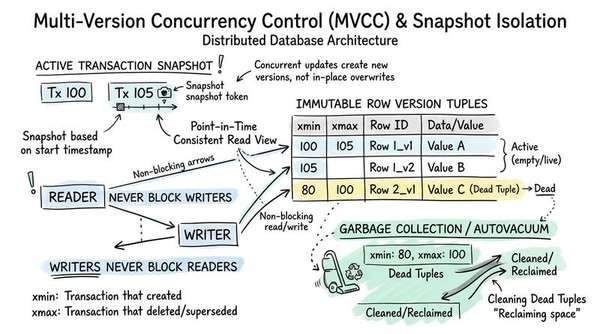
Hardened Implementation Steps
- 1Ingress Boundary Defense: Execute bulk deletions in small, throttled chunk batches (e.g. 5,000 rows per batch) with sleep pauses between batches, or partition tables by time ra
- 2Failure Containment: Eliminate unconstrained buffering and propagate physical backpressure.
- 3Invariant Enforcement: Large-scale historical data pruning must utilize time-based table partitioning (DROP TABLE) or throttled chunked batch deletes.
Production Code Contrast & Implementation
// HARDENED: Redis in-memory atomic decrement via Lua script
String luaScript =
    "local curr = tonumber(redis.call('GET', KEYS[1]) or '0') " +
    "if curr >= tonumber(ARGV[1]) then " +
    "  redis.call('DECRBY', KEYS[1], ARGV[1]) return 1 " +
    "else return 0 end";
Long granted = (Long) redis.eval(luaScript, List.of("inv:" + itemId), List.of(qty));
// Decoupled reservation drains to PostgreSQL via background batch workerArchitectural comparison of naive unconstrained allocations versus production-hardened mechanical sympathy.
Architectural Decisions & Trade-Offs
- ⚖Ingress Admission: Naive unconstrained buffering causes queue bloat and GC exhaustion. Mitigation: Bounded ingress gate with fast non-blocking shedding.
- ⚖Resource Strategy: Static capacity allocations collapse under brownouts. Mitigation: Dynamic adaptive limits scaling to real-time physical bounds.
- ⚖Outage Impact: Cascading lock convoys and memory saturation. Mitigation: Isolated failure domains keep P99 latency flat and protected.
Alternatives Evaluated
- →Naive Approach: Deleting 50 million rows in a single SQL transaction generates 80 GB of Write- Ahead Log (WAL) records in minutes. WAL disk volume fills to 100%, forc
- →Production-Hardened Pattern: Execute bulk deletions in small, throttled chunk batches (e.g. 5,000 rows per batch) with sleep pauses between batches, or partition tables by time ra
Operational Hazards & Mitigations
- ⚠Cascading Failure: Deleting 50 million rows in a single SQL transaction generates 80 GB of Write- Ahead Log (WAL) records in minutes. WAL disk volume fills to 100%, forcing PostgreSQL to shut down into emergency panic mode.
- ⚠Breakdown Chain: Scale Surge → Unbounded Contention → Physical Bottleneck → 💥 Outage Cascade
- ⚠Shedding Failure: Without fast rejection at the boundary, queued dead work triggers multi-second GC pauses, CPU thrashing, and cascading 504 Gateway Timeouts.
How does the system enforce physical resource boundaries under sudden downstream latency brownouts?
Extension Implementation Steps
- 1Track real-time latency gradients and inflight concurrency.
- 2Reject excess traffic at the ingress boundary within <0.1ms.
- 3Monitor P99 latency and verify autonomous recovery when downstream pressure subsides.
Follow-Up Trade-Offs
- ⚖Architectural Invariant: "Large-scale historical data pruning must utilize time-based table partitioning (DROP TABLE) or throttled chunked batch deletes."
- ⚖Physical Resource Boundary: Dynamic admission control ensures worker threads never buffer dead requests during downstream brownouts.
Interactive Assessment & Knowledge Check
Test your understanding of the architecture decisions, data patterns, and trade-offs used in Massive Batch Deletes Bloating PostgreSQL WAL.
B+ Tree vs LSM-Tree Storage Engine Trade-Offs
Why do high-throughput write-heavy storage engines (like RocksDB and Cassandra) use LSM-Trees instead of traditional B+ Trees?