Lock-Free Atomic Spinlock Thrashing (CAS Loop High CPU Burn)
High-velocity order book matching engine utilizing lock-free Compare-And-Swap (CAS) loops under extreme contention.
High-velocity order book matching engine utilizing lock-free Compare-And-Swap (CAS) loops under extreme contention. Failure cascade dynamic: Burst → Pool Saturated → Queue Bloat (10k) → STW GC → 💥 504 Timeouts.
Core Functional Requirements
- ✓Operational Invariant: "Unbounded tight CAS spin loops degrade into CPU livelocks; always incorporate pause hints and backoff fallbacks."
- ✓Production Hardening: Insert CPU pause instructions (e.g., Thread.onSpinWait() in Java or PAUSE assembly opcode) inside the spin loop to prevent pipeline flushes, and transition to exponential backoff o
- ✓Prevent cascading failure by isolating downstream degradation at the ingress boundary.
Scale & Latency Constraints
- —Incident Scenario Baseline: High-velocity order book matching engine utilizing lock-free Compare-And-Swap (CAS) loops under extreme contention.
- —Failure Cascade Path: Burst → Pool Saturated → Queue Bloat (10k) → STW GC → 💥 504 Timeouts
- —Sub-millisecond rejection / shed latency for overloaded requests
Insert CPU pause instructions (e.g., Thread.onSpinWait() in Java or PAUSE assembly opcode) inside the spin loop to prevent pipeline flushes, and transition to exponential backoff or parking after 16 failed spin attempts. Invariant: "Unbounded tight CAS spin loops degrade into CPU livelocks; always incorporate pause hints and backoff fallbacks."
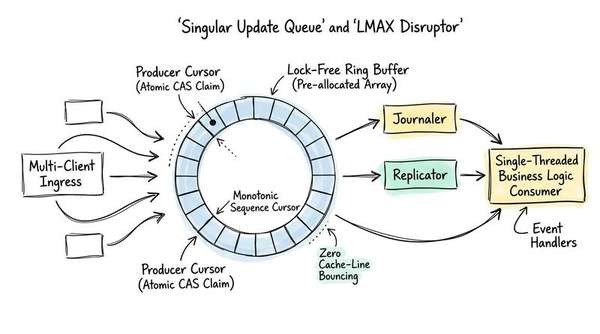
Hardened Implementation Steps
- 1Ingress Boundary Defense: Insert CPU pause instructions (e.g., Thread.onSpinWait() in Java or PAUSE assembly opcode) inside the spin loop to prevent pipeline flushes, and trans
- 2Failure Containment: Eliminate unconstrained buffering and propagate physical backpressure.
- 3Invariant Enforcement: Unbounded tight CAS spin loops degrade into CPU livelocks; always incorporate pause hints and backoff fallbacks.
Production Code Contrast & Implementation
// HARDENED: Adaptive concurrency limit & non-blocking ingress admission
AdaptiveLimiter limiter = new VegasLimiter(minRtt);
if (!limiter.tryAcquire()) {
    // Fast non-blocking load shedding in <0.1ms; protect worker threads
    return HttpResponse.status(HttpStatus.TOO_MANY_REQUESTS);
}
// Vegas limit automatically shrinks window on RTT gradient inflation, keeping P99 flatArchitectural comparison of naive unconstrained allocations versus production-hardened mechanical sympathy.
Architectural Decisions & Trade-Offs
- ⚖Ingress Admission: Naive unconstrained buffering causes queue bloat and GC exhaustion. Mitigation: Bounded ingress gate with fast non-blocking shedding.
- ⚖Resource Strategy: Static capacity allocations collapse under brownouts. Mitigation: Dynamic adaptive limits scaling to real-time physical bounds.
- ⚖Outage Impact: Cascading lock convoys and memory saturation. Mitigation: Isolated failure domains keep P99 latency flat and protected.
Alternatives Evaluated
- →Naive Approach: Under 100 competing threads, CAS success rate drops to <5%. Threads execute tight while (!cas()) spin loops, burning 100% of all CPU cores without mak
- →Production-Hardened Pattern: Insert CPU pause instructions (e.g., Thread.onSpinWait() in Java or PAUSE assembly opcode) inside the spin loop to prevent pipeline flushes, and trans
Operational Hazards & Mitigations
- ⚠Cascading Failure: Under 100 competing threads, CAS success rate drops to <5%. Threads execute tight while (!cas()) spin loops, burning 100% of all CPU cores without making forward progress (livelock).
- ⚠Breakdown Chain: Burst → Pool Saturated → Queue Bloat (10k) → STW GC → 💥 504 Timeouts
- ⚠Shedding Failure: Without fast rejection at the boundary, queued dead work triggers multi-second GC pauses, CPU thrashing, and cascading 504 Gateway Timeouts.
How does the system enforce physical resource boundaries under sudden downstream latency brownouts?
Interactive Assessment & Knowledge Check
Test your understanding of the architecture decisions, data patterns, and trade-offs used in Lock-Free Atomic Spinlock Thrashing (CAS Loop High CPU Burn).
Core Architectural Principles of JVM Architecture, Memory Model & Garbage Collection
What is the primary benefit of applying JVM Architecture, Memory Model & Garbage Collection in production systems?