Kubernetes CrashLoopBackOff Triggered by Missing Secret or ConfigMap
Production deployment referencing a newly created database password Secret in envFrom.
Production deployment referencing a newly created database password Secret in envFrom. Failure cascade dynamic: Scale Surge → Unbounded Contention → Physical Bottleneck → 💥 Outage Cascade.
Core Functional Requirements
- ✓Operational Invariant: "Validate all Secret and ConfigMap dependencies in CI/CD pipeline pre- flight checks before executing pod rolling updates."
- ✓Production Hardening: Use GitOps workflows (ArgoCD / Flux) to validate configuration dependencies before rollout, implement Helm/Kustomize schema validation, and mark optional config references as 'opti
- ✓Prevent cascading failure by isolating downstream degradation at the ingress boundary.
Scale & Latency Constraints
- —Incident Scenario Baseline: Production deployment referencing a newly created database password Secret in envFrom.
- —Failure Cascade Path: Scale Surge → Unbounded Contention → Physical Bottleneck → 💥 Outage Cascade
- —Sub-millisecond rejection / shed latency for overloaded requests
Use GitOps workflows (ArgoCD / Flux) to validate configuration dependencies before rollout, implement Helm/Kustomize schema validation, and mark optional config references as 'optional: true' where appropriate. Invariant: "Validate all Secret and ConfigMap dependencies in CI/CD pipeline pre- flight checks before executing pod rolling updates."
Hardened Implementation Steps
- 1Ingress Boundary Defense: Use GitOps workflows (ArgoCD / Flux) to validate configuration dependencies before rollout, implement Helm/Kustomize schema validation, and mark optio
- 2Failure Containment: Eliminate unconstrained buffering and propagate physical backpressure.
- 3Invariant Enforcement: Validate all Secret and ConfigMap dependencies in CI/CD pipeline pre- flight checks before executing pod rolling updates.
Production Code Contrast & Implementation
// HARDENED: Transactional Outbox Pattern with Debezium CDC
@Transactional
public void createOrder(Order order) {
    orderRepo.save(order);
    // Atomically persist event into outbox table within same ACID transaction
    outboxRepo.save(new OutboxEvent("orders", order.getId(), order.toJson()));
}
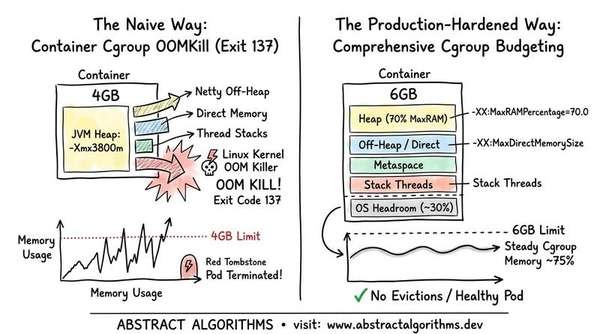
// Debezium captures transaction log (WAL) and guarantees at-least-once Kafka publicationArchitectural comparison of naive unconstrained allocations versus production-hardened mechanical sympathy.
Architectural Decisions & Trade-Offs
- ⚖Ingress Admission: Naive unconstrained buffering causes queue bloat and GC exhaustion. Mitigation: Bounded ingress gate with fast non-blocking shedding.
- ⚖Resource Strategy: Static capacity allocations collapse under brownouts. Mitigation: Dynamic adaptive limits scaling to real-time physical bounds.
- ⚖Outage Impact: Cascading lock convoys and memory saturation. Mitigation: Isolated failure domains keep P99 latency flat and protected.
Alternatives Evaluated
- →Naive Approach: The Secret manifest was applied to staging but omitted from production. When pods launch, Kubelet cannot resolve the environment variables and termina
- →Production-Hardened Pattern: Use GitOps workflows (ArgoCD / Flux) to validate configuration dependencies before rollout, implement Helm/Kustomize schema validation, and mark optio
Operational Hazards & Mitigations
- ⚠Cascading Failure: The Secret manifest was applied to staging but omitted from production. When pods launch, Kubelet cannot resolve the environment variables and terminates the containers immediately, trapping the fleet in exponential CrashLoopBackOff.
- ⚠Breakdown Chain: Scale Surge → Unbounded Contention → Physical Bottleneck → 💥 Outage Cascade
- ⚠Shedding Failure: Without fast rejection at the boundary, queued dead work triggers multi-second GC pauses, CPU thrashing, and cascading 504 Gateway Timeouts.
How does the system enforce physical resource boundaries under sudden downstream latency brownouts?
Extension Implementation Steps
- 1Track real-time latency gradients and inflight concurrency.
- 2Reject excess traffic at the ingress boundary within <0.1ms.
- 3Monitor P99 latency and verify autonomous recovery when downstream pressure subsides.
Follow-Up Trade-Offs
- ⚖Architectural Invariant: "Validate all Secret and ConfigMap dependencies in CI/CD pipeline pre- flight checks before executing pod rolling updates."
- ⚖Physical Resource Boundary: Dynamic admission control ensures worker threads never buffer dead requests during downstream brownouts.
Interactive Assessment & Knowledge Check
Test your understanding of the architecture decisions, data patterns, and trade-offs used in Kubernetes CrashLoopBackOff Triggered by Missing Secret or ConfigMap.
Core Architectural Principles of Apache Spark: AQE, Catalyst Optimizer & Distributed DataFrames
What is the primary benefit of applying Apache Spark: AQE, Catalyst Optimizer & Distributed DataFrames in production systems?