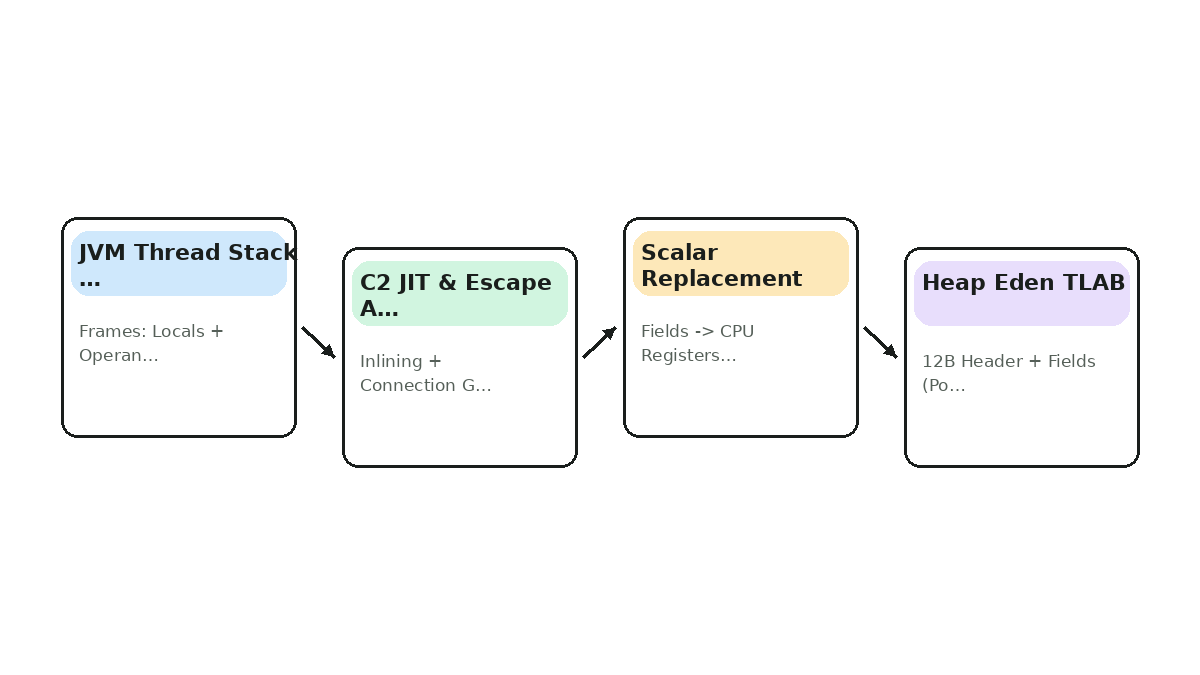
A low-latency Java payment router allocates short-lived wrapper objects (Money, RoutingKey, Optional<Route>) inside a hot path executing 2M requests/sec. On some deployments, allocation rate is near 0 MB/sec and G1GC young pauses are absent; after a small refactor adds a virtual interface call and a 45-bytecode helper method, young-gen allocation jumps to 1.8 GB/sec and p99 latency spikes from 0.4 ms to 14 ms. Diagnose how JVM thread stacks, TLABs, and C2 Escape Analysis / Scalar Replacement interact, and refactor the hot path to guarantee zero-allocation execution.
From patterns to decisions.
A low-latency Java payment router allocates short-lived wrapper objects (Money, RoutingKey, Optional<Route>) inside a hot path executing 2M requests/sec. On some deployments, allocation rate is near 0 MB/sec and G1GC young pauses are absent; after a small refactor adds a virtual interface call and a 45-bytecode helper method, young-gen allocation jumps to 1.8 GB/sec and p99 latency spikes from 0.4 ms to 14 ms. Diagnose how JVM thread stacks, TLABs, and C2 Escape Analysis / Scalar Replacement interact, and refactor the hot path to guarantee zero-allocation execution.
Stack frames store primitive locals.
Stack frames store primitive locals and 4-byte compressed object references; heap objects carry a 12-byte header, fields, and 8-byte alignment padding.
| Choice | What it buys | What it costs |
|---|---|---|
| Trade-off 1 | Compressed OOPs save 4 bytes per header and per reference for heaps under 32 GB. |
List stack frame components
Local Variable Array, Operand Stack, Frame Data (return address, constant pool ref).
Step 2
Compute heap size for Money(long amount, int currencyCode): 12B header + 8B long + 4B int = 24 bytes.
Alternative 1
Compact Object Headers (Project Lilliput / JEP 450 in JDK 24) shrink the header further from 12B to 8B.
Failure Mode 1
Heaps >= 32 GB disable Compressed OOPs, expanding headers to 16B and references to 8B.
// Heap layout with Compressed OOPs (-XX:+UseCompressedOops):
// [8B Mark Word][4B Klass Ptr][8B long minorUnits][4B int currencyCode] = 24 bytes
public record Money(long minorUnits, int currencyCode) {}
Eliminate Optional wrappers, guard debug.
Eliminate Optional wrappers, guard debug logging, and keep hot helpers concise so C2 proves NoEscape and scalar-replaces temporary tuples.
| Choice | What it buys | What it costs |
|---|---|---|
| Trade-off 1 | Returning a small immutable `FeeBreakdown` works with 0B allocation *only* because `computeFee` is private/small and inlined. | |
| Trade-off 2 | Passing `FeeBreakdown` to an unguarded `logRoute` would turn it into `ArgEscape` even if `debug` is false. |
Step 1
Replace Optional<Route> with direct null check or primitive routeId (-1 if missing).
Step 2
Guard logger calls with isDebugEnabled() so temporary objects never become ArgEscape.
Step 3
Keep calculateFee() small (< 35 bytecodes) and final so C2 always inlines it.
Alternative 1
Pack (total, tier) or pass a thread-local mutable scratch object if computeFee grows too large to inline.
Failure Mode 1
Using Optional.of(routeId) boxes Integer and allocates Optional if the call chain exceeds -XX:FreqInlineSize=325.
public final class FastPaymentRouter {
    private static final int NO_ROUTE = -1;

    public long routeAndPrice(long amountMinor, int regionCode, RouteTable table, boolean debug) {
        // Scalar-replaceable local value if inlined; or even better, direct primitive math
        FeeBreakdown breakdown = computeFee(amountMinor, regionCode);
        int routeId = table.lookupFast(regionCode, breakdown.tier);
        if (routeId == NO_ROUTE) {
            return -1L;
        }
        if (debug) {
            logRoute(routeId, breakdown.total);
        }
        return breakdown.total;
    }

    // < 35 bytecodes, final: guaranteed C2 inline -> FeeBreakdown is NoEscape -> Scalar Replaced (0B)
    private FeeBreakdown computeFee(long amountMinor, int regionCode) {
        long fee = (amountMinor * (regionCode == 1 ? 15L : 25L)) / 10_000L;
        int tier = amountMinor > 100_000L ? 2 : 1;
        return new FeeBreakdown(amountMinor + fee, tier);
    }

    private static final class FeeBreakdown {
        final long total;
        final int tier;
        FeeBreakdown(long total, int tier) { this.total = total; this.tier = tier; }
    }

    private void logRoute(int routeId, long total) { /* cold path */ }
}
Prefer Scalar Replacement for small.
Prefer Scalar Replacement for small short-lived tuples, ThreadLocal pooling only for large reusable buffers (byte[]), and off-heap MemorySegment for multi-GB caches.
| Choice | What it buys | What it costs |
|---|---|---|
| Trade-off 1 | Scalar Replacement requires zero cleanup and zero ThreadLocal hash lookups. | |
| Trade-off 2 | Arrays (`new byte[4096]`) are rarely scalar-replaced if indexed dynamically, making pooling worthwhile for large buffers. |
Step 1
Use Scalar Replacement for < 64-byte value objects inside inlinable hot paths.
Step 2
Use ThreadLocal scratch byte[] / ByteBuffer for serialization buffers that cannot be scalar-replaced.
Alternative 1
Java 22+ Foreign Function & Memory API (Arena.ofConfined() / MemorySegment) for deterministic off-heap buffers.
Failure Mode 1
Leaking ThreadLocal buffers in dynamic thread pools or virtual threads.
private static final ThreadLocal<byte[]> SCRATCH_BUF =
    ThreadLocal.withInitial(() -> new byte[4096]);
When a variable merges a.
When a variable merges a newly allocated object with an existing/escaped object at a control-flow Phi node, C2 cannot eliminate the allocation.
| Choice | What it buys | What it costs |
|---|---|---|
| Trade-off 1 | Computing primitives before constructing avoids Phi-node merges and keeps Scalar Replacement reliable. |
Avoid `Money m = flag ? new Money(a)
ZERO; where ZERO` is a static constant.
Step 2
Construct new Money(...) unconditionally or compute primitives before constructing.
Alternative 1
Use GraalVM JIT compiler, which supports Partial Escape Analysis (allocating only on the escaping branch).
Failure Mode 1
HotSpot C2's all-or-nothing Escape Analysis allocates on all paths if any branch escapes.
// BAD: Phi node merges new Money (NoEscape) with static ZERO (GlobalEscape) -> forces heap allocation!
// Money m = valid ? new Money(amt, 1) : Money.ZERO;

// GOOD: Compute primitive first; single allocation site or pure primitive path
long finalAmt = valid ? amt : 0L;
Money m = new Money(finalAmt, 1);
If Escape Analysis proves an.
If Escape Analysis proves an object is NoEscape (visible to only one thread), C2 removes all synchronized monitor acquire/release instructions on it.
| Choice | What it buys | What it costs |
|---|---|---|
| Trade-off 1 | Lock Elision eliminates CAS/fence instructions on legacy synchronized classes when local, but fails if the object escapes. |
Verify `-XX
+EliminateLocks` (enabled by default in HotSpot C2).
Step 2
Recognize that StringBuffer inside a local method has its lock elided, though StringBuilder is still preferred.
Alternative 1
Always use unsynchronized StringBuilder or ArrayList for local state instead of relying on JIT lock elision.
Failure Mode 1
Returning sb or passing it to a non-inlined logger re-enables full monitor locking.
public String formatLocal(int id) {
    // StringBuffer is synchronized, but C2 proves sb is NoEscape and elides all locks
    StringBuffer sb = new StringBuffer(32);
    sb.append("id=").append(id);
    return sb.toString();
}
Theory & Tips and Tricks
Practical heuristics & interview traps
- 01Interview anchor: Objects in Java are conceptually heap-allocated, but HotSpot C2 Escape Analysis decomposes NoEscape objects into CPU registers/stack slots via Scalar Replacement—unless method inlining fails or references escape.
- 02Trade-off tip: Scalar Replacement requires zero cleanup and zero ThreadLocal hash lookups.
- 03Trade-off tip: Arrays (
new byte[4096]) are rarely scalar-replaced if indexed dynamically, making pooling worthwhile for large buffers. - 04Watch out for: HotSpot C2's all-or-nothing Escape Analysis allocates on all paths if any branch escapes.
Java Memory Model Stack Heap Escape Analysis — Normal → Load / Fault → Recovery
Objects in Java are conceptually heap-allocated, but HotSpot C2 Escape Analysis decomposes NoEscape objects into CPU registers/stack slots via Scalar Replacement—unless method inlining fails or references escape.
Putting JVM Memory Model: Stack, Heap & Escape Analysis Together
Objects in Java are conceptually heap-allocated, but HotSpot C2 Escape Analysis decomposes NoEscape objects into CPU registers/stack slots via Scalar Replacement—unless method inlining fails or references escape.
Putting JVM Memory Model: Stack, Heap & Escape Analysis Together
- Replace Optional<Route> with direct null check or primitive routeId (-1 if missing).
- Guard logger calls with isDebugEnabled() so temporary objects never become ArgEscape.
- Keep calculateFee() small (< 35 bytecodes) and final so C2 always inlines it.
Interview Readiness Check
When a variable merges a newly allocated object with an existing/escaped object at a control-flow Phi node, C2 cannot eliminate the allocation.
Walk through bottlenecks, back-of-the-envelope math, and failure recovery.
Make the trade-off yourself.
Practice Check
Test your understanding
When is ACID Transaction Fundamentals the right default for a production team?
JVM Memory Model: Stack, Heap & Escape Analysis
Objects in Java are conceptually heap-allocated, but HotSpot C2 Escape Analysis decomposes NoEscape objects into CPU registers/stack slots via Scalar Replacement—unless method inlining fails or references escape.