HTTP/2 Stream ID Exhaustion (2^31 Cap) Forcing Aggressive Connection Teardowns
Long-lived persistent HTTP/2 TCP connection processing millions of streaming RPCs over several weeks.
Long-lived persistent HTTP/2 TCP connection processing millions of streaming RPCs over several weeks. Failure cascade dynamic: Scale Surge → Unbounded Contention → Physical Bottleneck → 💥 Outage Cascade.
Core Functional Requirements
- ✓Operational Invariant: "Gracefully retire long-lived HTTP/2 connections after a bounded time or request count to avoid stream ID exhaustion."
- ✓Production Hardening: Strict SLA Configure connection age limits (e.g. Envoy 'max_connection_duration: 1h' or 'max_requests_per_connection: 100000'), gracefully rotating long-lived connections before st
- ✓Prevent cascading failure by isolating downstream degradation at the ingress boundary.
Scale & Latency Constraints
- —Incident Scenario Baseline: Long-lived persistent HTTP/2 TCP connection processing millions of streaming RPCs over several weeks.
- —Failure Cascade Path: Scale Surge → Unbounded Contention → Physical Bottleneck → 💥 Outage Cascade
- —Sub-millisecond rejection / shed latency for overloaded requests
Strict SLA Configure connection age limits (e.g. Envoy 'max_connection_duration: 1h' or 'max_requests_per_connection: 100000'), gracefully rotating long-lived connections before stream ID exhaustion triggers abrupt connection drops. Invariant: "Gracefully retire long-lived HTTP/2 connections after a bounded time or request count to avoid stream ID exhaustion."
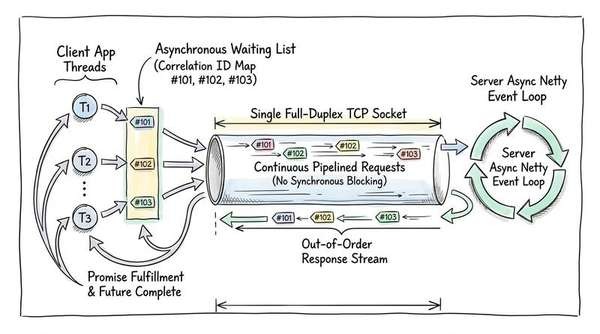
Hardened Implementation Steps
- 1Ingress Boundary Defense: Strict SLA Configure connection age limits (e.g. Envoy 'max_connection_duration: 1h' or 'max_requests_per_connection: 100000'), gracefully rotating lo
- 2Failure Containment: Eliminate unconstrained buffering and propagate physical backpressure.
- 3Invariant Enforcement: Gracefully retire long-lived HTTP/2 connections after a bounded time or request count to avoid stream ID exhaustion.
Production Code Contrast & Implementation
// HARDENED: Non-blocking reactive token bucket rate limiter
Mono filter(ServerWebExchange exchange, GatewayFilterChain chain) {
    return tokenBucketLimiter.tryConsume(clientIp)
        .flatMap(allowed -> allowed ?
            chain.filter(exchange).timeout(Duration.ofMillis(300)) :
            exchange.getResponse().setStatusCode(HttpStatus.TOO_MANY_REQUESTS).setComplete()
        );
}Architectural comparison of naive unconstrained allocations versus production-hardened mechanical sympathy.
Architectural Decisions & Trade-Offs
- ⚖Ingress Admission: Naive unconstrained buffering causes queue bloat and GC exhaustion. Mitigation: Bounded ingress gate with fast non-blocking shedding.
- ⚖Resource Strategy: Static capacity allocations collapse under brownouts. Mitigation: Dynamic adaptive limits scaling to real-time physical bounds.
- ⚖Outage Impact: Cascading lock convoys and memory saturation. Mitigation: Isolated failure domains keep P99 latency flat and protected.
Alternatives Evaluated
- →Naive Approach: HTTP/2 stream identifiers are 31-bit unsigned integers (max 2,147,483,647). Stream IDs are strictly monotonically increasing and cannot be reused on t
- →Production-Hardened Pattern: Strict SLA Configure connection age limits (e.g. Envoy 'max_connection_duration: 1h' or 'max_requests_per_connection: 100000'), gracefully rotating lo
Operational Hazards & Mitigations
- ⚠Cascading Failure: HTTP/2 stream identifiers are 31-bit unsigned integers (max 2,147,483,647). Stream IDs are strictly monotonically increasing and cannot be reused on the same connection. Upon reaching the cap, the server issues GOAWAY, terminating the connection abruptly.
- ⚠Breakdown Chain: Scale Surge → Unbounded Contention → Physical Bottleneck → 💥 Outage Cascade
- ⚠Shedding Failure: Without fast rejection at the boundary, queued dead work triggers multi-second GC pauses, CPU thrashing, and cascading 504 Gateway Timeouts.
How does the system enforce physical resource boundaries under sudden downstream latency brownouts?
Interactive Assessment & Knowledge Check
Test your understanding of the architecture decisions, data patterns, and trade-offs used in HTTP/2 Stream ID Exhaustion (2^31 Cap) Forcing Aggressive Connection Teardowns.
Circuit Breaker State Machine Transitions
In a Circuit Breaker state machine (Closed, Open, Half-Open), what triggers the transition from OPEN back to HALF-OPEN?