HBase Region Server Splitting Freezing Real-Time Ingestion
HBase cluster storing time-series sensor data undergoing high write load.
HBase cluster storing time-series sensor data undergoing high write load. Failure cascade dynamic: Network Partition → Heartbeat Timeout → Dual Primaries → 💥 Split-Brain Drift.
Core Functional Requirements
- ✓Operational Invariant: "Pre-split HBase and Bigtable regions ahead of time; avoid unpredictable dynamic mid-flight region splits."
- ✓Production Hardening: Strict Safety Pre-split HBase tables into a fixed number of regions during table creation based on hash prefixes, and disable automatic runtime splitting ('hbase.hregion.max.filesi
- ✓Prevent cascading failure by isolating downstream degradation at the ingress boundary.
Strict Safety Pre-split HBase tables into a fixed number of regions during table creation based on hash prefixes, and disable automatic runtime splitting ('hbase.hregion.max.filesize' high with scheduled off-peak manual splits). Invariant: "Pre-split HBase and Bigtable regions ahead of time; avoid unpredictable dynamic mid-flight region splits."
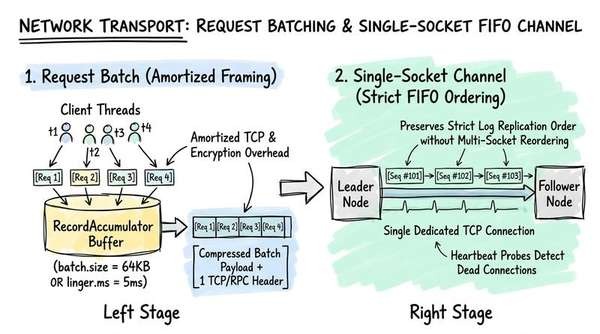
Hardened Implementation Steps
- 1Ingress Boundary Defense: Strict Safety Pre-split HBase tables into a fixed number of regions during table creation based on hash prefixes, and disable automatic runtime splitt
- 2Failure Containment: Eliminate unconstrained buffering and propagate physical backpressure.
- 3Invariant Enforcement: Pre-split HBase and Bigtable regions ahead of time; avoid unpredictable dynamic mid-flight region splits.
Production Code Contrast & Implementation
// HARDENED: Error-handling deserializer with Dead Letter Queue (DLQ)
@KafkaListener(topics = "orders", errorHandler = "dlqErrorHandler")
public void onMessage(ConsumerRecord record) {
    try {
        OrderEvent event = serializer.deserialize(record.value());
        orderService.process(event);
        ack.acknowledge();
    } catch (DeserializationException de) {
        // Route poison pill immediately to DLQ without halting topic partition commit offset
        dlqProducer.send("orders-dead-letter", record.key(), record.value());
        ack.acknowledge();
    }
}Architectural comparison of naive unconstrained allocations versus production-hardened mechanical sympathy.
Architectural Decisions & Trade-Offs
- ⚖Ingress Admission: Naive unconstrained buffering causes queue bloat and GC exhaustion. Mitigation: Bounded ingress gate with fast non-blocking shedding.
- ⚖Resource Strategy: Static capacity allocations collapse under brownouts. Mitigation: Dynamic adaptive limits scaling to real-time physical bounds.
- ⚖Outage Impact: Cascading lock convoys and memory saturation. Mitigation: Isolated failure domains keep P99 latency flat and protected.
Alternatives Evaluated
- →Naive Approach: When an HBase Region reaches the maximum file size threshold (10 GB), the RegionServer initiates a synchronous region split. Ingestion to that key ran
- →Production-Hardened Pattern: Strict Safety Pre-split HBase tables into a fixed number of regions during table creation based on hash prefixes, and disable automatic runtime splitt
Operational Hazards & Mitigations
- ⚠Cascading Failure: When an HBase Region reaches the maximum file size threshold (10 GB), the RegionServer initiates a synchronous region split. Ingestion to that key range is suspended, causing client timeouts and ingestion backpressure.
- ⚠Breakdown Chain: Network Partition → Heartbeat Timeout → Dual Primaries → 💥 Split-Brain Drift
- ⚠Shedding Failure: Without fast rejection at the boundary, queued dead work triggers multi-second GC pauses, CPU thrashing, and cascading 504 Gateway Timeouts.
How does the system enforce physical resource boundaries under sudden downstream latency brownouts?
Interactive Assessment & Knowledge Check
Test your understanding of the architecture decisions, data patterns, and trade-offs used in HBase Region Server Splitting Freezing Real-Time Ingestion.
Core Architectural Principles of B-Trees vs LSM-Trees Storage Engines
What is the primary benefit of applying B-Trees vs LSM-Trees Storage Engines in production systems?