A Python and Java consumer fleet processes 12,000 Avro/JSON billing events/sec across 32 partitions. A misconfigured upstream service publishes 400 malformed records (invalid UTF-8 and missing required invoice_id fields) into partition 7. Every consumer assigned partition 7 throws SerializationException inside poll() before reaching try/catch application code, crashes, triggers a consumer group rebalance, and immediately crashes the next pod that picks up partition 7. Within 4 minutes, all 16 pods are in Kubernetes CrashLoopBackOff and partition 7 lag hits 2.8 million messages. Design a resilient poison-pill isolation, DLQ routing, and replay architecture.
From patterns to decisions.
A Python and Java consumer fleet processes 12,000 Avro/JSON billing events/sec across 32 partitions. A misconfigured upstream service publishes 400 malformed records (invalid UTF-8 and missing required invoice_id fields) into partition 7. Every consumer assigned partition 7 throws SerializationException inside poll() before reaching try/catch application code, crashes, triggers a consumer group rebalance, and immediately crashes the next pod that picks up partition 7. Within 4 minutes, all 16 pods are in Kubernetes CrashLoopBackOff and partition 7 lag hits 2.8 million messages. Design a resilient poison-pill isolation, DLQ routing, and replay architecture.
Implementation & Guardrails (1).
KafkaConsumer invokes the configured key/value Deserializer inside consumer.poll() before returning records to application code, so an unhandled exception kills the thread before your try/catch is reached.
| Choice | What it buys | What it costs |
|---|---|---|
| Trade-off 1 | Raw byte deserialization adds ~5 lines of wrapper code but completely eliminates poll() crash loops. |
Step 1
Inspect stack trace showing Deserializer.deserialize() called inside Fetcher.parseCompletedFetch().
Step 2
Verify offset is never committed, causing the next rebalanced pod to fetch the exact same offset.
Step 3
Confirm partition 7 bounces across all 16 pods.
Alternative 1
Use Spring Kafka's ErrorHandlingDeserializer which delegates and catches SerializationException.
Failure Mode 1
Calling commitSync() after catching the error without producing to DLQ silently drops the event.
# ANTI-PATTERN: value_deserializer runs inside poll() and crashes the consumer
# consumer = KafkaConsumer('billing.events', value_deserializer=lambda m: json.loads(m.decode('utf-8')))

# FIX: consume raw bytes and decode inside try/catch
consumer = Consumer({"bootstrap.servers": "kafka-01:9092", "group.id": "billing-v1", "enable.auto.commit": False})
consumer.subscribe(["billing.events"])
Decode raw bytes inside try/catch.
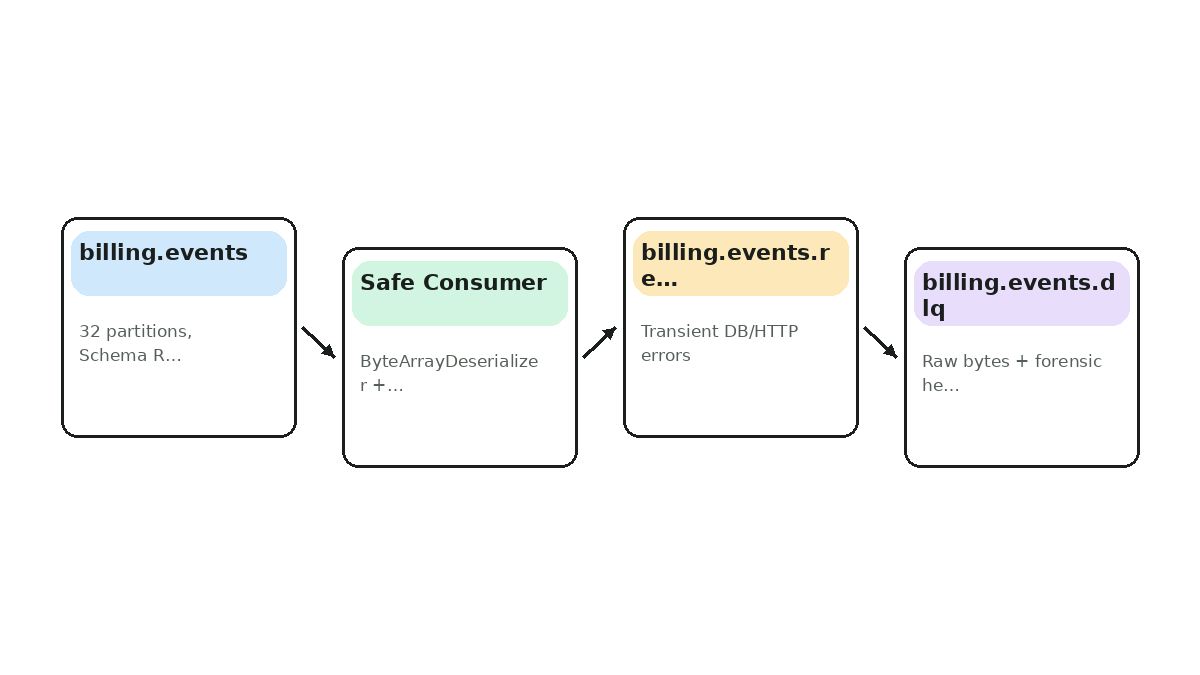
Decode raw bytes inside try/catch, validate schema fields, produce failed payloads synchronously to billing.events.dlq with diagnostic headers, and commit the main offset only after DLQ ack.
| Choice | What it buys | What it costs |
|---|---|---|
| Trade-off 1 | Flushing per DLQ message adds ~2-5ms only on poison pills while keeping normal throughput at 5,000+ msg/s. |
Step 1
Poll raw bytes from billing.events.
Step 2
Decode UTF-8 and JSON, validating invoice_id.
Step 3
On permanent error, produce raw bytes + headers to billing.events.dlq and flush() before commit().
Alternative 1
Use Spring Kafka @RetryableTopic with DltStrategy.FAIL_ON_ERROR.
Failure Mode 1
If flush(timeout=5.0) times out, do not commit the main consumer offset.
import json
from confluent_kafka import Consumer, Producer

def route_to_dlq(dlq_producer: Producer, msg, exc: Exception):
    headers = [
        ("x-orig-topic", msg.topic().encode()),
        ("x-orig-partition", str(msg.partition()).encode()),
        ("x-orig-offset", str(msg.offset()).encode()),
        ("x-exception-class", type(exc).__name__.encode()),
        ("x-exception-msg", str(exc)[:256].encode()),
    ]
    dlq_producer.produce("billing.events.dlq", key=msg.key(), value=msg.value(), headers=headers)
    dlq_producer.flush(timeout=5.0)

def process_message(msg, dlq_producer, db):
    try:
        payload = json.loads(msg.value().decode("utf-8"))
        if "invoice_id" not in payload:
            raise ValueError("Missing required field: invoice_id")
    except (UnicodeDecodeError, json.JSONDecodeError, ValueError) as exc:
        route_to_dlq(dlq_producer, msg, exc)
        return
    db.upsert_invoice(payload)
In-memory retries are only safe.
In-memory retries are only safe for sub-second blips (<2s total); longer transient outages require retry topics to avoid max.poll.interval.ms eviction, while strict ledger ordering may require halting or per-key parking.
| Choice | What it buys | What it costs |
|---|---|---|
| Trade-off 1 | Retry topics preserve main partition throughput at the cost of out-of-order execution for retried keys. |
Step 1
Use 2 fast in-memory retries (100ms, 300ms) for brief network blips.
Step 2
Move longer transient failures (DB failover) to retry-30s topic.
Step 3
Use DLQ for permanent schema/data bugs, or per-key parking if key order is mandatory.
Alternative 1
Consumer.pause() on the partition during a global DB outage so no messages are reordered.
Failure Mode 1
Retrying a permanent ValidationError in retry topics wastes 3 cycles before hitting DLQ.
# Error classification decision
PERMANENT_ERRORS = (UnicodeDecodeError, json.JSONDecodeError, ValueError)
TRANSIENT_ERRORS = (TimeoutError, ConnectionError)
A 100% poison-pill flood turns.
A 100% poison-pill flood turns the DLQ into a mirror of the broken stream and indicates a systemic deployment bug rather than isolated bad records; a DLQ-ratio circuit breaker should pause consumption.
| Choice | What it buys | What it costs |
|---|---|---|
| Trade-off 1 | Pausing protects downstream storage and avoids noisy massive DLQ backfills during bad releases. |
Step 1
Track sliding-window DLQ ratio over 1,000 messages or 30 seconds.
Step 2
If DLQ ratio > 50% (and count > 100), call consumer.pause() and page on-call.
Step 3
Roll back the broken upstream producer and resume.
Alternative 1
Enforce Schema Registry validation on producers so 100% bad deploys fail at produce() time.
Failure Mode 1
Circuit breaker tripping on a small 5-message batch during startup if min-sample threshold is omitted.
if window_total >= 100 and (window_dlq / window_total) > 0.50:
    consumer.pause(consumer.assignment())
    alert_oncall("DLQ ratio > 50% - halting consumption to prevent systemic corruption")
Replay tools must filter by.
Replay tools must filter by original timestamp/exception, patch the payload, increment x-retry-count, and rely on idempotent consumer keys (invoice_id) so already-processed records are not double-billed.
| Choice | What it buys | What it costs |
|---|---|---|
| Trade-off 1 | Republishing to main topic reuses standard monitoring, whereas a dedicated replay topic isolates replay lag. |
Step 1
Read DLQ messages between the incident start/end timestamps.
Step 2
Apply transformation/patch and validate against Schema Registry.
Step 3
Republish to main topic (or a dedicated replay topic) with x-replayed=true header.
Alternative 1
Run a standalone one-off backfill script directly against the billing DB.
Failure Mode 1
Replaying without bounding offsets re-processes months-old DLQ messages.
# Idempotency guard in billing consumer
# INSERT INTO invoices (invoice_id, amount_cents) VALUES (%s, %s) ON CONFLICT (invoice_id) DO NOTHING
Theory & Tips and Tricks
Practical heuristics & interview traps
- 01Interview anchor: Wrap deserializers with ErrorHandlingDeserializer, separate transient vs permanent errors, route poison pills to a Dead-Letter Queue with full offset/exception headers, and enforce producer-side schema validation.
- 02Trade-off tip: Retry topics preserve main partition throughput at the cost of out-of-order execution for retried keys.
- 03Watch out for: Circuit breaker tripping on a small 5-message batch during startup if min-sample threshold is omitted.
Handling Kafka Poison Pill Messages — Normal → Load / Fault → Recovery
Wrap deserializers with ErrorHandlingDeserializer, separate transient vs permanent errors, route poison pills to a Dead-Letter Queue with full offset/exception headers, and enforce producer-side schema validation.
Putting Handling Kafka Poison-Pill Messages & DLQs Together
Wrap deserializers with ErrorHandlingDeserializer, separate transient vs permanent errors, route poison pills to a Dead-Letter Queue with full offset/exception headers, and enforce producer-side schema validation.
Putting Handling Kafka Poison-Pill Messages & DLQs Together
- Poll raw bytes from billing.events.
- Decode UTF-8 and JSON, validating invoice_id.
- On permanent error, produce raw bytes + headers to billing.events.dlq and flush() before commit().
Interview Readiness Check
A 100% poison-pill flood turns the DLQ into a mirror of the broken stream and indicates a systemic deployment bug rather than isolated bad records; a DLQ-ratio circuit breaker should pause consumption.
Walk through bottlenecks, back-of-the-envelope math, and failure recovery.
Make the trade-off yourself.
Practice Check
Test your understanding
When is ACID Transaction Fundamentals the right default for a production team?
Handling Kafka Poison-Pill Messages & DLQs
Wrap deserializers with ErrorHandlingDeserializer, separate transient vs permanent errors, route poison pills to a Dead-Letter Queue with full offset/exception headers, and enforce producer-side schema validation.