gRPC HTTP/2 Subchannel Connection Pinning Bypassing L4 Load Balancers
Microservice fleet communicating with backend gRPC services via a standard Layer 4 (TCP) AWS Network Load Balancer (NLB).
Microservice fleet communicating with backend gRPC services via a standard Layer 4 (TCP) AWS Network Load Balancer (NLB). Failure cascade dynamic: Microburst → 100ms CFS Quota Used in 20ms → Kernel Freeze → 💥 P99 Latency Spike.
Core Functional Requirements
- ✓Operational Invariant: "gRPC HTTP/2 multiplexed streams require Layer 7 request-level load balancing or client-side xDS round-robin."
- ✓Production Hardening: Deploy Layer 7 (L7) application load balancers (Envoy, Istio, or AWS ALB) capable of inspecting individual HTTP/2 streams and balancing RPC requests per-call, or implement gRPC cli
- ✓Prevent cascading failure by isolating downstream degradation at the ingress boundary.
Scale & Latency Constraints
- —Incident Scenario Baseline: Microservice fleet communicating with backend gRPC services via a standard Layer 4 (TCP) AWS Network Load Balancer (NLB).
- —Failure Cascade Path: Microburst → 100ms CFS Quota Used in 20ms → Kernel Freeze → 💥 P99 Latency Spike
- —Sub-millisecond rejection / shed latency for overloaded requests
Deploy Layer 7 (L7) application load balancers (Envoy, Istio, or AWS ALB) capable of inspecting individual HTTP/2 streams and balancing RPC requests per-call, or implement gRPC client-side load balancing via DNS/xDS. Invariant: "gRPC HTTP/2 multiplexed streams require Layer 7 request-level load balancing or client-side xDS round-robin."
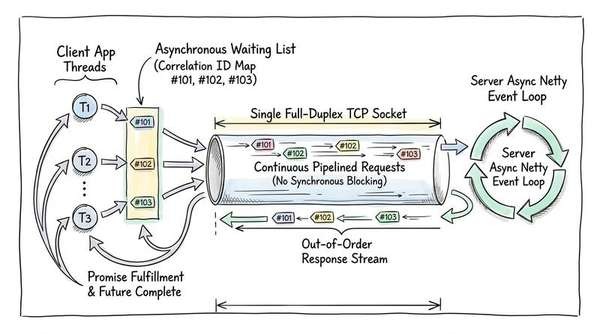
Hardened Implementation Steps
- 1Ingress Boundary Defense: Deploy Layer 7 (L7) application load balancers (Envoy, Istio, or AWS ALB) capable of inspecting individual HTTP/2 streams and balancing RPC requests p
- 2Failure Containment: Eliminate unconstrained buffering and propagate physical backpressure.
- 3Invariant Enforcement: gRPC HTTP/2 multiplexed streams require Layer 7 request-level load balancing or client-side xDS round-robin.
Production Code Contrast & Implementation
// HARDENED: Non-blocking reactive token bucket rate limiter
Mono filter(ServerWebExchange exchange, GatewayFilterChain chain) {
    return tokenBucketLimiter.tryConsume(clientIp)
        .flatMap(allowed -> allowed ?
            chain.filter(exchange).timeout(Duration.ofMillis(300)) :
            exchange.getResponse().setStatusCode(HttpStatus.TOO_MANY_REQUESTS).setComplete()
        );
}Architectural comparison of naive unconstrained allocations versus production-hardened mechanical sympathy.
Architectural Decisions & Trade-Offs
- ⚖Ingress Admission: Naive unconstrained buffering causes queue bloat and GC exhaustion. Mitigation: Bounded ingress gate with fast non-blocking shedding.
- ⚖Resource Strategy: Static capacity allocations collapse under brownouts. Mitigation: Dynamic adaptive limits scaling to real-time physical bounds.
- ⚖Outage Impact: Cascading lock convoys and memory saturation. Mitigation: Isolated failure domains keep P99 latency flat and protected.
Alternatives Evaluated
- →Naive Approach: gRPC multiplexes thousands of RPC calls over a single long-lived HTTP/2 TCP connection. The L4 load balancer routes the initial TCP connection to Pod
- →Production-Hardened Pattern: Deploy Layer 7 (L7) application load balancers (Envoy, Istio, or AWS ALB) capable of inspecting individual HTTP/2 streams and balancing RPC requests p
Operational Hazards & Mitigations
- ⚠Cascading Failure: gRPC multiplexes thousands of RPC calls over a single long-lived HTTP/2 TCP connection. The L4 load balancer routes the initial TCP connection to Pod 1. All subsequent RPCs flow exclusively to Pod 1, leaving Pods 2–10 sitting idle at 0% CPU.
- ⚠Breakdown Chain: Microburst → 100ms CFS Quota Used in 20ms → Kernel Freeze → 💥 P99 Latency Spike
- ⚠Shedding Failure: Without fast rejection at the boundary, queued dead work triggers multi-second GC pauses, CPU thrashing, and cascading 504 Gateway Timeouts.
How does the system enforce physical resource boundaries under sudden downstream latency brownouts?
Interactive Assessment & Knowledge Check
Test your understanding of the architecture decisions, data patterns, and trade-offs used in gRPC HTTP/2 Subchannel Connection Pinning Bypassing L4 Load Balancers.
Circuit Breaker State Machine Transitions
In a Circuit Breaker state machine (Closed, Open, Half-Open), what triggers the transition from OPEN back to HALF-OPEN?