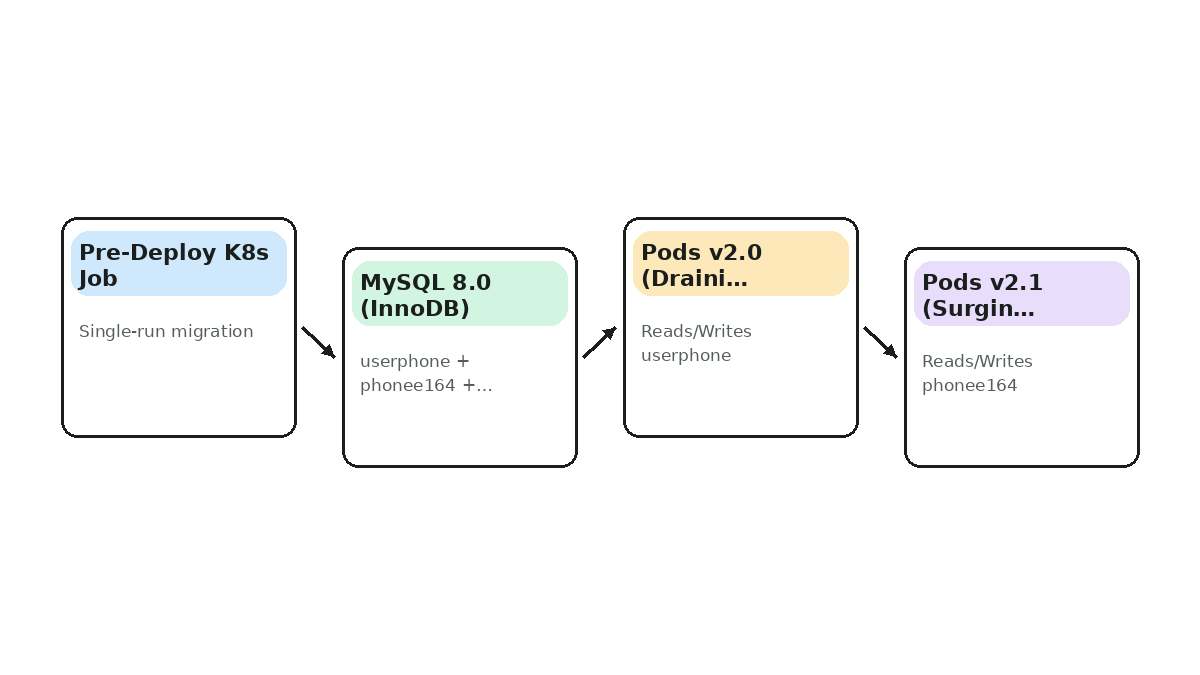
A 40-pod Kubernetes deployment (`maxSurge: 25%`, `maxUnavailable: 0`) running a Python/SQLAlchemy service against MySQL 8.0 executes a rolling update from v2.0 to v2.1. An initContainer on the first v2.1 pod runs `ALTER TABLE customers RENAME COLUMN user_phone TO phone_e164;` on a 25M-row table. Immediately, all 40 existing v2.0 pods fail with `OperationalError: (1054, "Unknown column 'user_phone' in 'field list'")`, halting the readiness-gated rollout and leaving the cluster in a split-brain outage. Design a zero-downtime column rename workflow for rolling deployments on MySQL 8.0.
From patterns to decisions.
A 40-pod Kubernetes deployment (`maxSurge: 25%`, `maxUnavailable: 0`) running a Python/SQLAlchemy service against MySQL 8.0 executes a rolling update from v2.0 to v2.1. An initContainer on the first v2.1 pod runs `ALTER TABLE customers RENAME COLUMN user_phone TO phone_e164;` on a 25M-row table. Immediately, all 40 existing v2.0 pods fail with `OperationalError: (1054, "Unknown column 'user_phone' in 'field list'")`, halting the readiness-gated rollout and leaving the cluster in a split-brain outage. Design a zero-downtime column rename workflow for rolling deployments on MySQL 8.0.
Metadata speed does not solve.
Metadata speed does not solve application-level schema skew: v2.0 pods still issue SQL referencing user_phone, which immediately ceases to exist.
| Choice | What it buys | What it costs |
|---|---|---|
| Trade-off 1 | Zero-downtime rolling updates require N and N-1 schema compatibility |
Explain that `maxSurge
25%, maxUnavailable: 0` guarantees v2.0 and v2.1 overlap.
Step 2
Show how initContainer execution raced and broke all 40 live v2.0 pods.
Step 3
Note that failed readiness probes halt the rolling update mid-flight.
Alternative 1
Take a maintenance window and scale replicas to 0 before renaming (violates zero-downtime constraint)
Failure Mode 1
initContainer migrations running concurrently across multiple surging pods
-- Immediate error on all 40 v2.0 pods:
SELECT id, user_phone FROM customers WHERE id = 123;
-- ERROR 1054 (42S22): Unknown column 'user_phone' in 'field list'
Implementation & Guardrails (2).
Add phone_e164 with ALGORITHM=INSTANT, synchronize both columns via BEFORE INSERT/UPDATE triggers using <=>, backfill in batches, and drop user_phone in v2.2.
| Choice | What it buys | What it costs |
|---|---|---|
| Trade-off 1 | Requires two releases (v2.1 + v2.2) to complete the rename cleanly |
Step 1
Run Expand in a single K8s pre-upgrade Job with lock_wait_timeout = 2.
Step 2
Use <=> in BEFORE UPDATE to detect whether v2.0 or v2.1 changed the value.
Step 3
Backfill 25M rows in 2,000-row batches and add indexes with LOCK=NONE.
Alternative 1
If phone_e164 is only read and never written directly until v2.2, use a MySQL VIRTUAL generated column instead of triggers
Failure Mode 1
Using != instead of <=> in the UPDATE trigger fails when either column transitions from NULL to non-null
SET SESSION lock_wait_timeout = 2;
ALTER TABLE customers ADD COLUMN phone_e164 VARCHAR(20) NULL, ALGORITHM=INSTANT;
-- Backfill in 2k batches, then:
ALTER TABLE customers ADD INDEX idx_phone_e164 (phone_e164), ALGORITHM=INPLACE, LOCK=NONE;
A VIRTUAL generated column avoids.
A VIRTUAL generated column avoids triggers and backfill entirely if v2.1 only reads phone_e164, but cannot be written to directly by INSERT/UPDATE.
| Choice | What it buys | What it costs |
|---|---|---|
| Trade-off 1 | Virtual columns are instant and trigger-free, but force v2.1 to still write to the old column name |
Step 1
Virtual generated columns compute phone_e164 on read with zero storage overhead.
Step 2
However, MySQL rejects INSERT INTO customers (phone_e164) VALUES (...) on generated columns.
Step 3
Therefore, triggers are required when v2.1 must write to phone_e164 while v2.0 still writes to user_phone.
Alternative 1
Use an updatable SQL VIEW (customers_v2) if the application can target a versioned table/view name
Failure Mode 1
Attempting to write to a generated column throws ERROR 3105: The value specified for generated column is not allowed
-- Valid ONLY if v2.1 reads phone_e164 but still writes user_phone:
ALTER TABLE customers
  ADD COLUMN phone_e164 VARCHAR(20) GENERATED ALWAYS AS (user_phone) VIRTUAL;
MySQL's Metadata Lock (MDL) queue.
MySQL's Metadata Lock (MDL) queue gives ALTER TABLE priority over new SELECT/UPDATEs; without lock_wait_timeout, all 3,000 QPS queue behind the analytics query.
| Choice | What it buys | What it costs |
|---|---|---|
| Trade-off 1 | The migration job may need 2–3 automated retries during busy hours, which is far safer than an MDL outage |
Trace the MDL pileup
Analytics SELECT -> ALTER TABLE waits -> all 3,000 QPS OLTP queries block.
Step 2
Set SET SESSION lock_wait_timeout = 2; so the DDL fails fast instead of blocking traffic.
Step 3
Retry the DDL with exponential backoff until the analytics query finishes.
Alternative 1
Use gh-ost or pt-online-schema-change for non-instant schema changes on large tables
Failure Mode 1
Default MySQL lock_wait_timeout is 31,536,000 seconds (1 year), guaranteeing an outage if an ALTER blocks
SET SESSION lock_wait_timeout = 2;
ALTER TABLE customers ADD COLUMN phone_e164 VARCHAR(20) NULL, ALGORITHM=INSTANT;
Execute migrations in a dedicated.
Execute migrations in a dedicated single-pod Kubernetes Job (Helm pre-upgrade hook or ArgoCD PreSync hook) before updating the Deployment.
| Choice | What it buys | What it costs |
|---|---|---|
| Trade-off 1 | Separates migration lifecycle from pod lifecycle, requiring CI/CD hook support |
Step 1
Remove Alembic/Flyway from application initContainers.
Create a Kubernetes `Job` with `completions
1, parallelism: 1, and backoffLimit: 2`.
Step 3
Gate the Deployment rollout on Job completion.
Alternative 1
Use a distributed advisory lock (GET_LOCK in MySQL) if migrations must remain in-app
Failure Mode 1
If ttlSecondsAfterFinished is omitted, old migration Jobs accumulate in the namespace
apiVersion: batch/v1
kind: Job
metadata:
  name: customers-db-migrate-v21
  annotations:
    argocd.argoproj.io/hook: PreSync
spec:
  backoffLimit: 2
  template:
    spec:
      restartPolicy: Never
      containers:
        - name: alembic
          image: payments-api:v2.1
          command: ["alembic", "upgrade", "head"]
Theory & Tips and Tricks
Practical heuristics & interview traps
- 01Interview anchor: Never rename a live column in place during a rolling deploy; use additive columns, generated/triggered sync, or updatable views across two releases.
- 02Trade-off tip: Virtual columns are instant and trigger-free, but force v2.1 to still write to the old column name
- 03Watch out for: Default MySQL
lock_wait_timeoutis 31,536,000 seconds (1 year), guaranteeing an outage if anALTERblocks
Expand Contract Column Renames — Normal → Load / Fault → Recovery
Never rename a live column in place during a rolling deploy; use additive columns, generated/triggered sync, or updatable views across two releases.
Putting Zero-Downtime Column Renames with Expand-and-Contract Together
Never rename a live column in place during a rolling deploy; use additive columns, generated/triggered sync, or updatable views across two releases.
Putting Zero-Downtime Column Renames with Expand-and-Contract Together
- Run Expand in a single K8s pre-upgrade Job with
lock_wait_timeout = 2. - Use
<=>inBEFORE UPDATEto detect whether v2.0 or v2.1 changed the value. - Backfill 25M rows in 2,000-row batches and add indexes with
LOCK=NONE.
Interview Readiness Check
MySQL's Metadata Lock (MDL) queue gives ALTER TABLE priority over new SELECT/UPDATEs; without lock_wait_timeout, all 3,000 QPS queue behind the analytics query.
Walk through bottlenecks, back-of-the-envelope math, and failure recovery.
Make the trade-off yourself.
Practice Check
Test your understanding
When is ACID Transaction Fundamentals the right default for a production team?
Zero-Downtime Column Renames with Expand-and-Contract
Never rename a live column in place during a rolling deploy; use additive columns, generated/triggered sync, or updatable views across two releases.