Event Schema Incompatibility Crushing Downstream Decoders (Protobuf/Avro Evolution)
Upstream microservice renaming a field or changing an integer data type to string in an Avro schema.
Upstream microservice renaming a field or changing an integer data type to string in an Avro schema. Failure cascade dynamic: Scale Surge → Unbounded Contention → Physical Bottleneck → 💥 Outage Cascade.
Core Functional Requirements
- ✓Operational Invariant: "Enforce strict schema evolution compatibility rules (Schema Registry) to prevent uncoordinated deserialization crashes."
- ✓Production Hardening: Deploy a centralized Schema Registry (Confluent Schema Registry / AWS Glue) enforcing BACKWARD_TRANSITIVE compatibility mode, rejecting breaking schema changes at the CI/CD pipelin
- ✓Prevent cascading failure by isolating downstream degradation at the ingress boundary.
Scale & Latency Constraints
- —Incident Scenario Baseline: Upstream microservice renaming a field or changing an integer data type to string in an Avro schema.
- —Failure Cascade Path: Scale Surge → Unbounded Contention → Physical Bottleneck → 💥 Outage Cascade
- —Sub-millisecond rejection / shed latency for overloaded requests
Deploy a centralized Schema Registry (Confluent Schema Registry / AWS Glue) enforcing BACKWARD_TRANSITIVE compatibility mode, rejecting breaking schema changes at the CI/CD pipeline stage. Invariant: "Enforce strict schema evolution compatibility rules (Schema Registry) to prevent uncoordinated deserialization crashes."
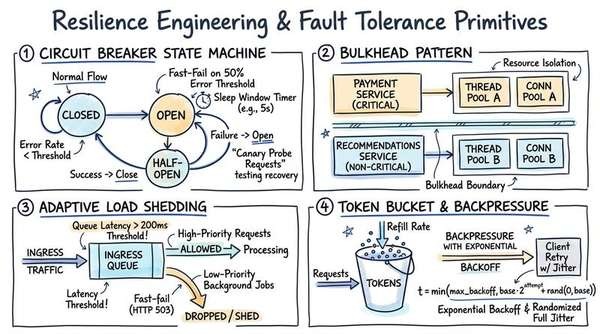
Hardened Implementation Steps
- 1Ingress Boundary Defense: Deploy a centralized Schema Registry (Confluent Schema Registry / AWS Glue) enforcing BACKWARD_TRANSITIVE compatibility mode, rejecting breaking schem
- 2Failure Containment: Eliminate unconstrained buffering and propagate physical backpressure.
- 3Invariant Enforcement: Enforce strict schema evolution compatibility rules (Schema Registry) to prevent uncoordinated deserialization crashes.
Production Code Contrast & Implementation
// HARDENED: Full Jitter exponential backoff with retry budget
public Response callService(Request req) {
    if (!retryBudget.acquireToken()) {
        throw new RetryBudgetExhaustedException("Shedding retries under cluster distress");
    }
    // Full Jitter: Uniform random backoff breaks synchronized wave patterns
    long sleepMs = (long) (Math.random() * Math.min(maxBackoffMs, baseMs * Math.pow(2, attempt)));
    scheduledExecutor.schedule(() -> executeCall(req), sleepMs, TimeUnit.MILLISECONDS);
}Architectural comparison of naive unconstrained allocations versus production-hardened mechanical sympathy.
Architectural Decisions & Trade-Offs
- ⚖Ingress Admission: Naive unconstrained buffering causes queue bloat and GC exhaustion. Mitigation: Bounded ingress gate with fast non-blocking shedding.
- ⚖Resource Strategy: Static capacity allocations collapse under brownouts. Mitigation: Dynamic adaptive limits scaling to real-time physical bounds.
- ⚖Outage Impact: Cascading lock convoys and memory saturation. Mitigation: Isolated failure domains keep P99 latency flat and protected.
Alternatives Evaluated
- →Naive Approach: Producer publishes messages with the new schema. Downstream consumers running older software versions throw AvroTypeException and crash, completely st
- →Production-Hardened Pattern: Deploy a centralized Schema Registry (Confluent Schema Registry / AWS Glue) enforcing BACKWARD_TRANSITIVE compatibility mode, rejecting breaking schem
Operational Hazards & Mitigations
- ⚠Cascading Failure: Producer publishes messages with the new schema. Downstream consumers running older software versions throw AvroTypeException and crash, completely stopping event ingestion.
- ⚠Breakdown Chain: Scale Surge → Unbounded Contention → Physical Bottleneck → 💥 Outage Cascade
- ⚠Shedding Failure: Without fast rejection at the boundary, queued dead work triggers multi-second GC pauses, CPU thrashing, and cascading 504 Gateway Timeouts.
How does the system enforce physical resource boundaries under sudden downstream latency brownouts?
Extension Implementation Steps
- 1Track real-time latency gradients and inflight concurrency.
- 2Reject excess traffic at the ingress boundary within <0.1ms.
- 3Monitor P99 latency and verify autonomous recovery when downstream pressure subsides.
Follow-Up Trade-Offs
- ⚖Architectural Invariant: "Enforce strict schema evolution compatibility rules (Schema Registry) to prevent uncoordinated deserialization crashes."
- ⚖Physical Resource Boundary: Dynamic admission control ensures worker threads never buffer dead requests during downstream brownouts.
Interactive Assessment & Knowledge Check
Test your understanding of the architecture decisions, data patterns, and trade-offs used in Event Schema Incompatibility Crushing Downstream Decoders (Protobuf/Avro Evolution).
Message Ordering in Distributed Log Partitions
How does Apache Kafka guarantee strict sequential ordering for messages delivered to consumers?