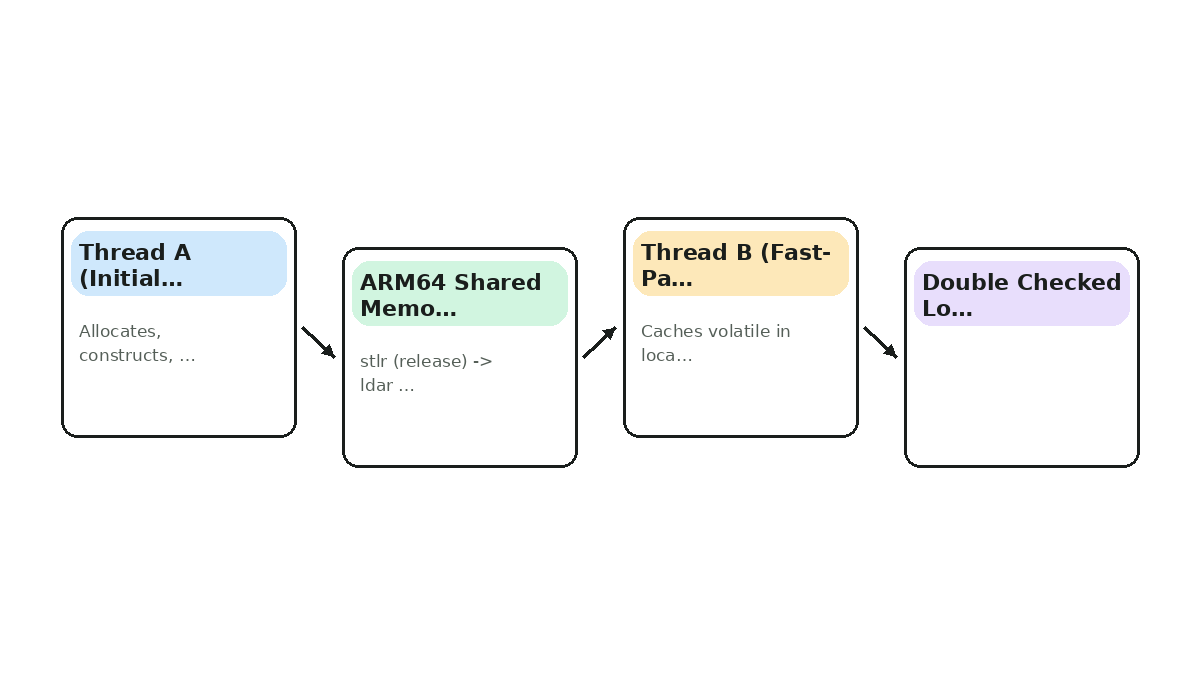
After migrating a high-throughput Java 21 microservice from x86-64 (TSO) to AWS Graviton ARM64 instances, the service experiences rare `NullPointerException`s and zeroed configuration fields during startup bursts. The culprit is a lazy-initialized `RoutingTable` singleton using Double-Checked Locking (DCL) without `volatile`. Explain the exact hardware/JIT reordering failure, fix the DCL implementation with minimal read-path overhead, and compare it against alternative safe lazy-initialization patterns.
From patterns to decisions.
After migrating a high-throughput Java 21 microservice from x86-64 (TSO) to AWS Graviton ARM64 instances, the service experiences rare `NullPointerException`s and zeroed configuration fields during startup bursts. The culprit is a lazy-initialized `RoutingTable` singleton using Double-Checked Locking (DCL) without `volatile`. Explain the exact hardware/JIT reordering failure, fix the DCL implementation with minimal read-path overhead, and compare it against alternative safe lazy-initialization patterns.
x86-64 TSO preserves store-store order.
x86-64 TSO preserves store-store order in hardware, whereas ARM64 allows the pointer store to become visible before constructor field stores.
| Choice | What it buys | What it costs |
|---|---|---|
| Trade-off 1 | Understanding hardware memory models prevents subtle cross-architecture production outages. |
Break `new RoutingTable()` into
(1) allocate, (2) init fields, (3) assign instance.
Step 2
Show how (1) -> (3) -> (2) passes if (instance != null) on Thread B while fields are still null/0.
Alternative 1
Testing under JCStress on ARM64 to surface weak-memory-model races in CI.
Failure Mode 1
Assuming final fields alone save DCL if the instance reference itself is read without a barrier (in practice final has freeze semantics, but non-final fields or JIT optimizations still break).
// BROKEN without volatile:
// Thread A: 1) mem = alloc(); 3) instance = mem; [Thread B reads instance != null!] 2) mem.routes = load();
// Thread B: routingTable.routes.get(k) -> NullPointerException!
Use volatile for happens-before safety.
Use volatile for happens-before safety and a local variable result to perform only one volatile read on the hot path.
| Choice | What it buys | What it costs |
|---|---|---|
| Trade-off 1 | Local variable caching avoids a second `ldar` instruction on every fast-path call. |
Step 1
Declare private static volatile RoutingTable instance;.
Step 2
Read RoutingTable result = instance; once before the outer if.
Step 3
Synchronize on RoutingTable.class only when result == null.
Alternative 1
VarHandle.getAcquire() / setRelease() for even finer control.
Failure Mode 1
Assigning instance = new RoutingTable(...) inside synchronized without volatile still fails.
public final class RoutingTable {
    private static volatile RoutingTable instance;
    private final Map<String, String> routes;

    private RoutingTable(Map<String, String> routes) {
        this.routes = Map.copyOf(routes);
    }

    public static RoutingTable getInstance(Supplier<Map<String, String>> loader) {
        RoutingTable result = instance; // single volatile read
        if (result == null) {
            synchronized (RoutingTable.class) {
                result = instance;
                if (result == null) {
                    result = new RoutingTable(loader.get());
                    instance = result; // volatile store-release
                }
            }
        }
        return result;
    }
}
Use the Holder idiom for.
Use the Holder idiom for parameterless singletons with zero-barrier reads; avoid it when initialization needs runtime arguments or must be retryable on failure.
| Choice | What it buys | What it costs |
|---|---|---|
| Trade-off 1 | Holder has ~0.5ns read cost vs. ~1.5ns for volatile DCL, but lacks retryability and runtime parameters. |
Step 1
JVM class initialization lock guarantees thread-safe lazy loading of Holder.INSTANCE.
Step 2
If new RoutingTable() throws in <clinit>, the class is permanently poisoned with NoClassDefFoundError.
Alternative 1
Java enum singleton (eagerly initialized on first enum reference).
Failure Mode 1
Using Holder for I/O-dependent initialization that can fail transiently during boot.
public final class HolderSingleton {
    private HolderSingleton() {}
    private static class Holder {
        static final HolderSingleton INSTANCE = new HolderSingleton();
    }
    public static HolderSingleton getInstance() {
        return Holder.INSTANCE; // zero volatile read overhead
    }
}
Swap an immutable RoutingTable instance.
Swap an immutable RoutingTable instance atomically via AtomicReference or a volatile field updated by a background scheduler.
| Choice | What it buys | What it costs |
|---|---|---|
| Trade-off 1 | Copy-on-write immutable swap gives lock-free reads at the cost of holding 2x table memory briefly during swap. |
Step 1
Build the new immutable Map.copyOf(...) off the request thread.
Step 2
Atomically publish the new reference via volatile write (instance = nextTable).
Step 3
Readers continue using RoutingTable r = instance; with zero locks.
Alternative 1
StampedLock optimistic reads for fine-grained mutable structures.
Failure Mode 1
Mutating the underlying Map in place instead of swapping an immutable snapshot.
private static volatile RoutingTable current = new RoutingTable(Map.of());

public static void refresh(Map<String, String> nextRoutes) {
    current = new RoutingTable(nextRoutes); // atomic immutable swap
}

public static String lookup(String key) {
    return current.routes.get(key);
}
Use OpenJDK JCStress on ARM64.
Use OpenJDK JCStress on ARM64 runners to exhaustively test interleavings of Actor initialization and Observer reads.
| Choice | What it buys | What it costs |
|---|---|---|
| Trade-off 1 | JCStress catches JMM bugs in seconds that otherwise appear once a month in production. |
Step 1
Annotate a test class with @JCStressTest and @Outcome(id = "0", expect = FORBIDDEN).
Step 2
Run on Graviton/ARM64 CI runners where weak memory ordering actively manifests.
Alternative 1
ThreadSanitizer (TSan) for C++/Go workloads.
Failure Mode 1
Running concurrency stress tests only on x86-64 laptops.
// @JCStressTest
// @Outcome(id = "42", expect = Expect.ACCEPTABLE)
// @Outcome(id = "0", expect = Expect.FORBIDDEN, desc = "Partially constructed object observed!")
// @State public class DclStressTest { ... }
Theory & Tips and Tricks
Practical heuristics & interview traps
- 01Interview anchor: Without
volatile, the JVM and ARM64 CPU can reorder pointer assignment before constructor completion; fix it withvolatile(plus a local variable cache) or the lock-free Initialization-on-Demand Holder idiom. - 02Trade-off tip: Holder has ~0.5ns read cost vs. ~1.5ns for volatile DCL, but lacks retryability and runtime parameters.
- 03Watch out for: Mutating the underlying
Mapin place instead of swapping an immutable snapshot.
Double Checked Locking Memory Barriers — Normal → Load / Fault → Recovery
Without volatile, the JVM and ARM64 CPU can reorder pointer assignment before constructor completion; fix it with volatile (plus a local variable cache) or the lock-free Initialization-on-Demand Holder idiom.
Putting Double-Checked Locking & Memory Barriers Together
Without `volatile`, the JVM and ARM64 CPU can reorder pointer assignment before constructor completion; fix it with `volatile` (plus a local variable cache) or the lock-free Initialization-on-Demand Holder idiom.
Putting Double-Checked Locking & Memory Barriers Together
- Declare
private static volatile RoutingTable instance;. - Read
RoutingTable result = instance;once before the outerif. - Synchronize on
RoutingTable.classonly whenresult == null.
Interview Readiness Check
Swap an immutable RoutingTable instance atomically via AtomicReference or a volatile field updated by a background scheduler.
Walk through bottlenecks, back-of-the-envelope math, and failure recovery.
Make the trade-off yourself.
Practice Check
Test your understanding
When is ACID Transaction Fundamentals the right default for a production team?
Double-Checked Locking & Memory Barriers
Without volatile, the JVM and ARM64 CPU can reorder pointer assignment before constructor completion; fix it with volatile (plus a local variable cache) or the lock-free Initialization-on-Demand Holder idiom.