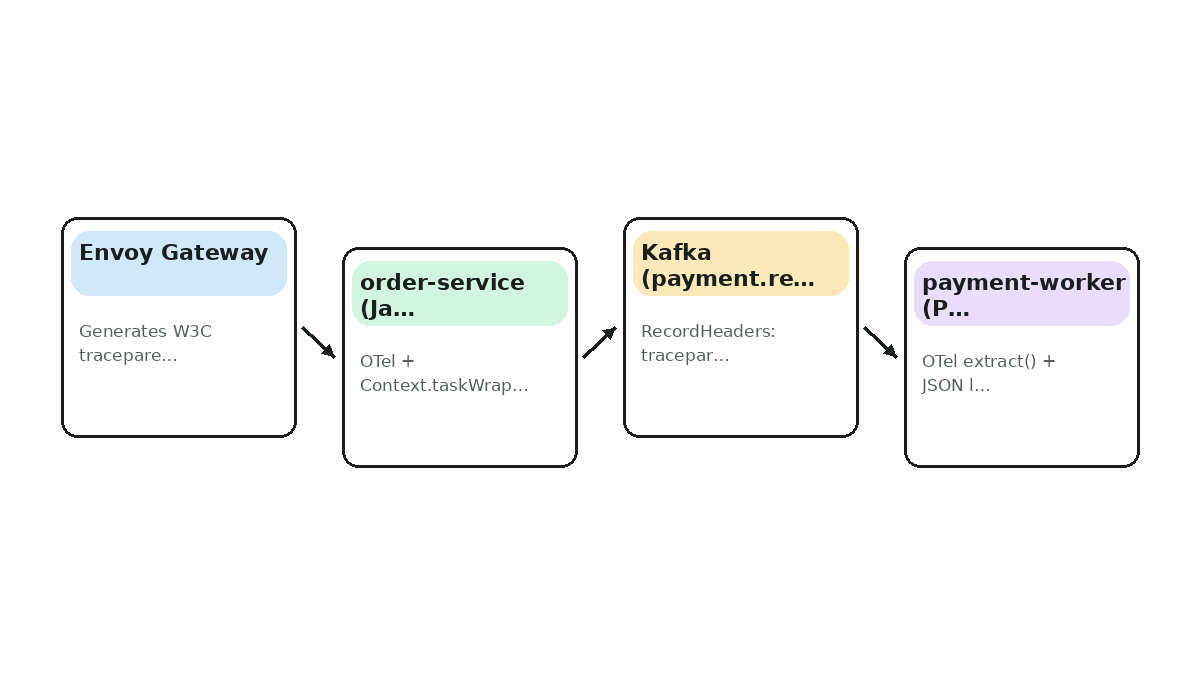
A checkout request traverses 6 hops: API Gateway -> `order-service` -> `inventory-service` (gRPC) -> Kafka `payment.requested` -> `payment-worker` (Python) -> `notification-service`. Currently, each service logs unstructured plain text with only local thread IDs, and async `CompletableFuture`/Kafka hops lose all request context. During a peak-hour incident where 2% of orders are charged twice or stuck in `PENDING`, on-call engineers spend 4+ hours grepping 120 GB/hour of logs across 6 services by approximate timestamps. Design an end-to-end correlation and distributed tracing architecture that links every log line, metric exemplar, gRPC call, async thread, and Kafka message under a single immutable ID with < 1.5% CPU/network overhead.
From patterns to decisions.
A checkout request traverses 6 hops: API Gateway -> `order-service` -> `inventory-service` (gRPC) -> Kafka `payment.requested` -> `payment-worker` (Python) -> `notification-service`. Currently, each service logs unstructured plain text with only local thread IDs, and async `CompletableFuture`/Kafka hops lose all request context. During a peak-hour incident where 2% of orders are charged twice or stuck in `PENDING`, on-call engineers spend 4+ hours grepping 120 GB/hour of logs across 6 services by approximate timestamps. Design an end-to-end correlation and distributed tracing architecture that links every log line, metric exemplar, gRPC call, async thread, and Kafka message under a single immutable ID with < 1.5% CPU/network overhead.
Context breaks at ingress (no.
Context breaks at ingress (no traceparent), Java async executors (ThreadLocal drop), gRPC/Kafka boundaries (no header injection), and unstructured text logs.
| Choice | What it buys | What it costs |
|---|---|---|
| factor | Zero-Code OTel Java Agent vs. Manual SDK; pro: OTel Java Agent auto-instruments Spring, gRPC, CompletableFuture, and Kafka.; con: Adds ~100ms startup time and ~30 MB RAM per JVM. |
Step 1
Check Envoy ingress for traceparent generation.
Step 2
Trace ThreadLocal MDC loss inside CompletableFuture.supplyAsync().
Step 3
Inspect Kafka ProducerRecord headers and Python worker extraction.
Alternative 1
Micrometer Tracing + OpenTelemetry bridge in Spring Boot 3.
name
Stale MDC on Reused Threads; description: Without MDC.clear(), threads log previous requests' trace IDs.; mitigation: Always clear MDC in finally.
# Envoy HttpConnectionManager tracing config
generate_request_id: true
tracing:
  provider:
    name: envoy.tracers.opentelemetry
Propagate W3C traceparent across Envoy.
Propagate W3C traceparent across Envoy, Java Context.taskWrapping, Kafka RecordHeaders, and Python structlog.
| Choice | What it buys | What it costs |
|---|---|---|
| factor | Kafka Headers vs. Payload Field; pro: Keeps business schemas clean and works with Schema Registry.; con: Requires consumers to read `msg.headers()`. |
Step 1
Generate traceparent at Envoy and return X-Trace-Id.
Step 2
Wrap Java executors with Context.taskWrapping / MdcTaskDecorator.
Step 3
Inject traceparent into Kafka RecordHeaders and extract in Python.
Alternative 1
CloudEvents traceparent extension attribute.
name
Header Stripping by Legacy Proxy; description: Older Kafka/HTTP bridges may drop non-ASCII or custom headers.; mitigation: Use standard lowercase ASCII traceparent.
from opentelemetry.propagate import inject, extract
headers = []
inject(carrier := {})
for k, v in carrier.items():
    headers.append((k, v.encode()))
producer.produce('payment.requested', value=payload, headers=headers)
External IDs can be spoofed.
External IDs can be spoofed, non-unique, or injection vectors; mint a fresh 128-bit trace_id at Envoy and index trace_id as a keyword while sampling spans.
| Choice | What it buys | What it costs |
|---|---|---|
| factor | Tail-Based Span Sampling (5% + 100% Errors); pro: Cuts APM trace storage cost by ~90% while keeping 100% of failure waterfalls.; con: Requires stateful OTel Collector tail-sampling tier routing by `trace_id`. |
Step 1
Store client-supplied X-Request-ID in a separate client_request_id attribute.
Step 2
Index trace_id as an exact keyword field in OpenSearch/Loki and drop verbose DEBUG logs in prod.
Alternative 1
Head-based 5% sampling + 100% structured JSON logs.
name
Tail Sampler Split-Brain; description: If spans for the same trace_id hit different OTel Collectors, tail sampling drops half the trace.; mitigation: Use OTel loadbalancing exporter hashing on traceID.
{
  "ts": "2026-11-12T19:30:01.123Z",
  "level": "ERROR",
  "service": "payment-worker",
  "trace_id": "4bf92f3577b34da6a3ce929d0e0e4736",
  "client_request_id": "mobile-ios-9912",
  "msg": "idempotency_conflict"
}
Create a new batch span.
Create a new batch span with Span Links pointing to each message's traceparent rather than making 500 parents.
| Choice | What it buys | What it costs |
|---|---|---|
| factor | Span Links vs. Direct Parent; pro: Preserves exact trace-to-batch causality without breaking UI waterfalls.; con: Not all legacy APM UIs render Span Links prominently. |
Step 1
Extract SpanContext from each of the 500 Kafka messages.
Step 2
Start a batch span with links=[Link(ctx) for ctx in contexts] and process each item with its own child span.
Alternative 1
Process messages individually inside the poll loop with per-message child spans.
name
Giant 10,000-Span Trace; description: Linking a cron batch to 10k traces crashes Jaeger/Tempo UI.; mitigation: Cap links per batch span to 128.
links = [trace.Link(trace.get_current_span(extract(h)).get_span_context()) for h in batch_headers]
with tracer.start_as_current_span("consume_batch", links=links):
    for msg in batch:
        handle_message(msg)
Implementation & Guardrails (5).
Use SQLCommenter (OTel DB instrumentation) to prepend /*traceparent='00-...'*/ to every SQL query.
| Choice | What it buys | What it costs |
|---|---|---|
| factor | SQLCommenter; pro: Links DB locks/slow queries directly to upstream HTTP traces.; con: Can fragment `pg_stat_statements` if `traceparent` isn't stripped by `pg_stat_statements` normalization (PostgreSQL 14+ normalizes comments safely). |
Step 1
Enable otel.instrumentation.jdbc.statement-sanitizer.enabled=true and sqlcommenter.
Step 2
PostgreSQL slow-query logs (log_min_duration_statement = 200ms) automatically capture the trace_id.
Alternative 1
Set SET LOCAL application_name = '<trace_id>' inside transactions.
name
Prepared Statement Cache Miss; description: Dynamic comments in query text can bust app-side prepared statement caches.; mitigation: Only enable SQLCommenter on slow-path or use SET LOCAL.
SELECT * FROM orders WHERE id = $1 /*traceparent='00-4bf92f3577b34da6a3ce929d0e0e4736-00f067aa0ba902b7-01'*/;
Theory & Tips and Tricks
Practical heuristics & interview traps
- 01Interview anchor: Generate and propagate W3C
traceparent+X-Correlation-IDat the edge gateway, bridge them across JavaExecutorService/Reactor threads and Kafka headers, and emit JSON logs indexed bytrace_id. - 02Trade-off tip: factor: Tail-Based Span Sampling (5% + 100% Errors); pro: Cuts APM trace storage cost by ~90% while keeping 100% of failure waterfalls.; con: Requires stateful OTel Collector tail-sampling tier routing by
trace_id. - 03Watch out for: name: Giant 10,000-Span Trace; description: Linking a cron batch to 10k traces crashes Jaeger/Tempo UI.; mitigation: Cap
linksper batch span to 128.
Distributed Tracing Correlation Ids — Normal → Load / Fault → Recovery
Generate and propagate W3C traceparent + X-Correlation-ID at the edge gateway, bridge them across Java ExecutorService/Reactor threads and Kafka headers, and emit JSON logs indexed by traceid.
Putting End-to-End Request Tracing with Correlation IDs Together
Generate and propagate W3C `traceparent` + `X-Correlation-ID` at the edge gateway, bridge them across Java `ExecutorService`/Reactor threads and Kafka headers, and emit JSON logs indexed by `trace_id`.
Putting End-to-End Request Tracing with Correlation IDs Together
- Generate
traceparentat Envoy and returnX-Trace-Id. - Wrap Java executors with
Context.taskWrapping/MdcTaskDecorator. - Inject
traceparentinto KafkaRecordHeadersand extract in Python.
Interview Readiness Check
Create a new batch span with Span Links pointing to each message's traceparent rather than making 500 parents.
Walk through bottlenecks, back-of-the-envelope math, and failure recovery.
Make the trade-off yourself.
Practice Check
Test your understanding
When is ACID Transaction Fundamentals the right default for a production team?
End-to-End Request Tracing with Correlation IDs
Generate and propagate W3C traceparent + X-Correlation-ID at the edge gateway, bridge them across Java ExecutorService/Reactor threads and Kafka headers, and emit JSON logs indexed by trace_id.