Distributed Trace Clock Skew Causing Inverted (Negative) Span Durations
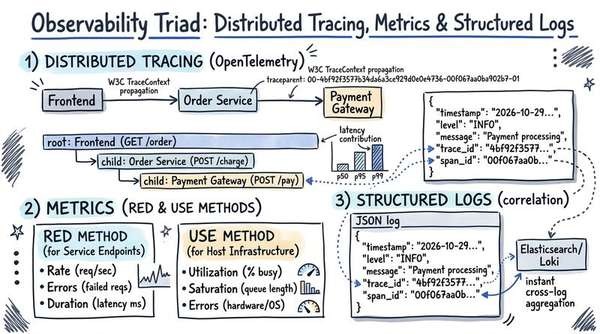
Distributed trace where Service A in Node 1 calls Service B in Node 2.
Distributed trace where Service A in Node 1 calls Service B in Node 2. Failure cascade dynamic: 50k Mut. → Row X-Lock → Spinlock Thrash → Deadlock Graph → 💥 DB Freeze.
Core Functional Requirements
- ✓Operational Invariant: "Synchronize server clocks via PTP/Chrony to eliminate clock skew distortion in distributed tracing waterfalls."
- ✓Production Hardening: Enforce sub-millisecond clock synchronization using Amazon Time Sync Service or Chrony with PTP (Precision Time Protocol), and enable trace clock skew adjustment algorithms in the
- ✓Prevent cascading failure by isolating downstream degradation at the ingress boundary.
Enforce sub-millisecond clock synchronization using Amazon Time Sync Service or Chrony with PTP (Precision Time Protocol), and enable trace clock skew adjustment algorithms in the APM collector . Invariant: "Synchronize server clocks via PTP/Chrony to eliminate clock skew distortion in distributed tracing waterfalls."
Hardened Implementation Steps
- 1Ingress Boundary Defense: Enforce sub-millisecond clock synchronization using Amazon Time Sync Service or Chrony with PTP (Precision Time Protocol), and enable trace clock skew
- 2Failure Containment: Eliminate unconstrained buffering and propagate physical backpressure.
- 3Invariant Enforcement: Synchronize server clocks via PTP/Chrony to eliminate clock skew distortion in distributed tracing waterfalls.
Production Code Contrast & Implementation
// HARDENED: Adaptive tail-based sampling with non-blocking ring buffer drop
Span span = Tracer.startSpan("process");
// Retain 100% of error spans (5xx) and latency outliers (>P95); sample 0.1% of nominal 200s
spanCollector.offerWithDropPolicy(span, DropPolicy.DROP_OLDEST_NOMINAL);Architectural comparison of naive unconstrained allocations versus production-hardened mechanical sympathy.
Architectural Decisions & Trade-Offs
- ⚖Ingress Admission: Naive unconstrained buffering causes queue bloat and GC exhaustion. Mitigation: Bounded ingress gate with fast non-blocking shedding.
- ⚖Resource Strategy: Static capacity allocations collapse under brownouts. Mitigation: Dynamic adaptive limits scaling to real-time physical bounds.
- ⚖Outage Impact: Cascading lock convoys and memory saturation. Mitigation: Isolated failure domains keep P99 latency flat and protected.
Alternatives Evaluated
- →Naive Approach: Node 1 and Node 2 clocks are skewed by 40ms due to un-tuned NTP . Service B records span start time earlier than Service A's span start time. The APM
- →Production-Hardened Pattern: Enforce sub-millisecond clock synchronization using Amazon Time Sync Service or Chrony with PTP (Precision Time Protocol), and enable trace clock skew
Operational Hazards & Mitigations
- ⚠Cascading Failure: Node 1 and Node 2 clocks are skewed by 40ms due to un-tuned NTP . Service B records span start time earlier than Service A's span start time. The APM UI displays broken inverted spans, showing negative latencies and corrupting performance waterfall charts.
- ⚠Breakdown Chain: 50k Mut. → Row X-Lock → Spinlock Thrash → Deadlock Graph → 💥 DB Freeze
- ⚠Shedding Failure: Without fast rejection at the boundary, queued dead work triggers multi-second GC pauses, CPU thrashing, and cascading 504 Gateway Timeouts.
How does the system enforce physical resource boundaries under sudden downstream latency brownouts?
Interactive Assessment & Knowledge Check
Test your understanding of the architecture decisions, data patterns, and trade-offs used in Distributed Trace Clock Skew Causing Inverted (Negative) Span Durations.
Distributed Tracing: fundamentals
When is Distributed Tracing the right default for a production team?