Deadlock Between Bulkhead Semaphore and
Database Connection Pool Microservice with Bulkhead Semaphore = 50 and HikariCP Database Connection Pool = 20.
Database Connection Pool Microservice with Bulkhead Semaphore = 50 and HikariCP Database Connection Pool = 20. Failure cascade dynamic: Burst → Pool Saturated → Queue Bloat (10k) → STW GC → 💥 504 Timeouts.
Core Functional Requirements
- ✓Operational Invariant: "Bulkhead concurrency limits must never exceed downstream connection pool capacities."
- ✓Production Hardening: Always calibrate bulkhead capacity to be strictly LESS than or equal to the underlying shared resource pool (Bulkhead <= Connection Pool), and never hold database connections acros
- ✓Prevent cascading failure by isolating downstream degradation at the ingress boundary.
Scale & Latency Constraints
- —Incident Scenario Baseline: Database Connection Pool Microservice with Bulkhead Semaphore = 50 and HikariCP Database Connection Pool = 20.
- —Failure Cascade Path: Burst → Pool Saturated → Queue Bloat (10k) → STW GC → 💥 504 Timeouts
- —Sub-millisecond rejection / shed latency for overloaded requests
Always calibrate bulkhead capacity to be strictly LESS than or equal to the underlying shared resource pool (Bulkhead <= Connection Pool), and never hold database connections across external RPC calls. Invariant: "Bulkhead concurrency limits must never exceed downstream connection pool capacities."
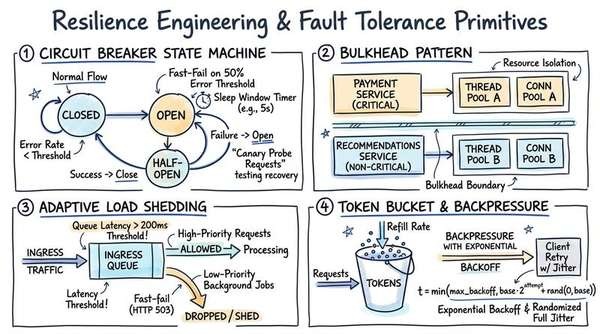
Hardened Implementation Steps
- 1Ingress Boundary Defense: Always calibrate bulkhead capacity to be strictly LESS than or equal to the underlying shared resource pool (Bulkhead <= Connection Pool), and never h
- 2Failure Containment: Eliminate unconstrained buffering and propagate physical backpressure.
- 3Invariant Enforcement: Bulkhead concurrency limits must never exceed downstream connection pool capacities.
Production Code Contrast & Implementation
// HARDENED: Multi-layer memory budgeting reserving 30% OS headroom
// resources:
//   limits: { memory: "4Gi" }
// java -XX:MaxRAMPercentage=70.0 -XX:+UseG1GC -XX:+ExitOnOutOfMemoryError -jar app.jar
// Reserves 1.2GB headroom for Metaspace, Netty direct buffers, thread stacks & OS kernelArchitectural comparison of naive unconstrained allocations versus production-hardened mechanical sympathy.
Architectural Decisions & Trade-Offs
- ⚖Ingress Admission: Naive unconstrained buffering causes queue bloat and GC exhaustion. Mitigation: Bounded ingress gate with fast non-blocking shedding.
- ⚖Resource Strategy: Static capacity allocations collapse under brownouts. Mitigation: Dynamic adaptive limits scaling to real-time physical bounds.
- ⚖Outage Impact: Cascading lock convoys and memory saturation. Mitigation: Isolated failure domains keep P99 latency flat and protected.
Alternatives Evaluated
- →Naive Approach: 50 threads acquire the Bulkhead Semaphore. The first 20 threads acquire database connections. Those 20 threads hit an external REST dependency while h
- →Production-Hardened Pattern: Always calibrate bulkhead capacity to be strictly LESS than or equal to the underlying shared resource pool (Bulkhead <= Connection Pool), and never h
Operational Hazards & Mitigations
- ⚠Cascading Failure: 50 threads acquire the Bulkhead Semaphore. The first 20 threads acquire database connections. Those 20 threads hit an external REST dependency while holding database connections. The remaining 30 threads block on HikariCP . The system deadlocks.
- ⚠Breakdown Chain: Burst → Pool Saturated → Queue Bloat (10k) → STW GC → 💥 504 Timeouts
- ⚠Shedding Failure: Without fast rejection at the boundary, queued dead work triggers multi-second GC pauses, CPU thrashing, and cascading 504 Gateway Timeouts.
How does the system enforce physical resource boundaries under sudden downstream latency brownouts?
Interactive Assessment & Knowledge Check
Test your understanding of the architecture decisions, data patterns, and trade-offs used in Deadlock Between Bulkhead Semaphore and.
Core Architectural Principles of JVM Architecture, Memory Model & Garbage Collection
What is the primary benefit of applying JVM Architecture, Memory Model & Garbage Collection in production systems?