Your checkout platform routes traffic through Envoy Gateway (30s edge timeout) -> OrderService (45s HTTP client timeout) -> InventoryService (60s gRPC timeout, 3 retries with 5s backoff) -> PricingDB (30s query timeout). During a 12% slow-down on PricingDB, Envoy returns 504 Gateway Timeout at 30s, triggering mobile client retries, while OrderService and InventoryService keep threads and DB connections pinned for up to 195s. CPU hits 98% and connection pools exhaust within 90 seconds. Redesign the timeout, deadline propagation, and retry architecture.
From patterns to decisions.
Your checkout platform routes traffic through Envoy Gateway (30s edge timeout) -> OrderService (45s HTTP client timeout) -> InventoryService (60s gRPC timeout, 3 retries with 5s backoff) -> PricingDB (30s query timeout). During a 12% slow-down on PricingDB, Envoy returns 504 Gateway Timeout at 30s, triggering mobile client retries, while OrderService and InventoryService keep threads and DB connections pinned for up to 195s. CPU hits 98% and connection pools exhaust within 90 seconds. Redesign the timeout, deadline propagation, and retry architecture.
Envoy closes the client connection.
Envoy closes the client connection at 30s, but OrderService (45s) and InventoryService (60s x 3 retries) have no knowledge of the edge deadline and keep executing zombie work.
| Choice | What it buys | What it costs |
|---|---|---|
| factor | Per-hop static timeouts vs propagated budgets; pro: Static timeouts are simple to configure in isolation.; con: They inevitably drift out of sync and create timeout inversion. |
Step 1
Map each hop's configured timeout and retry count from edge to database.
Step 2
Calculate worst-case downstream execution time: 3 retries * 60s + backoffs = 195s.
Step 3
Observe that client retries on 504 multiply concurrent pinned threads by 3-5x.
Alternative 1
Fail-fast circuit breakers (complementary, but do not stop in-flight slow requests before the breaker trips).
name
Connection Pool Starvation; description: HikariCP pools fill with abandoned queries, causing even healthy fast endpoints to fail.; mitigation: Propagate deadlines down to JDBC and abort queries when the caller disconnects.
# Broken configuration causing timeout inversion
edge_envoy_timeout: 30s
order_service_http_timeout: 45s       # > edge!
inventory_grpc_timeout: 60s         # > order!
inventory_retries: 3                # up to 180s+ zombie work
Implementation & Guardrails (2).
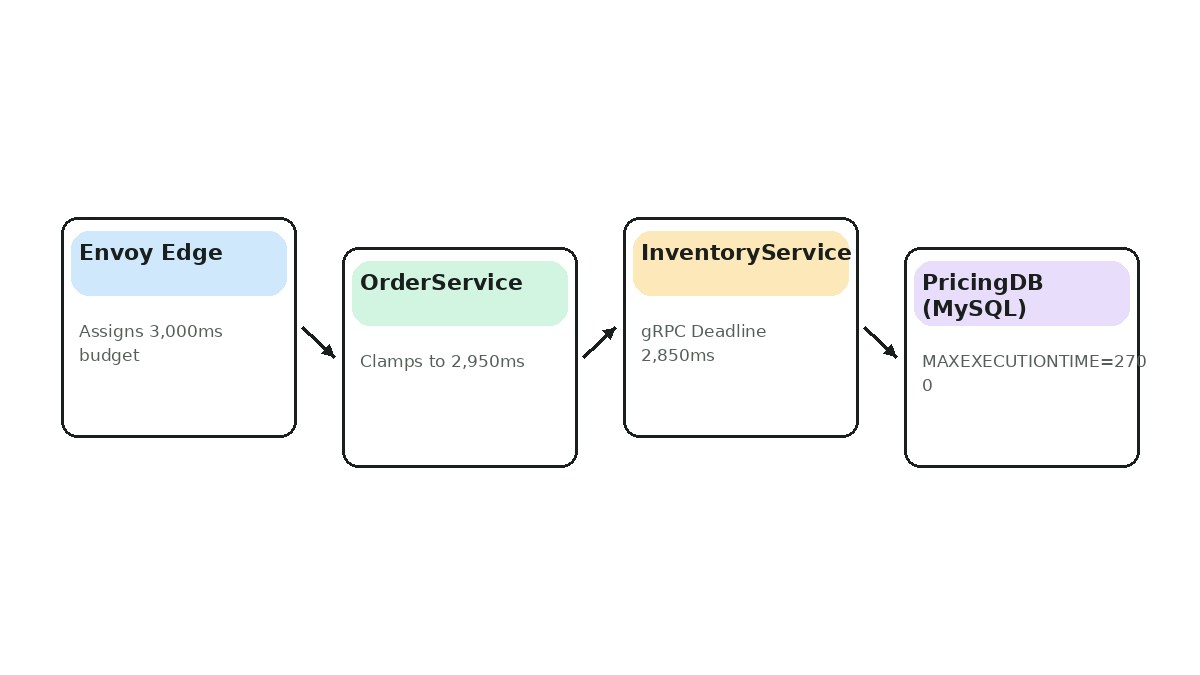
Use nanoTime-based relative deadline tracking in Java and Envoy's native retry_budget + x-envoy-upstream-rq-timeout-ms.
| Choice | What it buys | What it costs |
|---|---|---|
| factor | 50ms Hop Safety Buffer; pro: Ensures downstream errors serialize cleanly back to the caller before the caller's timer fires.; con: Reduces usable leaf budget by 50ms per hop (150ms across 3 hops). |
Step 1
Parse incoming deadline duration into a monotonic System.nanoTime() deadline.
Step 2
Subtract 50ms hop overhead before making downstream gRPC/HTTP calls.
Step 3
Bind remaining ms to MySQL MAX_EXECUTION_TIME and skip retries if budget < 2 * p99.
Alternative 1
OpenTelemetry Baggage for custom HTTP frameworks where gRPC metadata is unavailable.
name
Missing Header Fallback; description: Internal batch callers without headers could get infinite timeouts.; mitigation: Default missing headers to 5,000ms at service ingress.
public final class DeadlineContext {
  private final long deadlineNanos;

  public DeadlineContext(long budgetMs) {
    this.deadlineNanos = System.nanoTime() + TimeUnit.MILLISECONDS.toNanos(budgetMs);
  }

  public long remainingMs() {
    return Math.max(0L, TimeUnit.NANOSECONDS.toMillis(deadlineNanos - System.nanoTime()));
  }

  public <T extends AbstractStub<T>> T attachToGrpcStub(T stub, long hopBufferMs) {
    long budget = remainingMs() - hopBufferMs;
    if (budget <= 0) {
      throw Status.DEADLINE_EXCEEDED.withDescription("Budget exhausted").asRuntimeException();
    }
    return stub.withDeadlineAfter(budget, TimeUnit.MILLISECONDS);
  }
}
Relative durations eliminate NTP clock.
Relative durations eliminate NTP clock skew vulnerabilities across distributed nodes while only costing a small, predictable hop-overhead subtraction.
| Choice | What it buys | What it costs |
|---|---|---|
| factor | Relative Duration vs Epoch Timestamp; pro: Zero dependency on synchronized wall clocks.; con: Does not account for variable network queuing delay unless a small buffer is subtracted. |
Step 1
Compare 150ms NTP skew against a 300ms remaining budget: absolute timestamps cause false rejections.
Step 2
Show how relative durations only depend on local monotonic clocks (System.nanoTime()).
Alternative 1
Synchronized TrueTime / AWS Time Sync Service (microsecond accuracy, but unavailable across hybrid/client networks).
name
Unbounded Retry Storms; description: Without retry_budget, per-request retries still double traffic during brownouts.; mitigation: Enforce 20% global retry budget in Envoy.
# Envoy Route Policy with Retry Budget
route:
  cluster: order_service
  timeout: 3.0s
  retry_policy:
    retry_on: 5xx,reset,connect-failure
    num_retries: 1
    per_try_timeout: 1.2s
    retry_budget:
      budget_percent: 20.0
      min_retry_concurrency: 10
Implementation & Guardrails (4).
Application-layer thread interruption does not automatically kill an in-flight MySQL query; you must bind the deadline to the SQL driver and DB engine.
| Choice | What it buys | What it costs |
|---|---|---|
| factor | Driver Statement.cancel() vs MAX_EXECUTION_TIME; pro: MAX_EXECUTION_TIME runs inside the MySQL server even if the client network drops.; con: MAX_EXECUTION_TIME applies only to read-only SELECTs, not DML. |
Step 1
Set JDBC Statement.setQueryTimeout() from the remaining deadline.
Step 2
Inject MySQL /+ MAX_EXECUTION_TIME(ms) / hint for sub-second precision.
Step 3
Listen to gRPC Context.current().addListener() to call Statement.cancel() immediately on client disconnect.
Alternative 1
ProxySQL query timeout rules at the database proxy tier.
name
Orphaned DML Locks; description: Long UPDATE/DELETE statements ignore MAX_EXECUTION_TIME.; mitigation: Use Statement.cancel() via gRPC cancellation listener + innodb_lock_wait_timeout=5.
Context.current().addListener(ctx -> {
  try { preparedStatement.cancel(); } catch (SQLException ignored) {}
}, cancelExecutor);
Inject synthetic latency faults in.
Inject synthetic latency faults in staging/canary using Envoy fault injection and assert that leaf SQL queries abort within 100ms of the edge deadline.
| Choice | What it buys | What it costs |
|---|---|---|
| factor | Canary Chaos Injection vs Synthetic Load Tests; pro: Tests real production Envoy + HikariCP + MySQL behavior.; con: Must be scoped strictly to dark-launch or synthetic test headers (x-chaos-test: true). |
Step 1
Enable Envoy HTTP fault injection (5s fixed delay on 1% of canary PricingDB calls).
Verify Prometheus metrics
grpc_server_handled_total{grpc_code='DeadlineExceeded'} and zero HikariCP pool saturation.
Step 3
Alert on retry_budget_exhausted_total spikes.
Alternative 1
Automated CI integration test using Toxiproxy to inject 5s TCP latency.
name
Leaking Chaos Faults to Real Users; description: Unscoped fault percentage impacts live checkout conversion.; mitigation: Gate fault injection on a dedicated header match (x-synthetic-probe: true).
# Envoy Fault Injection for Chaos Testing
typed_per_filter_config:
  envoy.filters.http.fault:
    delay:
      fixed_delay: 5s
      percentage: { numerator: 1, denominator: HUNDRED }
Theory & Tips and Tricks
Practical heuristics & interview traps
- 01Interview anchor: Downstream timeouts must never exceed the remaining upstream budget; without deadline propagation, edge 504s trigger silent thread-pool exhaustion across backend hops.
- 02Trade-off tip: factor: Relative Duration vs Epoch Timestamp; pro: Zero dependency on synchronized wall clocks.; con: Does not account for variable network queuing delay unless a small buffer is subtracted.
- 03Watch out for: name: Orphaned DML Locks; description: Long UPDATE/DELETE statements ignore MAX_EXECUTION_TIME.; mitigation: Use Statement.cancel() via gRPC cancellation listener + innodb_lock_wait_timeout=5.
Deadline Propagation Timeout Budgets — Normal → Load / Fault → Recovery
Downstream timeouts must never exceed the remaining upstream budget; without deadline propagation, edge 504s trigger silent thread-pool exhaustion across backend hops.
Putting Deadline Propagation & Request Timeout Budgets Together
Downstream timeouts must never exceed the remaining upstream budget; without deadline propagation, edge 504s trigger silent thread-pool exhaustion across backend hops.
Putting Deadline Propagation & Request Timeout Budgets Together
- Parse incoming deadline duration into a monotonic System.nanoTime() deadline.
- Subtract 50ms hop overhead before making downstream gRPC/HTTP calls.
- Bind remaining ms to MySQL MAX_EXECUTION_TIME and skip retries if budget < 2 * p99.
Interview Readiness Check
Application-layer thread interruption does not automatically kill an in-flight MySQL query; you must bind the deadline to the SQL driver and DB engine.
Walk through bottlenecks, back-of-the-envelope math, and failure recovery.
Make the trade-off yourself.
Practice Check
Test your understanding
When is ACID Transaction Fundamentals the right default for a production team?
Deadline Propagation & Request Timeout Budgets
Downstream timeouts must never exceed the remaining upstream budget; without deadline propagation, edge 504s trigger silent thread-pool exhaustion across backend hops.