CPU Cache-Line False Sharing in Concurrent Ring Buffers & Counters
LMAX Disruptor-style ring buffer tracking sequence cursors across multiple producer and consumer threads.
LMAX Disruptor-style ring buffer tracking sequence cursors across multiple producer and consumer threads. Failure cascade dynamic: 100k QPS → TTL Expiration → Cache Miss Herd → Origin Slam → 💥 DB Meltdown.
Core Functional Requirements
- ✓Operational Invariant: "High-write concurrent variables shared across CPU cores must be padded to 64-byte boundaries to prevent cache-line false sharing."
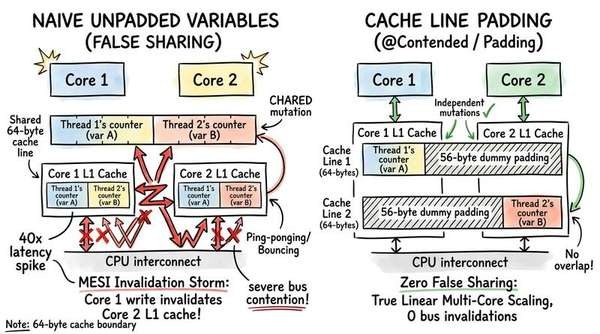
- ✓Production Hardening: Apply cache-line padding (adding 56 bytes of unused long dummy variables or using @jdk.internal.vm.annotation.Contended) to ensure independent variables occupy distinct 64-byte cac
- ✓Prevent cascading failure by isolating downstream degradation at the ingress boundary.
Scale & Latency Constraints
- —Incident Scenario Baseline: LMAX Disruptor-style ring buffer tracking sequence cursors across multiple producer and consumer threads.
- —Failure Cascade Path: 100k QPS → TTL Expiration → Cache Miss Herd → Origin Slam → 💥 DB Meltdown
- —Sub-millisecond rejection / shed latency for overloaded requests
Apply cache-line padding (adding 56 bytes of unused long dummy variables or using @jdk.internal.vm.annotation.Contended) to ensure independent variables occupy distinct 64-byte cache lines. Invariant: "High-write concurrent variables shared across CPU cores must be padded to 64-byte boundaries to prevent cache-line false sharing."
Hardened Implementation Steps
- 1Ingress Boundary Defense: Apply cache-line padding (adding 56 bytes of unused long dummy variables or using @jdk.internal.vm.annotation.Contended) to ensure independent variabl
- 2Failure Containment: Eliminate unconstrained buffering and propagate physical backpressure.
- 3Invariant Enforcement: High-write concurrent variables shared across CPU cores must be padded to 64-byte boundaries to prevent cache-line false sharing.
Production Code Contrast & Implementation
// HARDENED: Adaptive concurrency limit & non-blocking ingress admission
AdaptiveLimiter limiter = new VegasLimiter(minRtt);
if (!limiter.tryAcquire()) {
    // Fast non-blocking load shedding in <0.1ms; protect worker threads
    return HttpResponse.status(HttpStatus.TOO_MANY_REQUESTS);
}
// Vegas limit automatically shrinks window on RTT gradient inflation, keeping P99 flatArchitectural comparison of naive unconstrained allocations versus production-hardened mechanical sympathy.
Architectural Decisions & Trade-Offs
- ⚖Ingress Admission: Naive unconstrained buffering causes queue bloat and GC exhaustion. Mitigation: Bounded ingress gate with fast non-blocking shedding.
- ⚖Resource Strategy: Static capacity allocations collapse under brownouts. Mitigation: Dynamic adaptive limits scaling to real-time physical bounds.
- ⚖Outage Impact: Cascading lock convoys and memory saturation. Mitigation: Isolated failure domains keep P99 latency flat and protected.
Alternatives Evaluated
- →Naive Approach: Independent volatile cursor variables for producer and consumer are placed adjacent in memory on the same 64-byte L1 cache line. Whenever core 1 updat
- →Production-Hardened Pattern: Apply cache-line padding (adding 56 bytes of unused long dummy variables or using @jdk.internal.vm.annotation.Contended) to ensure independent variabl
Operational Hazards & Mitigations
- ⚠Cascading Failure: Independent volatile cursor variables for producer and consumer are placed adjacent in memory on the same 64-byte L1 cache line. Whenever core 1 updates its cursor , it invalidates core 2's cache line, causing massive memory bus stalls.
- ⚠Breakdown Chain: 100k QPS → TTL Expiration → Cache Miss Herd → Origin Slam → 💥 DB Meltdown
- ⚠Shedding Failure: Without fast rejection at the boundary, queued dead work triggers multi-second GC pauses, CPU thrashing, and cascading 504 Gateway Timeouts.
How does the system enforce physical resource boundaries under sudden downstream latency brownouts?
Extension Implementation Steps
- 1Track real-time latency gradients and inflight concurrency.
- 2Reject excess traffic at the ingress boundary within <0.1ms.
- 3Monitor P99 latency and verify autonomous recovery when downstream pressure subsides.
Follow-Up Trade-Offs
- ⚖Architectural Invariant: "High-write concurrent variables shared across CPU cores must be padded to 64-byte boundaries to prevent cache-line false sharing."
- ⚖Physical Resource Boundary: Dynamic admission control ensures worker threads never buffer dead requests during downstream brownouts.
Interactive Assessment & Knowledge Check
Test your understanding of the architecture decisions, data patterns, and trade-offs used in CPU Cache-Line False Sharing in Concurrent Ring Buffers & Counters.
Core Architectural Principles of JVM Architecture, Memory Model & Garbage Collection
What is the primary benefit of applying JVM Architecture, Memory Model & Garbage Collection in production systems?