Consensus Log Compaction (Snapshotting) Causing
Node Latency Freezes Raft-based key-value store appending 50,000 state machine mutations per second.
Node Latency Freezes Raft-based key-value store appending 50,000 state machine mutations per second. Failure cascade dynamic: Burst → Pool Saturated → Queue Bloat (10k) → STW GC → 💥 504 Timeouts.
Core Functional Requirements
- ✓Operational Invariant: "Consensus log snapshotting and compaction must execute asynchronously off the critical heartbeat and replication path."
- ✓Production Hardening: Perform snapshotting asynchronously using copy-on- write OS fork() mechanics (or immutable LSM-tree state memtable flushes), allowing the consensus engine to continue processing in
- ✓Prevent cascading failure by isolating downstream degradation at the ingress boundary.
Scale & Latency Constraints
- —Incident Scenario Baseline: Node Latency Freezes Raft-based key-value store appending 50,000 state machine mutations per second.
- —Failure Cascade Path: Burst → Pool Saturated → Queue Bloat (10k) → STW GC → 💥 504 Timeouts
- —Sub-millisecond rejection / shed latency for overloaded requests
Perform snapshotting asynchronously using copy-on- write OS fork() mechanics (or immutable LSM-tree state memtable flushes), allowing the consensus engine to continue processing ingress without interruption. Invariant: "Consensus log snapshotting and compaction must execute asynchronously off the critical heartbeat and replication path."
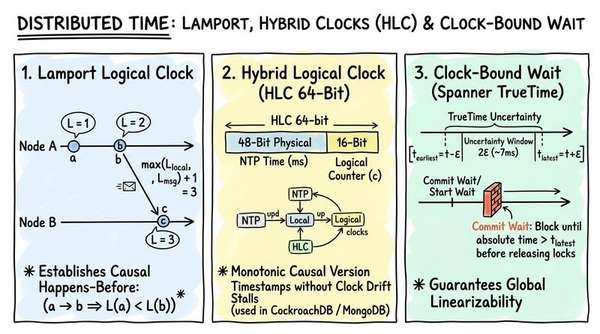
Hardened Implementation Steps
- 1Ingress Boundary Defense: Perform snapshotting asynchronously using copy-on- write OS fork() mechanics (or immutable LSM-tree state memtable flushes), allowing the consensus en
- 2Failure Containment: Eliminate unconstrained buffering and propagate physical backpressure.
- 3Invariant Enforcement: Consensus log snapshotting and compaction must execute asynchronously off the critical heartbeat and replication path.
Production Code Contrast & Implementation
// HARDENED: Monotonic generation clock fencing token verification
public boolean writeData(String key, byte[] val, long fencingToken) {
    // Storage engine validates strictly monotonic fencing token before applying mutation
    if (storageEngine.validateAndAdvanceToken(fencingToken)) {
        return storageEngine.write(key, val);
    }
    throw new StaleFencingTokenException("Rejected mutation from superseded leader");
}Architectural comparison of naive unconstrained allocations versus production-hardened mechanical sympathy.
Architectural Decisions & Trade-Offs
- ⚖Ingress Admission: Naive unconstrained buffering causes queue bloat and GC exhaustion. Mitigation: Bounded ingress gate with fast non-blocking shedding.
- ⚖Resource Strategy: Static capacity allocations collapse under brownouts. Mitigation: Dynamic adaptive limits scaling to real-time physical bounds.
- ⚖Outage Impact: Cascading lock convoys and memory saturation. Mitigation: Isolated failure domains keep P99 latency flat and protected.
Alternatives Evaluated
- →Naive Approach: When the write-ahead log reaches 100,000 entries, the node triggers synchronous disk snapshotting on the main state machine thread. Writing the 5 GB s
- →Production-Hardened Pattern: Perform snapshotting asynchronously using copy-on- write OS fork() mechanics (or immutable LSM-tree state memtable flushes), allowing the consensus en
Operational Hazards & Mitigations
- ⚠Cascading Failure: When the write-ahead log reaches 100,000 entries, the node triggers synchronous disk snapshotting on the main state machine thread. Writing the 5 GB snapshot freezes consensus heartbeat handling for 4 seconds, causing followers to initiate an election.
- ⚠Breakdown Chain: Burst → Pool Saturated → Queue Bloat (10k) → STW GC → 💥 504 Timeouts
- ⚠Shedding Failure: Without fast rejection at the boundary, queued dead work triggers multi-second GC pauses, CPU thrashing, and cascading 504 Gateway Timeouts.
How does the system enforce physical resource boundaries under sudden downstream latency brownouts?
Interactive Assessment & Knowledge Check
Test your understanding of the architecture decisions, data patterns, and trade-offs used in Consensus Log Compaction (Snapshotting) Causing.
Core Architectural Principles of Distributed Locking & Redlock Algorithm
What is the primary benefit of applying Distributed Locking & Redlock Algorithm in production systems?