A checkout BFF (`checkout-bff`, 200 Tomcat worker threads, single shared Apache `PoolingHttpClientConnectionManager` with `maxTotal=200`) handles 1,200 req/s. Each `/checkout/summary` request fans out in parallel to three downstream services: `InventoryService` (p99=25 ms, critical), `PricingService` (p99=40 ms, critical), and `RecommendationService` (p99=80 ms, non-critical). During a DB lock storm in `RecommendationService`, its response time spikes to 10 seconds (matching the shared HttpClient socket timeout). Within 4 seconds, all 200 shared HTTP connections and Tomcat threads block waiting on `RecommendationService`. Requests to `InventoryService` and `PricingService` fail with connection-pool timeouts (`503/504`), causing a 100% checkout outage. Design a bulkhead isolation, capacity-partitioning, and fallback architecture.
From patterns to decisions.
A checkout BFF (`checkout-bff`, 200 Tomcat worker threads, single shared Apache `PoolingHttpClientConnectionManager` with `maxTotal=200`) handles 1,200 req/s. Each `/checkout/summary` request fans out in parallel to three downstream services: `InventoryService` (p99=25 ms, critical), `PricingService` (p99=40 ms, critical), and `RecommendationService` (p99=80 ms, non-critical). During a DB lock storm in `RecommendationService`, its response time spikes to 10 seconds (matching the shared HttpClient socket timeout). Within 4 seconds, all 200 shared HTTP connections and Tomcat threads block waiting on `RecommendationService`. Requests to `InventoryService` and `PricingService` fail with connection-pool timeouts (`503/504`), causing a 100% checkout outage. Design a bulkhead isolation, capacity-partitioning, and fallback architecture.
All three dependencies shared a.
All three dependencies shared a single 200-thread Tomcat pool and a single 200-connection HttpClient pool, allowing 10-second hangs in one service to consume 100% of shared capacity.
| Choice | What it buys | What it costs |
|---|---|---|
| Trade-off 1 | Shared pools maximize utilization under normal conditions, but provide zero fault isolation. |
Compute saturation time
60 req/s per pod * 10s hang = 600 threads needed, exhausting the 200-slot pool in ~3.3s.
Step 2
Note that even if Tomcat threads didn't exhaust, the shared PoolingHttpClientConnectionManager(maxTotal=200) would block Inventory and Pricing waiting for a free socket.
Alternative 1
Non-blocking reactive WebClient + semaphore bulkheads if migrating off blocking Tomcat.
Failure Mode 1
Forgetting to isolate the HTTP connection pool when adding thread-pool bulkheads.
// ANTI-PATTERN: shared pool + no explicit executor
CompletableFuture<Reco> reco = CompletableFuture.supplyAsync(() -> sharedHttpClient.get("/reco"));
// Uses ForkJoinPool.commonPool() AND sharedHttpClient!
Implementation & Guardrails (2).
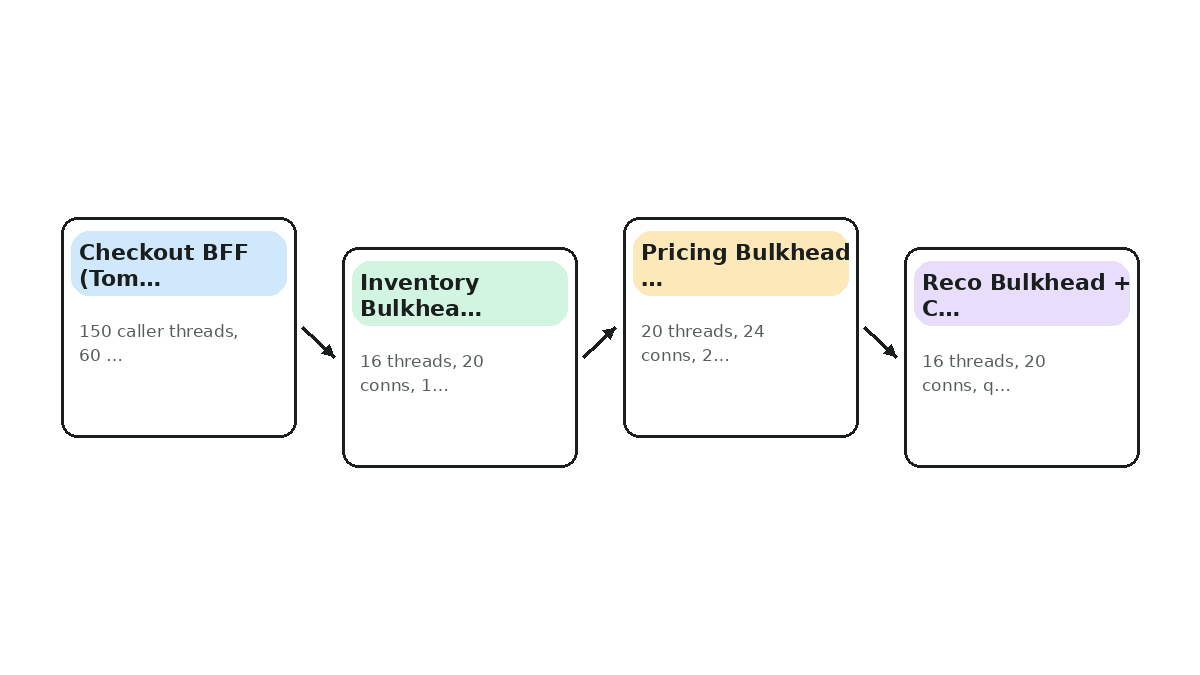
Configure separate thread-pool-bulkhead and circuitbreaker instances per service, backed by dedicated HttpClient pools and a fallback returning empty/cached recommendations.
| Choice | What it buys | What it costs |
|---|---|---|
| Trade-off 1 | Dedicated threads per pool add ~1 MB stack memory per thread (52 MB total), which is negligible for 2–4 GB JVM pods. |
Step 1
Define resilience4j.thread-pool-bulkhead for inventory (16), pricing (20), and reco (16, queue=4).
Step 2
Configure resilience4j.timelimiter (250ms for reco) and circuitbreaker (50% failure/slow-call rate).
Step 3
Annotate or wrap the recommendation call with a fallback returning cached/empty list.
Alternative 1
Use Java 21 Virtual Threads + Semaphore bulkhead to avoid OS thread stack overhead while keeping blocking code.
Failure Mode 1
If recoHttpClient does not set socketTimeout=250ms, threads inside recoBulkhead stay blocked for 10s even after CompletableFuture times out.
import io.github.resilience4j.bulkhead.ThreadPoolBulkhead;
import io.github.resilience4j.bulkhead.ThreadPoolBulkheadConfig;
import io.github.resilience4j.circuitbreaker.CircuitBreaker;
import java.time.Duration;
import java.util.Collections;
import java.util.List;
import java.util.concurrent.CompletableFuture;

public class CheckoutAggregator {
    private final ThreadPoolBulkhead recoBulkhead = ThreadPoolBulkhead.of("reco", ThreadPoolBulkheadConfig.custom()
        .coreThreadPoolSize(8).maxThreadPoolSize(16).queueCapacity(4)
        .keepAliveDuration(Duration.ofSeconds(30)).build());
    private final CircuitBreaker recoBreaker = CircuitBreaker.ofDefaults("reco");

    public CompletableFuture<List<String>> fetchRecommendations(String userId) {
        return recoBulkhead.executeSupplier(
            CircuitBreaker.decorateSupplier(recoBreaker, () -> recoHttpClient.getRecos(userId))
        ).toCompletableFuture().exceptionally(ex -> Collections.emptyList());
    }
}
Implementation & Guardrails (3).
Use SemaphoreBulkhead for non-blocking reactive/async calls (or Java 21 virtual threads) where thread context-switching is pure overhead; use ThreadPoolBulkhead when calling blocking synchronous I/O.
| Choice | What it buys | What it costs |
|---|---|---|
| Trade-off 1 | `SemaphoreBulkhead` has zero thread-pool overhead and preserves `ThreadLocal` automatically, but cannot interrupt a hung non-reactive socket. |
Step 1
Explain that SemaphoreBulkhead executes on the caller thread and only decrements an atomic permit counter.
Step 2
Note that with blocking I/O, a caller thread waiting on a slow socket still blocks inside the semaphore until the socket timeout fires.
Step 3
With non-blocking Netty/WebClient, SemaphoreBulkhead caps in-flight requests cleanly without extra threads.
Alternative 1
Java 21 Virtual Threads + Semaphore(16).
Setting `maxWaitDuration
5s on a SemaphoreBulkhead` turns it into a blocking queue on the Tomcat caller thread.
resilience4j.bulkhead:
  instances:
    recoAsync:
      maxConcurrentCalls: 16
      maxWaitDuration: 10ms # fail fast without blocking caller thread
Partition bulkheads by shard/tenant or.
Partition bulkheads by shard/tenant or pair the bulkhead with a per-endpoint outlier detector so 1 bad shard doesn't consume all 16 inventory threads.
| Choice | What it buys | What it costs |
|---|---|---|
| Trade-off 1 | Per-shard bulkheads multiply thread counts by `N` shards; prefer semaphore/connection-pool isolation per shard. |
Step 1
If calling shards directly, use per-shard connection pools + Envoy/client outlier detection.
Step 2
Add hedged requests or fast 150 ms timeouts so a single bad shard doesn't hold all 16 threads.
Alternative 1
Adaptive concurrency limits (Netflix Concurrency Limits / Little's Law Vegas).
Failure Mode 1
Ejecting >50% of shards during a global spike causes cascading overload on remaining healthy shards.
# Envoy / service-mesh outlier detection complements app bulkheads
outlier_detection:
  consecutive_5xx: 5
  interval: 5s
  base_ejection_time: 30s
  max_ejection_percent: 30
Implementation & Guardrails (5).
Track resilience4j_bulkhead_available_concurrent_calls, resilience4j_bulkhead_max_allowed_concurrent_calls, circuitbreaker_state, and per-dependency p99 latency.
| Choice | What it buys | What it costs |
|---|---|---|
| Trade-off 1 | Alerting on `reco` saturation as `warning` (not `page`) avoids alert fatigue when graceful degradation is working. |
Step 1
Alert when reco bulkhead available_concurrent_calls == 0 for > 10s (indicates saturation).
Step 2
Verify inventory and pricing available_concurrent_calls stay > 50% and p99 latency stays < 50 ms during reco chaos tests.
Alternative 1
Grafana dashboard comparing /checkout/summary 200 OK rate vs. fallback rate.
Failure Mode 1
Alerting only on HTTP 5xx hides that 100% of users are seeing degraded empty recommendations.
# Prometheus alert for bulkhead saturation
- alert: BulkheadSaturated
  expr: resilience4j_bulkhead_available_concurrent_calls{name="reco"} == 0
  for: 30s
  labels:
    severity: warning
Theory & Tips and Tricks
Practical heuristics & interview traps
- 01Interview anchor: Partition thread pools, semaphores, and HTTP connection pools per downstream dependency—and pair them with strict timeouts, circuit breakers, and fallback responses—so a failing non-critical service cannot starve critical paths.
- 02Trade-off tip:
SemaphoreBulkheadhas zero thread-pool overhead and preservesThreadLocalautomatically, but cannot interrupt a hung non-reactive socket. - 03Watch out for: Ejecting >50% of shards during a global spike causes cascading overload on remaining healthy shards.
Bulkhead Pattern Fault Isolation — Normal → Load / Fault → Recovery
Partition thread pools, semaphores, and HTTP connection pools per downstream dependency—and pair them with strict timeouts, circuit breakers, and fallback responses—so a failing non-critical service cannot starve critical paths.
Putting Bulkhead Pattern: Isolating Faults & Capacity Together
Partition thread pools, semaphores, and HTTP connection pools per downstream dependency—and pair them with strict timeouts, circuit breakers, and fallback responses—so a failing non-critical service cannot starve critical paths.
Putting Bulkhead Pattern: Isolating Faults & Capacity Together
- Define
resilience4j.thread-pool-bulkheadforinventory(16),pricing(20), andreco(16, queue=4). - Configure
resilience4j.timelimiter(250ms forreco) andcircuitbreaker(50% failure/slow-call rate). - Annotate or wrap the recommendation call with a fallback returning cached/empty list.
Interview Readiness Check
Partition bulkheads by shard/tenant or pair the bulkhead with a per-endpoint outlier detector so 1 bad shard doesn't consume all 16 inventory threads.
Walk through bottlenecks, back-of-the-envelope math, and failure recovery.
Make the trade-off yourself.
Practice Check
Test your understanding
In a Circuit Breaker state machine (Closed, Open, Half-Open), what triggers the transition from OPEN back to HALF-OPEN?
Bulkhead Pattern: Isolating Faults & Capacity
Partition thread pools, semaphores, and HTTP connection pools per downstream dependency—and pair them with strict timeouts, circuit breakers, and fallback responses—so a failing non-critical service cannot starve critical paths.