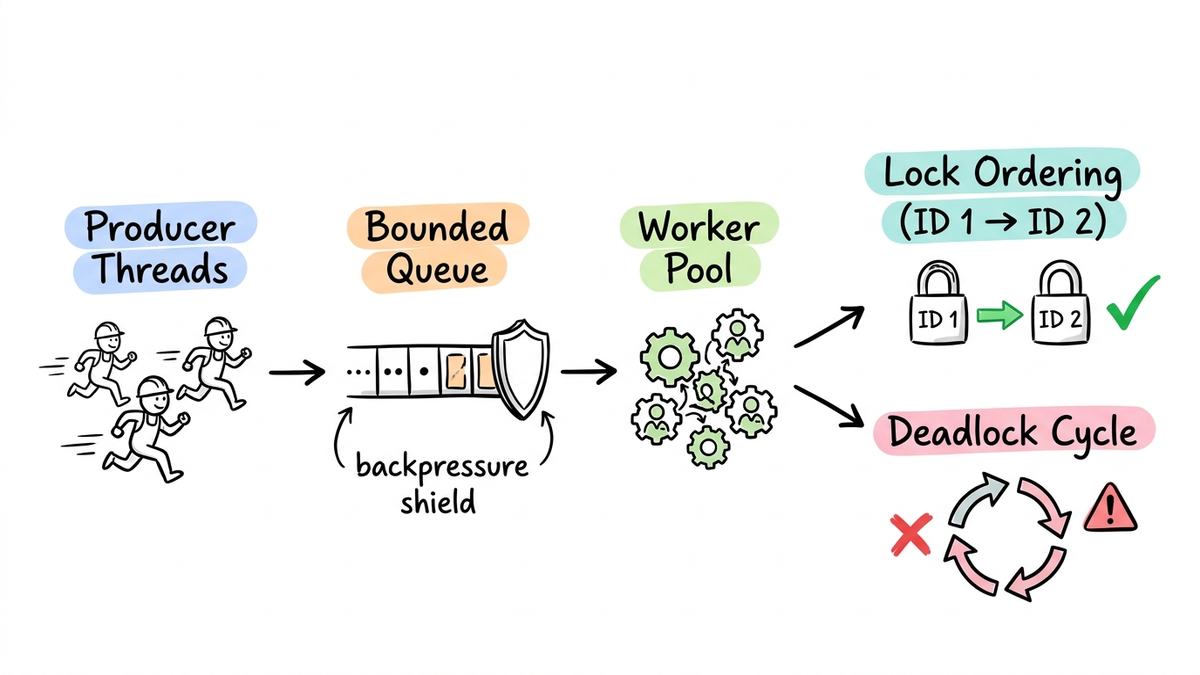
At scale, every possible thread interleaving and network pause will happen. Minimize shared mutable state, establish strict happens-before edges, enforce global lock ordering, and validate distributed leases with monotonic fencing tokens.
From patterns to decisions.
Concurrency bugs are non-deterministic, invisible under low local load, and catastrophic in production—silently corrupting balances, double-booking inventory, or freezing thread pools without throwing exceptions. Correct concurrent systems require reasoning from physical silicon (MESI cache coherence, memory barriers, CAS) through OS/runtime scheduling (futexes, M:N coroutines, bounded queues) up to distributed safety invariants (fencing tokens, linearizability, backpressure).
- Establish formal happens-before visibility across CPU store buffers using Acquire-Release semantics and hardware memory barriers.
- Choose between OS kernel threads, M:N user-space coroutines, and single-threaded event loops based on context-switch cost and blocking behavior.
- Analyze mutex fast-path/slow-path futex mechanics, spinlock hazards, and read-write lock starvation.
- Build or evaluate lock-free CAS loops while preventing the ABA problem via tagged pointers and safe memory reclamation.
- Eliminate deadlocks, livelocks, and priority inversion using Coffman-condition breaking, Wait-For Graphs, and Little's Law thread-pool bounds.
- Implement demand-driven reactive backpressure and monotonic distributed fencing tokens to survive slow consumers and GC pauses.
CPU Memory Models, Cache Coherence & Atomics.
Multi-core CPUs achieve high IPC by buffering writes in per-core store buffers and speculatively reordering loads ahead of stores. Even x86 Total Store Order (TSO) allows a core to read stale values before its own store buffer drains, while weak memory models like ARM64 and POWER reorder both loads and stores aggressively. Cache coherence protocols (MESI/MOESI) ensure all cores eventually see a consistent single-address history via cache-line invalidation messages, but visibility ordering between different addresses requires explicit happens-before edges. Acquire-Release atomics prevent reads from hoisting before a lock acquire and writes from sinking past a lock release without paying full Sequential Consistency (seq_cst) fence costs.
Acquire-Release Happens-Before
A store-release in Thread A synchronizing with a load-acquire in Thread B guarantees all prior writes in A are visible to all subsequent reads in B.
MESI Invalidation & False Sharing
Writing to any byte of a 64-byte cache line invalidates that entire line in peer L1/L2 caches; pad independent atomic variables to 64-byte boundaries.
Fixing an intermittent ARM64 ring-buffer race.
A C++ single-producer/single-consumer ring buffer passed all tests on x86_64 servers but intermittently read uninitialized payload slots after migrating to ARM64 Graviton instances.
On x86 TSO, stores are ordered with respect to other stores, masking a missing fence; on ARM64's weak memory model, the consumer observed the updated write_idx before the payload write landed. Upgrading write_idx to memory_order_release and memory_order_acquire emitted lightweight stlr/ldar barriers and eliminated the race.
Pause & reason: where would you draw the boundary?▼
- Which shared variables lack an explicit happens-before edge (mutex, acquire-release atomic, or channel handoff)?
- Have you tested lock-free or atomic code on weak-memory-order architectures like ARM64?
- Are independent threads mutating atomic fields that accidentally share the same 64-byte cache line?
- Where can `acquire`/`release` semantics replace heavier `seq_cst` full memory fences?
Threads, Processes & Coroutines.
Concurrency models differ sharply in isolation and scheduling cost. OS processes isolate virtual address spaces (requiring IPC and expensive TLB flushes on switch). Kernel threads (1:1) share memory but reserve 1-8 MB stacks and incur ~1-10 microsecond kernel context switches, limiting concurrency to thousands of threads. M:N schedulers—such as Go's GMP model (Goroutines multiplexed onto OS threads M across logical processors P) and Java Virtual Threads—run user-space tasks with tiny growable stacks (~2 KB) and work-stealing queues, enabling hundreds of thousands of concurrent I/O tasks. However, blocking syscalls or synchronized carrier-thread pinning in M:N runtimes can starve peer tasks.
| Choice | What it buys | What it costs |
|---|---|---|
| 1:1 Kernel Threads | Preemptive OS scheduling prevents CPU-bound tasks from starving peers. Direct compatibility with blocking C/OS syscalls and thread-local storage. | 1-8 MB stack reservation limits active threads to low thousands. Kernel trap and register/scheduler overhead on every blocking context switch. |
| M:N Coroutines / Green Threads | ~2 KB initial stacks support 100k+ concurrent I/O tasks with sub-microsecond user-space switches. Work-stealing keeps all CPU cores balanced without kernel intervention. | Carrier-thread pinning (e.g., JNI or Java `synchronized` blocks) stalls all multiplexed tasks. Requires cooperative yield points or runtime preemption for CPU-heavy loops. |
Go GMP Work-Stealing
Each logical processor P owns a lock-free local run queue; when idle, P steals half the tasks from a busy peer P to balance load with minimal contention.
Carrier-Thread Pinning Hazard
In Java Virtual Threads, entering a synchronized block around blocking I/O pins the OS carrier thread; replace with ReentrantLock to allow unmounting.
Unblocking 40,000 concurrent connections by fixing Virtual Thread pinning.
A Java 21 payment gateway migrated from a 500-thread pool to Virtual Threads, yet throughput collapsed under load with 90% idle CPU.
Flight Recorder (jdk.VirtualThreadPinned) revealed that a legacy connection pool used synchronized around socket reads, pinning all 16 OS carrier threads. Replacing synchronized with ReentrantLock allowed virtual threads to unmount during I/O, scaling to 40,000 concurrent connections at 1/5th the heap.
Pause & reason: where would you draw the boundary?▼
- Is your concurrency bottleneck CPU-bound computation (favors 1:1 core-sized threads) or high-fanout I/O wait (favors M:N coroutines)?
- Which legacy libraries or locks in your stack can pin carrier threads or block an async event loop?
- How much virtual and physical memory is consumed by thread stacks at peak concurrency?
- How does Python's GIL or runtime scheduler affect multi-core parallelism for your workload?
Locks, Mutexes & Synchronization Primitives.
Modern mutexes optimize for the common uncontended case using a two-tier design: a user-space atomic CAS flips the lock state from 0 to 1 with zero kernel syscalls; only when contended does the thread invoke a Linux futex(FUTEX_WAIT) syscall to sleep in a kernel wait queue. Spinlocks avoid sleeping and are viable only for sub-microsecond critical sections when the holder cannot be preempted—otherwise spinning burns 100% CPU while the holder is descheduled. Read-Write locks allow concurrent readers, but naive reader-preferring designs starve writers indefinitely, and high-frequency reader atomic increments still bounce cache lines across cores. Condition variables always require a while (!predicate) loop to guard against spurious wakeups.
User-Space Futex Fast Path
Uncontended lock/unlock executes purely via user-space atomic CAS; kernel transitions occur only when threads must park or wake.
SeqLock & RCU for Read-Mostly State
When reads outnumber writes 1000:1, sequence locks or immutable pointer swaps let readers proceed without writing to shared lock cache lines.
Eliminating RWLock cache-line ping-pong on 64-core feature flags.
An ad-routing service checked feature flags under a shared RWLock on every request, yet p99 latency degraded from 50 microseconds to 1.2ms as core count scaled to 64.
Even shared read locks perform an atomic increment/decrement on the lock counter, causing 64 cores to contend on one cache line. Switching to an immutable-snapshot pointer swap (RCU-style atomic load) eliminated reader writes and cut p99 read latency to 180 nanoseconds.
Pause & reason: where would you draw the boundary?▼
- How long is the critical section held—nanoseconds (adaptive/spin) or milliseconds (mutex/sharded lock)?
- Can you shrink the critical section by computing values before acquiring the lock and performing I/O after releasing it?
- Does your Read-Write lock prevent writer starvation under continuous read traffic?
- Are all `condvar.wait()` calls wrapped in a `while` loop checking the state predicate?
Lock-Free & Wait-Free Data Structures.
Blocking locks risk priority inversion and convoying when a lock holder is preempted. Lock-free algorithms guarantee system-wide progress (at least one thread finishes in finite steps) using atomic Read-Modify-Write primitives like Compare-And-Swap (CAS) and Fetch-And-Add (FAA); wait-free algorithms guarantee every thread finishes in bounded steps. However, CAS loops suffer two subtle hazards: the ABA problem, where Thread 1 reads value A, gets preempted while Thread 2 changes A -> B -> A (freeing and reallocating the same address), and Thread 1's CAS succeeds on a stale logical state; and memory reclamation, where freeing a removed node while a concurrent reader still holds its pointer causes use-after-free. Tagged pointers (pointer + monotonic version counter via double-width CAS) solve ABA, while Hazard Pointers or Epoch-Based Reclamation (EBR) defer free() safely.
Double-Width Tagged Pointers
Pair each pointer with a monotonic 64-bit version tag (CMPXCHG16B) so recycled addresses never match stale CAS expectations.
Epoch-Based Reclamation (EBR)
Threads enter a read-side epoch before dereferencing lock-free nodes; retired nodes are freed only after all active threads advance past that epoch.
Solving ABA use-after-free in a lock-free MPMC job queue.
A C++ lock-free stack/queue backed by a custom node free-list crashed intermittently under heavy multi-core churn with corrupted next pointers.
A preempted consumer held a pointer to node A while another thread popped A, pushed B, and pushed recycled A back to the head—passing the naive pointer CAS. Adding a 64-bit monotonic version tag (CMPXCHG16B) and epoch-based reclamation eliminated all crashes at 8M ops/sec.
Pause & reason: where would you draw the boundary?▼
- Have you measured lock contention first, or are you introducing lock-free complexity where a simple sharded mutex has zero contention?
- How does your CAS structure prevent ABA pointer reuse across node recycling?
- Which memory reclamation scheme (GC, Hazard Pointers, or EBR) guarantees readers never dereference freed nodes?
- Under extreme contention, does your CAS loop use exponential backoff to avoid saturating the cache-coherence interconnect?
Concurrency Bugs: Deadlocks, Livelocks & Starvation.
Deadlock requires all four Coffman conditions simultaneously: Mutual Exclusion, Hold and Wait, No Preemption, and Circular Wait. Breaking Circular Wait is the cleanest structural defense: enforce a strict global lock ordering (e.g., always lock the lower account ID before the higher ID) so cycles are mathematically impossible. Where dynamic ordering is unavoidable (like database row locks), engines maintain Wait-For Graphs (WFG) and run cycle detection to abort the younger transaction, or use bounded tryLock timeouts. Note that naive tryLock + immediate retry causes livelock—threads burn 100% CPU yielding to each other unless randomized exponential backoff is added. Priority inversion occurs when a low-priority thread holds a lock needed by a high-priority thread while medium-priority threads preempt it, solved by Priority Inheritance.
Deterministic Lock Ordering
Sort multi-resource locks by a canonical key (e.g. min(idA, idB) before max(idA, idB)) to break Circular Wait structurally.
Avoid Blocking Inside Event Loops
Calling synchronous .get() or .join() on an async future from inside a fixed event-loop pool causes instant thread-starvation deadlock.
Eliminating ledger transfer deadlocks via canonical account ordering.
Concurrent transfer(A -> B) and transfer(B -> A) database transactions deadlocked repeatedly under load, forcing 8% transaction aborts.
Enforced deterministic row-lock ordering (SELECT ... FOR UPDATE ordered by account_id ASC) so every multi-account transfer acquires locks in the exact same global direction. Circular wait became impossible, cutting deadlock aborts to zero.
Pause & reason: where would you draw the boundary?▼
- Which code paths acquire more than one lock simultaneously, and are they ordered by a strict global key?
- If you rely on `tryLock` timeouts, do retries use randomized backoff + jitter to prevent livelock?
- Could a callback or blocking `.get()` run on the same thread pool as the task it is waiting for (pool-induced deadlock)?
- How does your database or runtime detect and break Wait-For Graph cycles?
Thread Pools, Work-Stealing & Task Queues.
Thread pools decouple task submission from execution, but misconfigured pools cause OOMs or thrashing. By Little's Law (L = lambda W), optimal concurrency depends on workload type: CPU-bound pools should stay near N_cores to avoid context-switch overhead, whereas blocking I/O pools scale as N_cores (1 + WaitTime / ServiceTime). Unbounded queues (like Java's default LinkedBlockingQueue) hide slow consumers until the heap explodes with OutOfMemoryError. Always use bounded queues paired with explicit rejection policies: AbortPolicy (fail fast with 429/503), CallerRunsPolicy (apply natural backpressure by making the submitter execute the task), or DiscardOldestPolicy (for real-time telemetry). For recursive fork-join workloads, Chase-Lev work-stealing deques let owners push/pop LIFO for cache warmth while idle thieves steal FIFO from the opposite end.
Isolate CPU vs. I/O Pools
Never run slow blocking I/O on a core-sized CPU pool or heavy compute on an event-loop pool; give each workload class a dedicated bounded bulkhead.
Bounded Queues + CallerRuns
Cap queue depth to bound tail latency (QueueTime = Depth / Throughput) and use CallerRuns or explicit load shedding when saturated.
Preventing OOM crashes in an image-processing worker.
A thumbnail service using Executors.newFixedThreadPool(16) (unbounded queue) suffered silent latency climbs followed by OutOfMemoryError crashes whenever upstream uploads spiked.
Replaced the unbounded queue with an ArrayBlockingQueue(512) and CallerRunsPolicy, and isolated health checks onto a separate management pool. Queue depth stayed bounded, upstream callers felt immediate backpressure, and OOM crashes stopped completely.
Pause & reason: where would you draw the boundary?▼
- What is the maximum queue wait time (QueueCapacity / ServiceRate) before queued requests breach your SLA?
- Are CPU-bound tasks and blocking I/O tasks isolated in separate thread pools?
- Which rejection policy (Abort, CallerRuns, or DiscardOldest) matches your caller contract when the bounded queue fills?
- Does your fork-join workload risk deadlocking if child tasks are submitted to the same bounded pool as blocked parent tasks?
Reactive Streams, Event Loops & Backpressure.
Solving the C10K+ connection problem requires decoupling connections from OS threads. Legacy select and poll scan O(N) file descriptors on every syscall; Linux epoll (and BSD kqueue) registers sockets in a kernel red-black tree and returns only ready descriptors in O(1) per ready event, while io_uring eliminates syscall overhead via shared submission/completion ring buffers. Event-loop frameworks (Netty, Redis, Node.js) run a Reactor loop that dispatches ready I/O callbacks without blocking—meaning even a single 50ms blocking database call freezes all connections on that loop. To prevent fast producers from overwhelming slow consumers, the Reactive Streams specification enforces pull-based backpressure (subscription.request(n)), propagating downstream capacity limits all the way back to TCP SO_RCVBUF flow control.
Golden Rule of Event Loops
Never block an event-loop thread with synchronous I/O, Thread.sleep, or heavy CPU work; offload blocking work to dedicated bounded worker pools.
Demand-Driven `request(n)` Backpressure
Downstream subscribers signal exact capacity n upstream so memory stays bounded and TCP zero-window throttling slows fast producers.
Taming a 100,000-sensor IoT reconnection storm with backpressure.
When 100,000 IoT devices reconnected simultaneously after a carrier outage, an ingestion service buffered incoming telemetry in memory until consumer pods crashed with OOMs.
Adopted Project Reactor with bounded ring buffers and request(n) pull backpressure wired to Netty socket auto-read toggling. When downstream storage reached 80% buffer capacity, Netty paused socket reads, letting TCP flow control throttle devices cleanly with zero dropped packets or OOMs.
Pause & reason: where would you draw the boundary?▼
- Could any synchronous driver, DNS lookup, or heavy JSON parse block your Reactor event-loop threads?
- How does your streaming pipeline propagate slow-consumer backpressure to the network edge?
- What happens to memory if a fast publisher ignores `request(n)`—are you buffering, dropping, or failing?
- How many event-loop threads (typically 1x-2x CPU cores) are optimal before cross-loop coordination hurts?
Theory & Tips and Tricks
Practical heuristics & interview traps
- 01Domain principle: At scale, every possible thread interleaving and network pause will happen. Minimize shared mutable state, establish strict happens-before edges, enforce global lock ordering, and validate distributed leases with monotonic fencing tokens.
- 02End-to-end lesson: Serialize hot-key state transitions in single-threaded atomic engines or partitioned actors instead of wide distributed locks.
- 03Failure check — The Stale Lock Zombie Writer (GC Pause Disaster): Worker 1 acquires a 30s distributed lease with fencing token 41 to finalize seat A-12, then freezes for 35s in a Stop-The-World GC pause. The lease expires; Worker 2 acquires token 42 and sells seat A-12. Worker 1 wakes up and attempts to overwrite the seat record. Recovery: The database enforces
WHERE fencing_token < 41(or storesmax_token = 42), atomically rejecting Worker 1's stale write and preserving single-owner seat integrity.
Flash-Sale Concert Ticketing & Atomic Seat Reservation
Flash-Sale Concert Ticketing & Atomic Seat Reservation
500,000 concurrent users compete for 20,000 stadium seats. Naive database row locks cause deadlock freezes and pool exhaustion, while naive distributed locks risk double-booking during JVM GC pauses.
Flash-Sale Concert Ticketing & Atomic Seat Reservation
- Non-blocking epoll event loops absorb connection bursts without spawning 500k kernel threads.
- Single-threaded Redis Lua scripts serialize per-seat state transitions atomically without distributed multi-lock deadlocks.
- Multi-seat bundles sort seat IDs ascending before locking to make circular wait impossible.
- Monotonic fencing tokens protect final database commits against stale workers delayed by Stop-The-World GC pauses.
- Bounded worker queues shed excess checkout traffic with HTTP 429 rather than crashing pods with OOM.
The Stale Lock Zombie Writer (GC Pause Disaster)
Worker 1 acquires a 30s distributed lease with fencing token 41 to finalize seat A-12, then freezes for 35s in a Stop-The-World GC pause. The lease expires; Worker 2 acquires token 42 and sells seat A-12. Worker 1 wakes up and attempts to overwrite the seat record.
The database enforces WHERE fencing_token < 41 (or stores max_token = 42), atomically rejecting Worker 1's stale write and preserving single-owner seat integrity.
The decision framework
Can shared mutable state be eliminated via partitioning, immutability, or actor ownership?
Shared-nothing architectures remove lock contention, memory-barrier bugs, and cache-line bouncing at the root.
Does the workload fit 1:1 threads, M:N coroutines, or a single-threaded event loop?
Match CPU-bound work to core-sized pools, high-fanout I/O to M:N coroutines/Reactor loops, and never block an event loop.
Are happens-before edges and lock hierarchies explicitly enforced?
Acquire-release atomics guarantee cross-core visibility; global lock ordering prevents circular-wait deadlocks.
Are all queues bounded with explicit backpressure or shedding policies?
Unbounded queues convert slow downstream dependencies into silent OutOfMemoryError crashes.
How are distributed locks protected against process pauses and clock skew?
Pair every distributed lease with a monotonic fencing token verified atomically by the authoritative storage layer.
Make the trade-off yourself.
Service A acquires a 10-second Redis distributed lock before updating an S3/database record, but experiences a 15-second GC pause before writing. What prevents Service A from corrupting a newer writer's data?
Eliminate Multi-Account Transfer Deadlocks.
Diagnose a concurrent `transfer(from, to, amount)` function that deadlocks under bidirectional transfers and refactor it using canonical lock ordering and bounded timeouts.
Check your reasoning
- Why does locking `from` then `to` violate Coffman's Circular Wait condition?
- How do you handle the self-transfer edge case (`from == to`) safely?
- Why is an optimistic DB conditional update (`WHERE balance >= amount`) often superior to pessimistic locking?
Size & Isolate Mixed CPU/IO Thread Pools.
A service handles 2,000 RPS with 2ms CPU work and 48ms downstream DB wait per request on an 8-core host. Apply Little's Law to size the pools and design bounded queue backpressure.
Check your reasoning
- How many concurrent I/O tasks are active in flight at 2,000 RPS and 50ms total latency?
- Why should the 2ms CPU work not share the same pool if blocking DB calls can stall to 500ms?
- What queue bound and rejection policy protect heap memory during a 5x traffic spike?
Audit a Lock-Free Stack for ABA & Memory Safety.
Identify why a naive `CAS(head, old_head, old_head->next)` pop operation fails under concurrent node reuse and design a fix using tagged pointers and Epoch-Based Reclamation.
Check your reasoning
- What exact thread interleaving triggers the ABA failure?
- Why does tagged-pointer CAS alone not prevent use-after-free when a concurrent reader dereferences `old_head->next`?
- How does EBR determine when a retired node is safe to `free()`?
Distributed Concurrency & Multithreading
Reliable concurrency combines hardware-level discipline with distributed safety: establish explicit happens-before visibility, avoid shared mutable state where possible, bound every queue with backpressure, enforce global lock ordering, and validate distributed leases with monotonic fencing tokens.